Avila-Smirnow Daniela, Boutron Audrey, Beytía-Reyes María de Los Ángeles, Contreras-Olea Oscar, Caicedo-Feijoo Alfredo, Gejman-Enríquez Roger, Escobar-Henríquez Raúl, Förster-Mujica Jorge
Unidad de Neurología, Servicio de Pediatría, Complejo Asistencial Dr. Sotero del Río, Avenida Concha y Toro 3459, Puente Alto, Santiago, Chile.
Unidad Docente Asistencial-Sótero del Río, Pontificia Universidad Católica de Chile, Santiago, Chile.
J Med Case Rep. 2018 Aug 28;12(1):249. doi: 10.1186/s13256-018-1702-3.
The myopathic form of carnitine palmitoyltransferase type II deficiency is an inherited autosomal recessive metabolic myopathy usually starting in childhood. Most reports have been on European and Japanese populations, and no Native South American patients have been reported to date. The p.Ser113Leu mutation is the most frequent in the European population. Only lower-leg magnetic resonance imaging findings have been reported, with gluteus maximus involvement in one case and normal imaging in other patients.
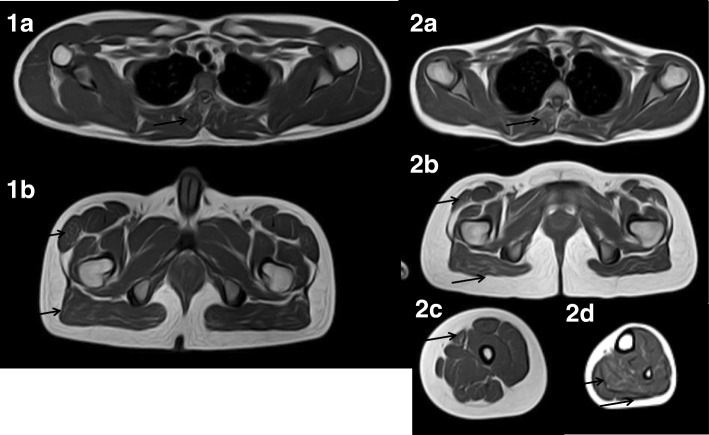
Two Native South American siblings, a boy and a girl, presented to our neuromuscular clinic with recurrent rhabdomyolysis associated with transient muscle weakness after prolonged exercise. During episodes, their creatine kinase concentrations were markedly increased, up to 148,000 (1.48 × 10) IU/L in the boy and 18,000 (1.8 × 10) IU/L in the girl. The results of electroneuromyography and histopathology suggested a nonspecific myopathy. CPT2 gene sequencing showed two heterozygous mutations: the p.Ser113Leu variant and a novel one (predicted to be deleterious by in silico analysis), the p.Ser373Pro variant. The patients' parents were asymptomatic carriers. Whole-body magnetic resonance imaging showed mild selective involvement in the thoracic extensors and pelvic girdle in both siblings, and in the thighs and lower legs in one of them. Dietary and bezafibrate treatment was started, and symptomatic relief was observed.
To the best of our knowledge, this is the first reported Native South American family with a CPT2 deficiency carrying a novel mutation and particular features visualized by whole-body magnetic resonance imaging.
肉碱棕榈酰转移酶II型缺乏症的肌病形式是一种遗传性常染色体隐性代谢性肌病,通常始于儿童期。大多数报告来自欧洲和日本人群,迄今为止尚未有南美洲原住民患者的报道。p.Ser113Leu突变在欧洲人群中最为常见。此前仅报道过小腿磁共振成像结果,其中1例臀大肌受累,其他患者成像正常。
两名南美洲原住民兄弟姐妹,一男一女,因长时间运动后反复出现横纹肌溶解并伴有短暂性肌无力,前来我们的神经肌肉诊所就诊。发作期间,他们的肌酸激酶浓度显著升高,男孩高达148,000(1.48×10)IU/L,女孩为18,000(1.8×10)IU/L。肌电图和组织病理学结果提示为非特异性肌病。CPT2基因测序显示两个杂合突变:p.Ser113Leu变异和一个新的变异(计算机分析预测为有害变异),即p.Ser373Pro变异。患者的父母为无症状携带者。全身磁共振成像显示,两名患者的胸段伸肌和骨盆带均有轻度选择性受累,其中一人的大腿和小腿也有受累。开始进行饮食和苯扎贝特治疗,症状得到缓解。
据我们所知,这是首例报道的携带新突变且有全身磁共振成像所显示的特殊特征的南美洲原住民CPT2缺乏症家族。