National Engineering Laboratory for Methanol to Olefins, Dalian Institute of Chemical Physics, Chinese Academy of Sciences, P. O. Box 110 , 116023, Dalian, People's Republic of China.
Dalian National Laboratory for Clean Energy, Dalian Institute of Chemical Physics, Chinese Academy of Sciences, Dalian, 116023, People's Republic of China.
Nat Commun. 2018 Aug 27;9(1):3457. doi: 10.1038/s41467-018-05880-4.
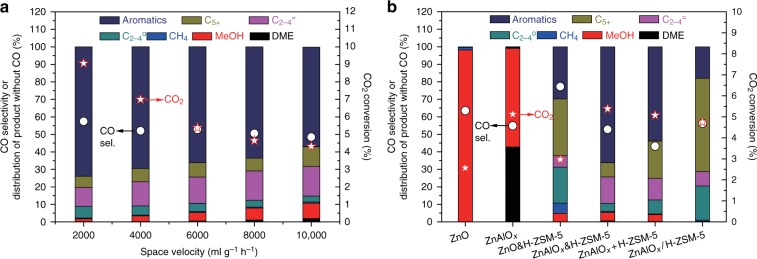
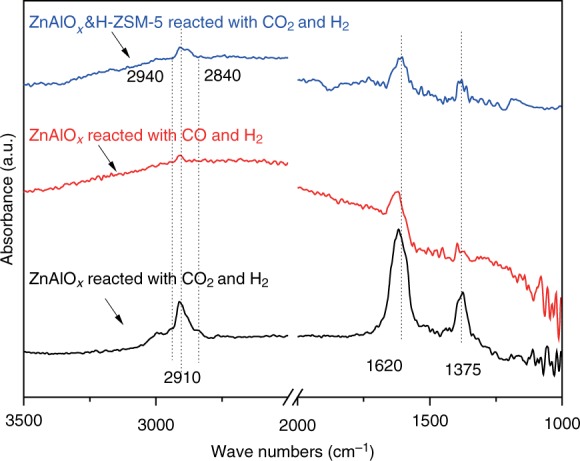
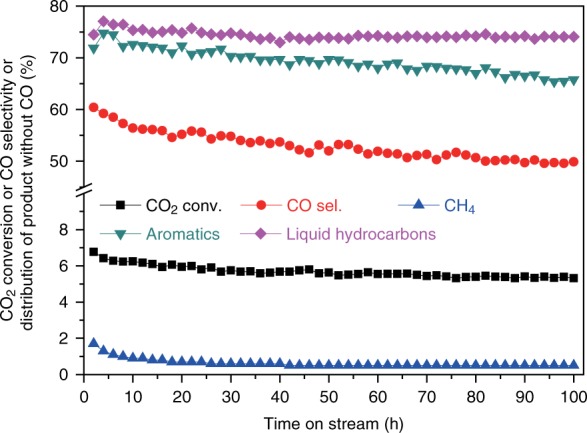
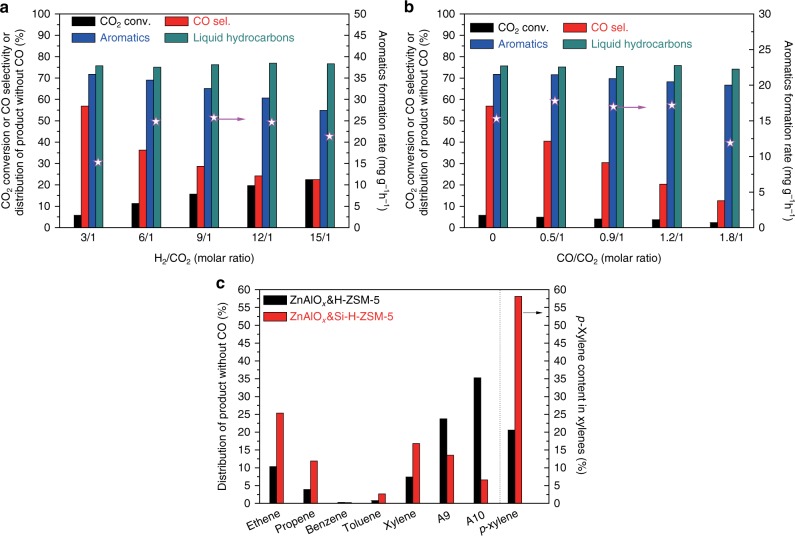
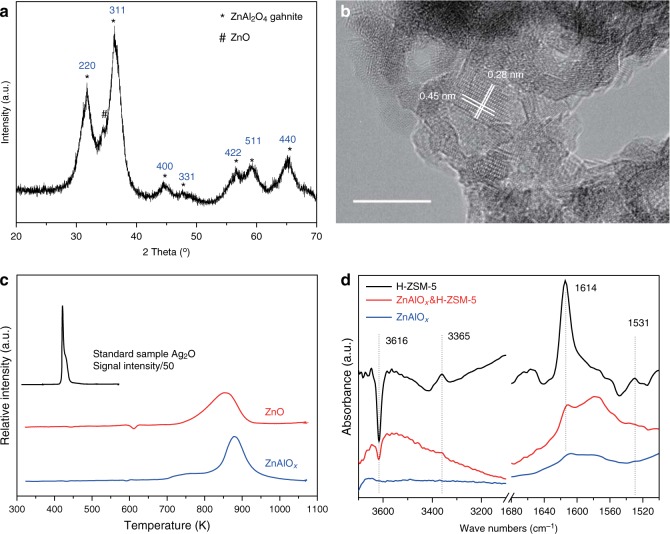
Transformation of greenhouse gas CO and renewable H into fuels and commodity chemicals is recognized as a promising route to store fluctuating renewable energy. Although several C chemicals, olefins, and gasoline have been successfully synthesized by CO hydrogenation, selective conversion of CO and H into aromatics is still challenging due to the high unsaturation degree and complex structures of aromatics. Here we report a composite catalyst of ZnAlO and H-ZSM-5 which yields high aromatics selectivity (73.9%) with extremely low CH selectivity (0.4%) among the carbon products without CO. Methanol and dimethyl ether, which are synthesized by hydrogenation of formate species formed on ZnAlO surface, are transmitted to H-ZSM-5 and subsequently converted into olefins and finally aromatics. Furthermore, 58.1% p-xylene in xylenes is achieved over the composite catalyst containing Si-H-ZSM-5. ZnAlO&H-ZSM-5 suggests a promising application in manufacturing aromatics from CO and H.
将温室气体 CO 和可再生 H 转化为燃料和大宗商品化学品被认为是储存波动可再生能源的一种很有前途的途径。尽管通过 CO 加氢已经成功合成了几种 C 化学品、烯烃和汽油,但由于芳烃的高不饱和度和复杂结构,选择性地将 CO 和 H 转化为芳烃仍然具有挑战性。在这里,我们报告了一种 ZnAlO 和 H-ZSM-5 的复合催化剂,在没有 CO 的情况下,该催化剂在碳产物中具有很高的芳烃选择性(73.9%),极低的 CH 选择性(0.4%)。甲醇和二甲醚是由 ZnAlO 表面形成的甲酸盐物种加氢合成的,然后传递到 H-ZSM-5,并进一步转化为烯烃,最终转化为芳烃。此外,在含有 Si-H-ZSM-5 的复合催化剂上,二甲苯中的对二甲苯达到 58.1%。ZnAlO&H-ZSM-5 表明它有望从 CO 和 H 中制造芳烃。