1 Department of Neuroscience, Cell Biology, and Anatomy, University of Texas Medical Branch, Galveston, TX, USA.
Mol Pain. 2018 Jan-Dec;14:1744806918797032. doi: 10.1177/1744806918797032.
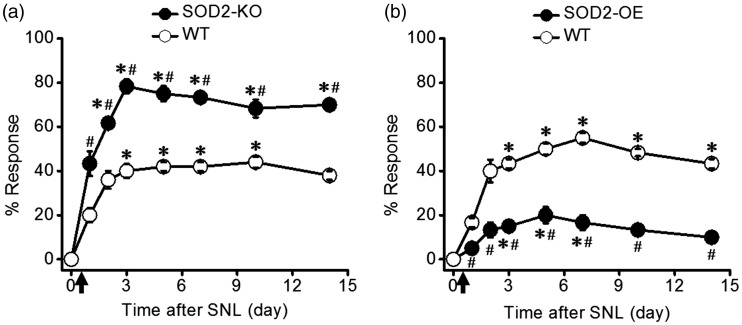
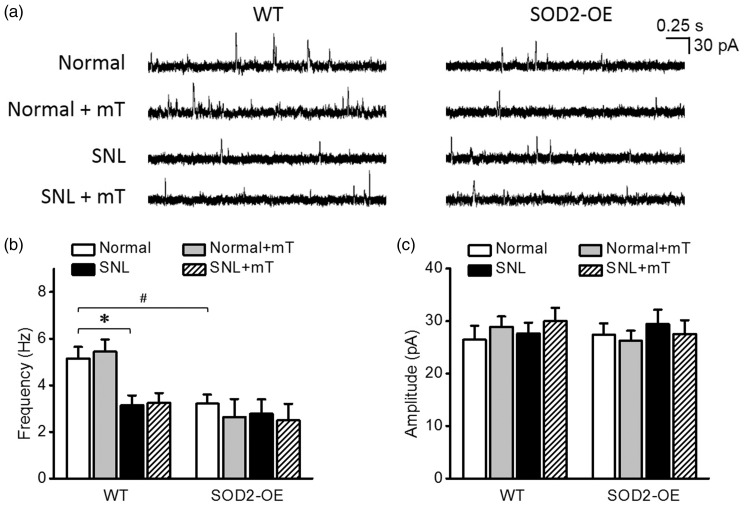
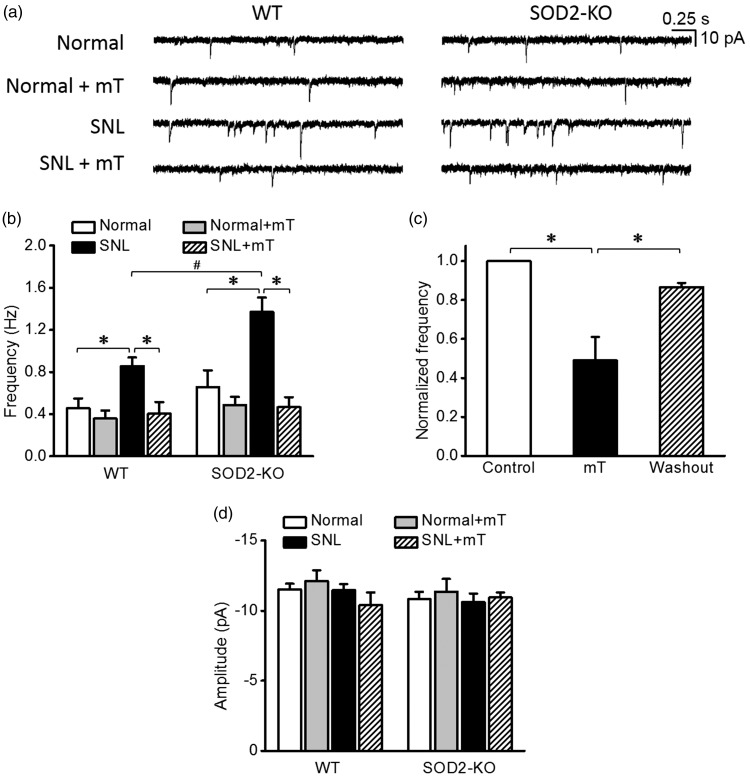
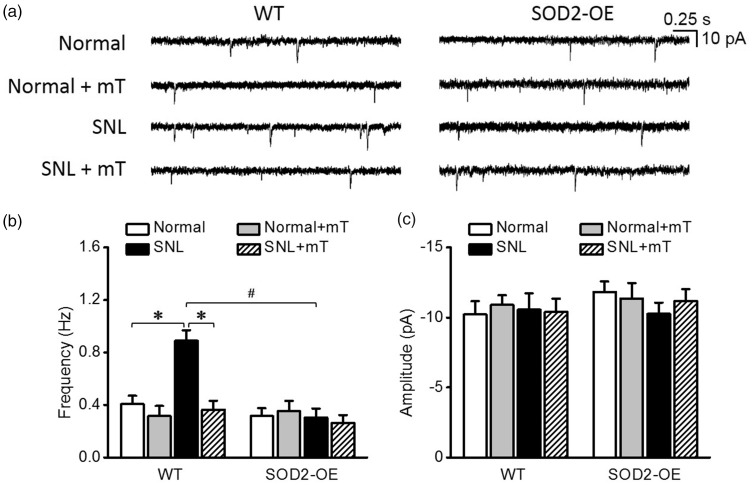
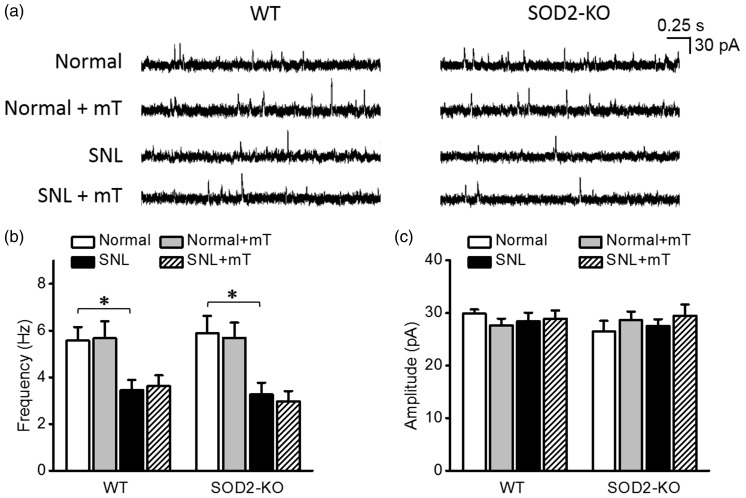
Reactive oxygen species has been suggested as a key player in neuropathic pain, causing central sensitization by changing synaptic strengths in spinal dorsal horn neurons. However, it remains unclear as to what type of reactive oxygen species changes what aspect of synaptic strengths for central sensitization in neuropathic pain conditions. In this study, we investigated whether mitochondrial superoxide affects both excitatory and inhibitory synaptic strengths in spinal dorsal horn neurons after peripheral nerve injury. Upregulation of mitochondrial superoxide level by knockout of superoxide dismutase-2 exacerbated neuropathic mechanical hypersensitivity caused by L5 spinal nerve ligation, whereas downregulation of mitochondrial superoxide level by overexpression of superoxide dismutase-2 alleviated the hypersensitivity. In spinal nerve ligation condition, the frequency of miniature excitatory postsynaptic currents increased, while that of miniature inhibitory postsynaptic currents decreased in spinal dorsal horn neurons. Superoxide dismutase-2-knockout augmented, whereas superoxide dismutase-2-overexpression prevented, the spinal nerve ligation-increased miniature excitatory postsynaptic currents frequency. However, superoxide dismutase-2-knockout had no effect on the spinal nerve ligation-decreased miniature inhibitory postsynaptic current frequency, and superoxide dismutase-2-overexpression unexpectedly decreased miniature inhibitory postsynaptic current frequency in the normal condition. When applied to the spinal cord slice during in vitro recordings, mitoTEMPO, a specific scavenger of mitochondrial superoxide, reduced the spinal nerve ligation-increased miniature excitatory postsynaptic currents frequency but failed to normalize the spinal nerve ligation-decreased miniature inhibitory postsynaptic current frequency. These results suggest that in spinal dorsal horn neurons, high levels of mitochondrial superoxide increase excitatory synaptic strength after peripheral nerve injury and contribute to neuropathic mechanical hypersensitivity. However, mitochondrial superoxide does not seem to be involved in the decreased inhibitory synaptic strength in this neuropathic pain condition.
活性氧被认为是神经病理性疼痛的关键因素,通过改变脊髓背角神经元突触强度引起中枢敏化。然而,在神经病理性疼痛状态下,哪种类型的活性氧会改变突触强度的哪个方面以引起中枢敏化仍不清楚。在这项研究中,我们研究了外周神经损伤后线粒体超氧阴离子是否会影响脊髓背角神经元的兴奋性和抑制性突触强度。通过敲除超氧化物歧化酶-2 增加线粒体超氧阴离子水平加剧了 L5 脊神经结扎引起的神经病理性机械性过敏,而通过过表达超氧化物歧化酶-2 降低线粒体超氧阴离子水平缓解了过敏。在脊神经结扎条件下,脊髓背角神经元的微小兴奋性突触后电流频率增加,而微小抑制性突触后电流频率降低。超氧化物歧化酶-2 敲除增强,而过表达超氧化物歧化酶-2 则阻止了脊神经结扎增加的微小兴奋性突触后电流频率。然而,超氧化物歧化酶-2 敲除对脊神经结扎降低的微小抑制性突触后电流频率没有影响,而过表达超氧化物歧化酶-2 出乎意料地降低了正常情况下的微小抑制性突触后电流频率。当在体外记录时应用于脊髓切片时,mitoTEMPO,一种线粒体超氧阴离子的特异性清除剂,降低了脊神经结扎增加的微小兴奋性突触后电流频率,但未能使脊神经结扎降低的微小抑制性突触后电流频率正常化。这些结果表明,在脊髓背角神经元中,高水平的线粒体超氧阴离子增加了外周神经损伤后的兴奋性突触强度,并导致神经病理性机械性过敏。然而,线粒体超氧阴离子似乎不参与这种神经病理性疼痛状态下抑制性突触强度的降低。