GRECO, Institute of Aquatic Ecology, University of Girona, Girona, Spain.
Department of Chemistry and Pharmacy, University of Sassari, Sassari, Italy.
PLoS One. 2018 Aug 28;13(8):e0203119. doi: 10.1371/journal.pone.0203119. eCollection 2018.
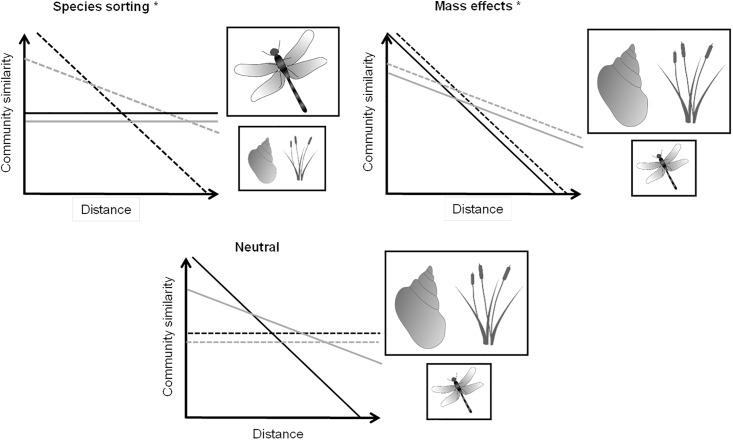
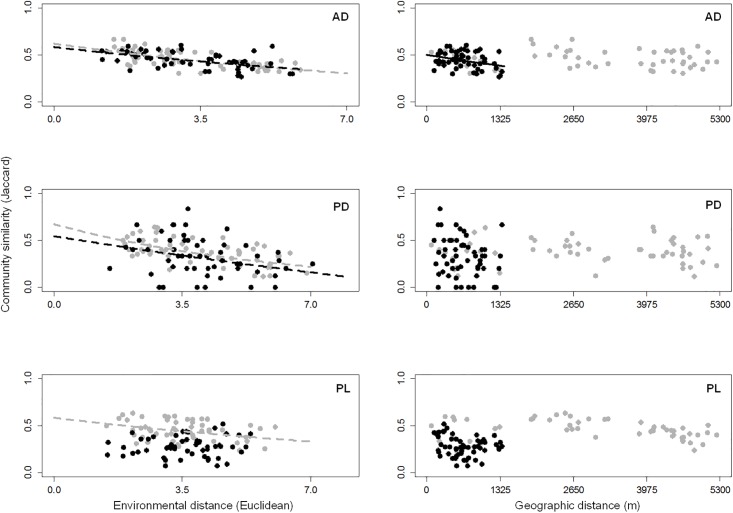
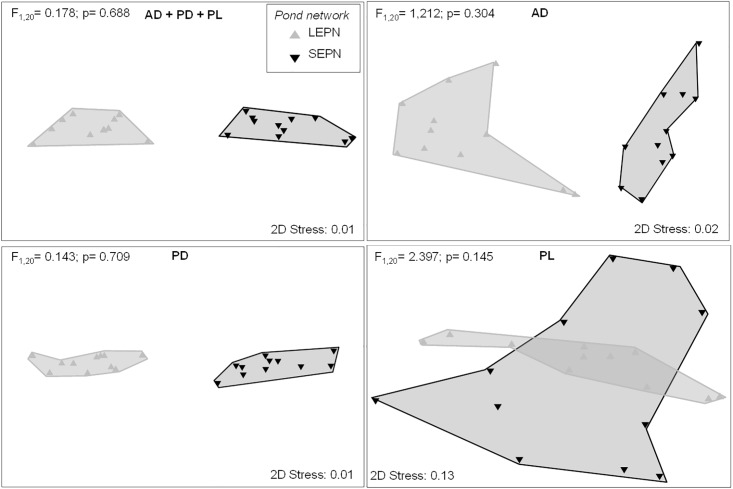
Assuming that dispersal modes or abilities can explain the different responses of organisms to geographic or environmental distances, the distance-decay relationship is a useful tool to evaluate the relative role of local environmental structuring versus regional control in community composition. Based on continuing the current theoretical framework on metacommunity dynamics and based on the predictive effect of distance on community similarity, we proposed a new framework that includes the effect of spatial extent. In addition, we tested the validity of our proposal by studying the community similarity among three biotic groups with different dispersal modes (macrofaunal active and passive dispersers and plants) from two pond networks, where one network had a small spatial extent, and the other network had an extent that was 4 times larger. Both pond networks have similar environmental variability. Overall, we found that environmental distance had larger effects than geographical distances in both pond networks. Moreover, our results suggested that species sorting is the main type of metacommunity dynamics shaping all biotic groups when the spatial extent is larger. In contrast, when the spatial extent is smaller, the observed distance-decay patterns suggested that different biotic groups were mainly governed by different metacommunity dynamics. While the distance-decay patterns of active dispersers better fit the trend that was expected when mass effects govern a metacommunity, passive dispersers showed a pattern that was expected when species sorting prevails. Finally, in the case of plants, it is difficult to associate their distance-decay patterns with one type of metacommunity dynamics.
假设扩散模式或能力可以解释生物体对地理或环境距离的不同反应,距离衰减关系是评估局部环境结构与群落组成的区域控制相对作用的有用工具。基于对后生境动态的现有理论框架的延续,并基于距离对群落相似性的预测效应,我们提出了一个新的框架,其中包括空间范围的影响。此外,我们通过研究来自两个池塘网络的三个具有不同扩散模式的生物群(大型动物主动和被动扩散者和植物)之间的群落相似性来测试我们建议的有效性,其中一个网络的空间范围较小,另一个网络的空间范围是前者的 4 倍。这两个池塘网络都具有相似的环境变异性。总体而言,我们发现环境距离在两个池塘网络中都比地理距离有更大的影响。此外,我们的结果表明,当空间范围较大时,物种分选是塑造所有生物群的后生境动态的主要类型。相比之下,当空间范围较小时,观察到的距离衰减模式表明,不同的生物群主要受不同的后生境动态控制。虽然主动扩散者的距离衰减模式更符合质量效应控制后生境时所预期的趋势,但被动扩散者表现出物种分选占主导地位时的模式。最后,就植物而言,很难将它们的距离衰减模式与一种后生境动态联系起来。