Kłosiewicz-Latoszek Longina, Cybulska Barbara, Białobrzeska-Paluszkiewicz Janina, Jagielska Anna, Janowska Jolanta, Danowska Dorota, Reguła Anna, Stroniawska-Woźniak Małgorzata
Institute of Food and Nutrition, Warsaw, Poland.
Department of Social Medicine and Public Health, Medical University of Warsaw, Warsaw, Poland.
Arch Med Sci. 2018 Aug;14(5):962-970. doi: 10.5114/aoms.2017.71855. Epub 2017 Nov 30.
There are currently no reports available from a Polish clinical practice on heterozygous familial hypercholesterolemia (HeFH) management. The aim of this study was to test the efficacy of HeFH hypolipidemic treatment in a Polish outpatient metabolic clinic according to treatment targets outlined in the European Atherosclerosis Society (EAS) and European Society of Cardiology (ESC) guidelines.
This retrospective, observational study was performed on HeFH patients who attended their routine follow-up visits in the metabolic outpatient clinic in the period between April and September 2016. According to EAS/ESC guidelines, the goal and intensity of therapy were assigned individually for every patient based on cardiovascular (CV) risk (high or very high). The treatment target was achievement of low-density lipoprotein cholesterol (LDL-C) levels < 1.8 mmol/l for very high CV risk patients and < 2.6 mmol/l for high CV risk patients. A ≥ 50% decrease in LDL-C over the observation period was an additional outcome measure.
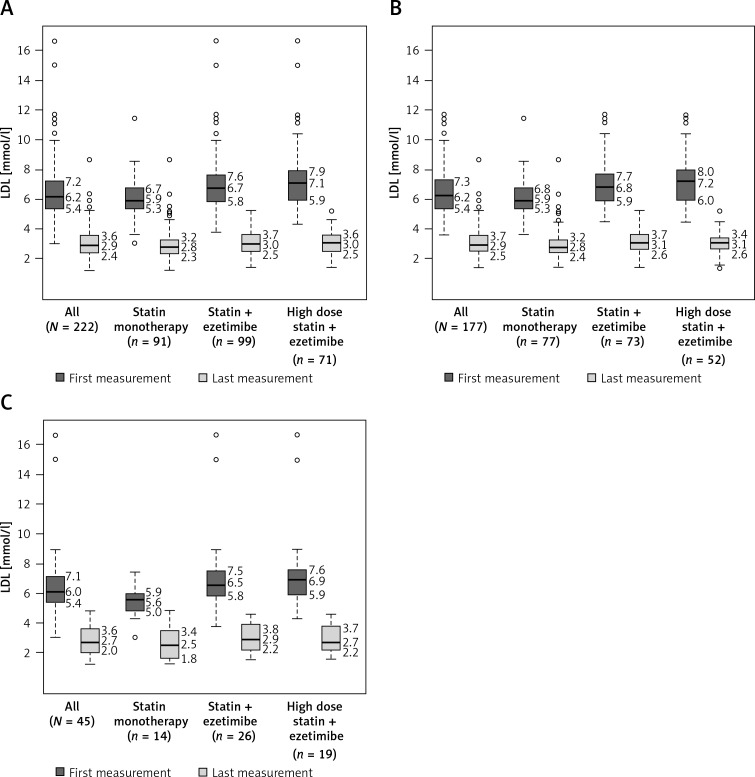
In the overall group of 222 HeFH patients (mean age: 55.2 ±16.2 years, 72% women), LDL-C levels decreased on average by 52.6% ( < 0.001). More than half of the patients were treated with the maximum tolerated dose of statins. A total of 25.2% of patients attained target levels of LDL-C and 55.9% attained a ≥ 50% reduction in its concentration. Despite therapy, significantly elevated post-follow-up levels of LDL-C (> 4.1 mmol/l) remained in 14% of all patients.
Hypolipidemic therapy according to EAS/ESC guidelines was suboptimal for a significant number of HeFH patients. Additional clinical management should be considered.
目前波兰临床实践中尚无关于杂合子家族性高胆固醇血症(HeFH)管理的报告。本研究的目的是根据欧洲动脉粥样硬化学会(EAS)和欧洲心脏病学会(ESC)指南中概述的治疗目标,在波兰一家门诊代谢诊所测试HeFH降脂治疗的疗效。
这项回顾性观察性研究是对2016年4月至9月期间在代谢门诊进行常规随访的HeFH患者进行的。根据EAS/ESC指南,基于心血管(CV)风险(高或非常高)为每位患者单独分配治疗目标和强度。治疗目标是,心血管风险非常高的患者将低密度脂蛋白胆固醇(LDL-C)水平降至<1.8 mmol/l,心血管风险高的患者降至<2.6 mmol/l。观察期内LDL-C降低≥50%是另一项结果指标。
在总共222例HeFH患者(平均年龄:55.2±16.2岁,72%为女性)中,LDL-C水平平均下降了52.6%(P<0.001)。超过一半的患者接受了他汀类药物的最大耐受剂量治疗。共有25.2%的患者达到了LDL-C的目标水平,55.9%的患者LDL-C浓度降低了≥50%。尽管进行了治疗,但仍有14%的患者随访后LDL-C水平显著升高(>4.1 mmol/l)。
对于大量HeFH患者,按照EAS/ESC指南进行的降脂治疗并不理想。应考虑额外的临床管理措施。