1Institute of Hygiene, University Hospital Münster, Robert-Koch-Strasse 41, 48149 Münster, Germany.
2Institute of Medical Microbiology, University Hospital Münster, Münster, Germany.
Antimicrob Resist Infect Control. 2018 Aug 23;7:103. doi: 10.1186/s13756-018-0394-1. eCollection 2018.
Vancomycin resistant enterococci (VRE) occur with enhanced frequency in hospitalised patients. This study elucidates the prevalence of VRE on admission among surgical intensive care unit (SICU) patients, whether these patients are at special risk for VRE acquisition and which risk factors support this process.
Patients admitted to SICUs of the University Hospital Münster were examined during August-October 2017. VRE screening was performed within 48 h after admission and directly prior to discharge of patients. In parallel risk factors were recorded to estimate their effect on VRE acquisition during SICU stay.
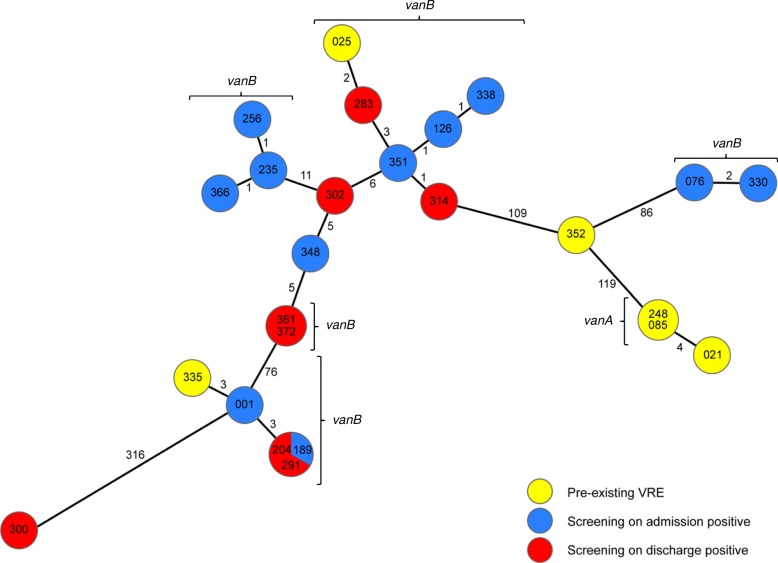
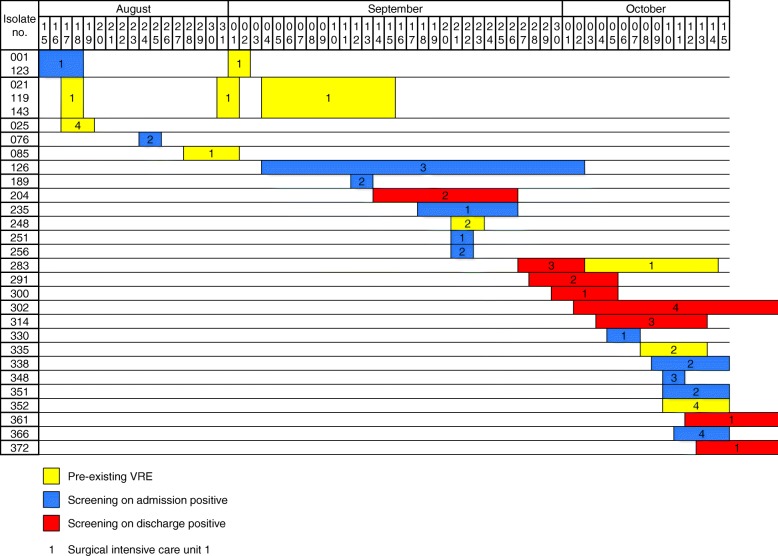
In total, 374 patients (68% male) with a median age of 66 years were admitted to one of the SICUs during the investigation period. Of all, 336 patients (89.8%) were screened on admission and 268 (71.7%) on discharge. Nine patients were admitted with previously known VRE colonisation. Twelve (3.6%) further patients were VRE positive on admission. During ICU stay, eight (3.0%) additional patients turned out to be VRE colonised. Risk factors found to be significantly associated with VRE acquisition were median length of stay on the ICU (14 vs. 3 days; = 0.01), long-term dialysis (12.5% vs. 2.0% of patients; = 0.05), and antibiotic treatment with flucloxacillin (28.6% vs. 7.2% of patients; = 0.01) or piperacillin/tazobactam (57.1% vs. 26.6% of patients; = 0.01).
SICU patients are not at special risk for VRE acquisition. Previous stay on a SICU should therefore not be considered as specific risk factor for VRE colonisation.
万古霉素耐药肠球菌(VRE)在住院患者中的出现频率增加。本研究阐明了外科重症监护病房(SICU)患者入院时 VRE 的患病率,这些患者是否特别容易获得 VRE,以及哪些危险因素支持这一过程。
2017 年 8 月至 10 月期间,对明斯特大学医院的 SICU 患者进行了检查。入院后 48 小时内和患者出院前进行 VRE 筛查。同时记录危险因素,以评估其对 SICU 住院期间获得 VRE 的影响。
在调查期间,共有 374 名(68%为男性)中位年龄为 66 岁的患者入住 SICU。其中,336 名(89.8%)患者在入院时接受了筛查,268 名(71.7%)患者在出院时接受了筛查。9 名患者入院时已知 VRE 定植。入院时,12 名(3.6%)患者 VRE 阳性。在 ICU 住院期间,另外 8 名(3.0%)患者被发现 VRE 定植。与 VRE 获得显著相关的危险因素包括 ICU 中位住院时间(14 天 vs. 3 天;=0.01)、长期透析(12.5%vs. 2.0%的患者;=0.05)以及使用氟氯西林(28.6%vs. 7.2%的患者;=0.01)或哌拉西林/他唑巴坦(57.1%vs. 26.6%的患者;=0.01)进行抗生素治疗。
SICU 患者获得 VRE 的风险并不特殊。因此,之前入住 SICU 不应被视为 VRE 定植的特定危险因素。