Analysis Group, Inc., 111 Huntington Avenue, 14th Floor, Boston, MA, 02199, USA.
Pfizer, Inc., New York, NY, USA.
BMC Infect Dis. 2018 Aug 29;18(1):438. doi: 10.1186/s12879-018-3333-0.
To compare the risk of severe hepatotoxicity with anidulafungin versus caspofungin and micafungin in hospitalized adults.
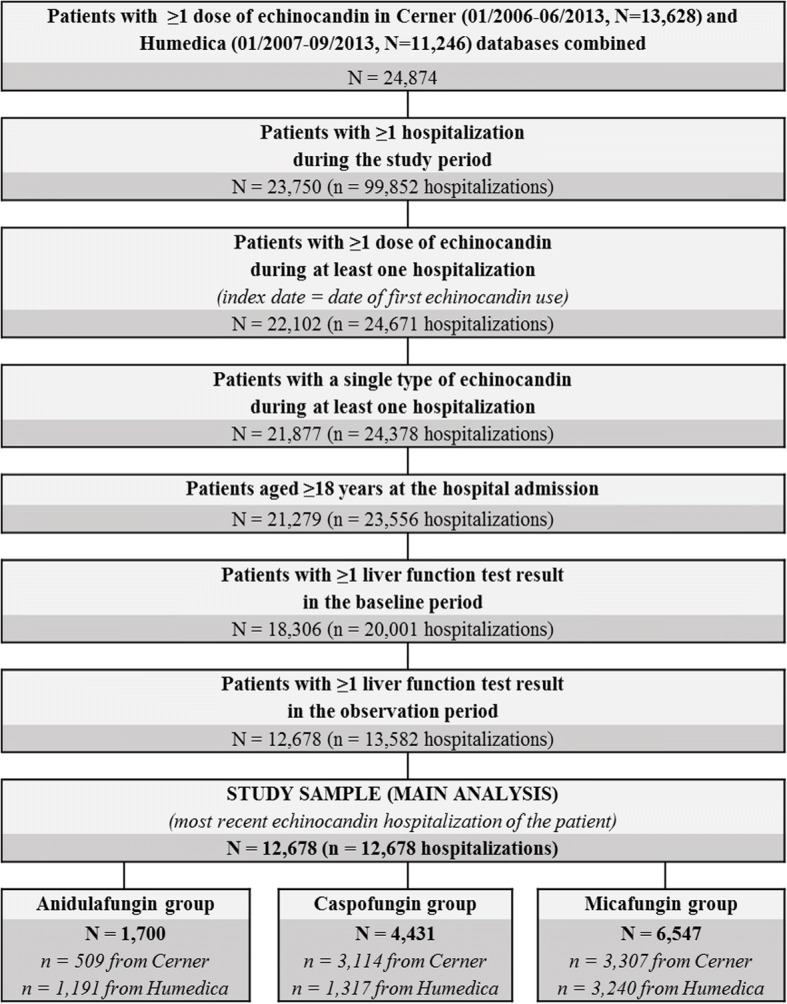
This retrospective cohort study combined data from two large US- based hospital electronic medical record databases. Severe hepatotoxicity was a Grade ≥ 3 liver function test (LFT) post-echinocandin initiation. Adjusted incidence rate ratios (IRRs) were estimated for anidulafungin versus caspofungin and micafungin, overall and in patients with normal baseline LFT (Grade 0).
Treatments included anidulafungin (n = 1700), caspofungin (n = 4431), or micafungin (n = 6547). The proportions with LFT Grade ≥ 3 pre-echinocandin initiation were: anidulafungin 40.4% versus caspofungin 25.9% (p < 0.001) and micafungin 25.6% (p < 0.001). Rates of severe underlying diseases or comorbidities were: critical care admissions: 75.3% versus 52.6 and 48.6%; and organ failures: 69.4% versus 46.7 and 51.5%. Adjusted IRRs of severe hepatotoxicity for anidulafungin versus caspofungin and micafungin were 1.43 (p = 0.002) and 1.19 (p = 0.183) overall, and 0.88 (P = 0.773) and 0.97 (P = 0.945) for normal baseline LFT, respectively.
Accounting for confounders, severe hepatotoxicity risk was not significantly different across echinocandins in this real-world head-to-head study. Anidulafungin was used more frequently in patients with more comorbidities. Those with normal baseline LFT (least susceptible to confounding by indication), showed no elevated hepatotoxicity risk for anidulafungin.
比较住院成人中安尼芬净与卡泊芬净和米卡芬净的严重肝毒性风险。
这项回顾性队列研究结合了两个大型美国基于医院电子病历数据库的数据。严重肝毒性是指依曲康唑起始后发生的肝功能试验(LFT)≥3 级。估计了安尼芬净与卡泊芬净和米卡芬净的调整发病率比值(IRR),总体上和基线 LFT 正常(0 级)的患者中。
治疗包括安尼芬净(n=1700)、卡泊芬净(n=4431)或米卡芬净(n=6547)。依曲康唑起始前 LFT 分级≥3 的比例为:安尼芬净 40.4%比卡泊芬净 25.9%(p<0.001)和米卡芬净 25.6%(p<0.001)。严重基础疾病或合并症的发生率为:重症监护病房入院:75.3%比 52.6%和 48.6%;和器官衰竭:69.4%比 46.7%和 51.5%。安尼芬净与卡泊芬净和米卡芬净的严重肝毒性调整 IRR 分别为 1.43(p=0.002)和 1.19(p=0.183),基线 LFT 正常分别为 0.88(p=0.773)和 0.97(p=0.945)。
在这项真实世界的头对头研究中,考虑到混杂因素,依曲康唑之间严重肝毒性的风险没有显著差异。安尼芬净在合并症较多的患者中使用更为频繁。那些基线 LFT 正常(最不易受指示性混杂的影响)的患者,安尼芬净没有增加肝毒性风险。