Rey Pascal, Tarrago Lionel
Laboratoire d'Ecophysiologie Moléculaire des Plantes, Aix Marseille University, CEA, CNRS, BIAM, F-13108 Saint Paul-Lez-Durance, France.
Laboratoire de Bioénergétique Cellulaire, Aix Marseille University, CEA, CNRS, BIAM, F-13108 Saint Paul-Lez-Durance, France.
Antioxidants (Basel). 2018 Aug 29;7(9):114. doi: 10.3390/antiox7090114.
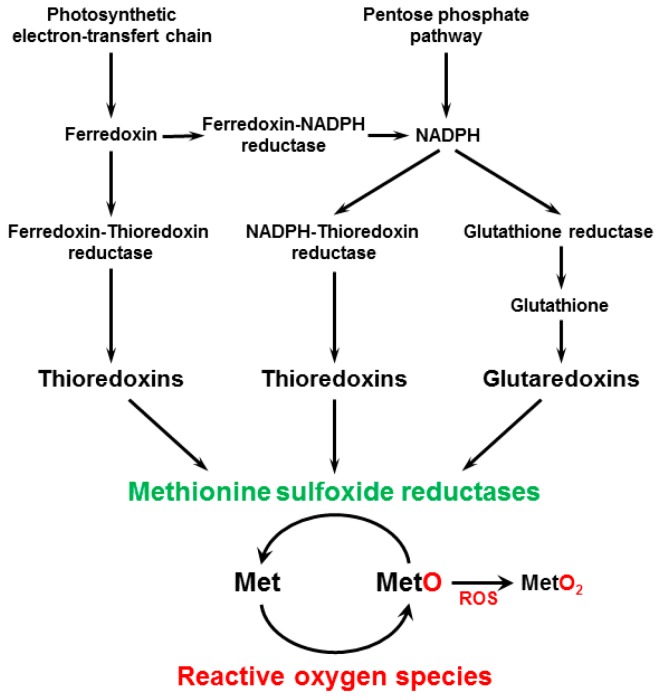
Oxidation of methionine (Met) leads to the formation of two - and -diastereoisomers of Met sulfoxide (MetO) that are reduced back to Met by methionine sulfoxide reductases (MSRs), A and B, respectively. Here, we review the current knowledge about the physiological functions of plant MSRs in relation with subcellular and tissue distribution, expression patterns, mutant phenotypes, and possible targets. The data gained from modified lines of plant models and crop species indicate that MSRs play protective roles upon abiotic and biotic environmental constraints. They also participate in the control of the ageing process, as shown in seeds subjected to adverse conditions. Significant advances were achieved towards understanding how MSRs could fulfil these functions via the identification of partners among Met-rich or MetO-containing proteins, notably by using redox proteomic approaches. In addition to a global protective role against oxidative damage in proteins, plant MSRs could specifically preserve the activity of stress responsive effectors such as glutathione--transferases and chaperones. Moreover, several lines of evidence indicate that MSRs fulfil key signaling roles via interplays with Ca- and phosphorylation-dependent cascades, thus transmitting ROS-related information in transduction pathways.
甲硫氨酸(Met)的氧化会导致甲硫氨酸亚砜(MetO)形成两种非对映异构体,它们分别被甲硫氨酸亚砜还原酶A和B还原为Met。在此,我们综述了目前关于植物甲硫氨酸亚砜还原酶生理功能的知识,涉及亚细胞和组织分布、表达模式、突变体表型以及可能的作用靶点。从植物模型和作物品种的改良株系中获得的数据表明,甲硫氨酸亚砜还原酶在非生物和生物环境胁迫下发挥保护作用。它们还参与衰老过程的调控,如在遭受不利条件的种子中所示。通过在富含Met或含有MetO的蛋白质中鉴定相互作用伙伴,特别是使用氧化还原蛋白质组学方法,在理解甲硫氨酸亚砜还原酶如何履行这些功能方面取得了重大进展。除了对蛋白质氧化损伤具有全局保护作用外,植物甲硫氨酸亚砜还原酶还可以特异性地维持应激反应效应物如谷胱甘肽-S-转移酶和伴侣蛋白的活性。此外,有几条证据表明,甲硫氨酸亚砜还原酶通过与钙和磷酸化依赖性级联反应相互作用来履行关键的信号传导作用,从而在转导途径中传递与活性氧相关的信息。