Department of Biomedicine, Aarhus Research Center for Innate Immunology, Aarhus University, Bartholin Alle 6, 8000, Aarhus, Denmark.
Department of Chemistry, Aarhus University, Langelandsgade 140, 8000, Aarhus, Denmark.
Nat Commun. 2018 Aug 29;9(1):3506. doi: 10.1038/s41467-018-05861-7.
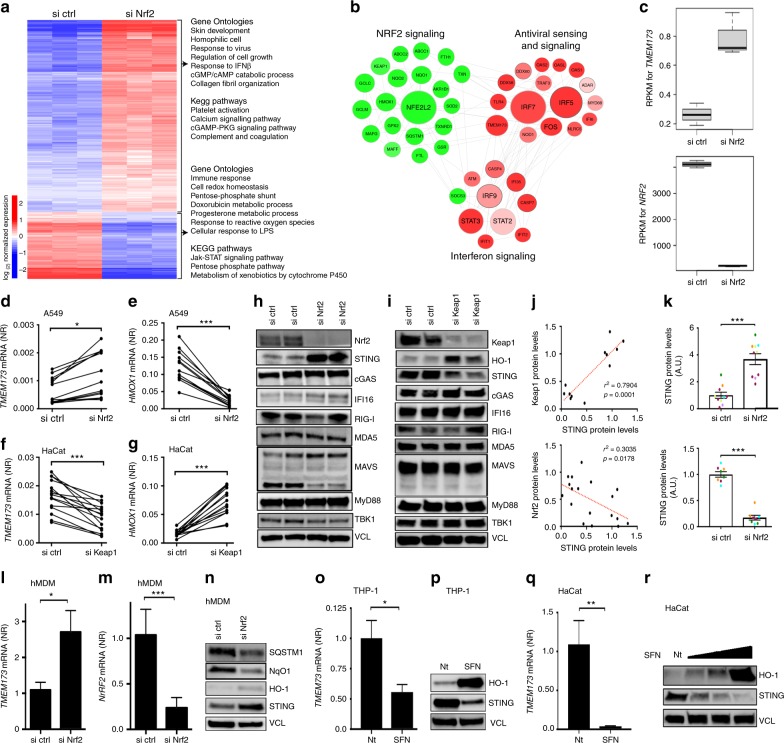
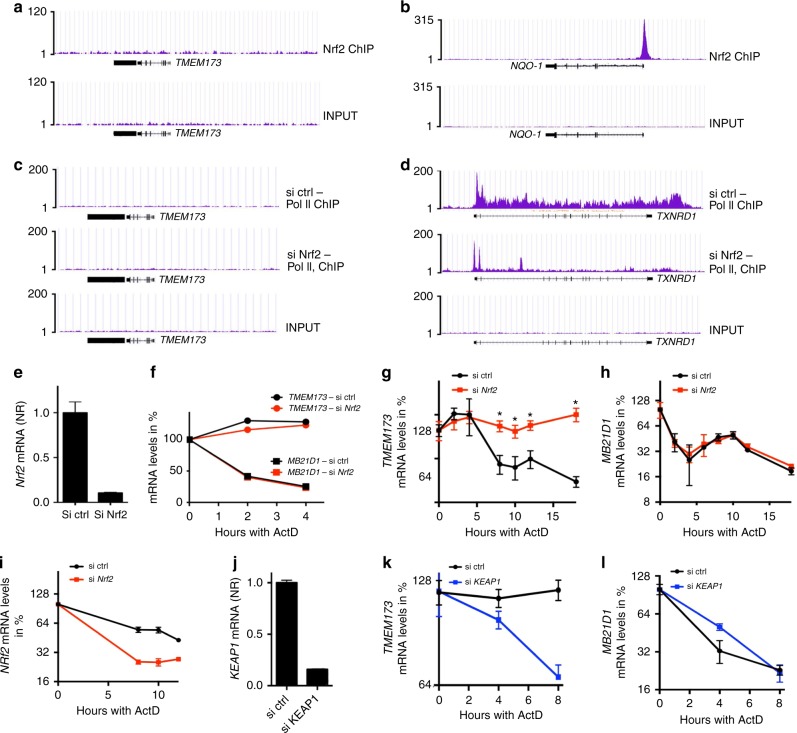
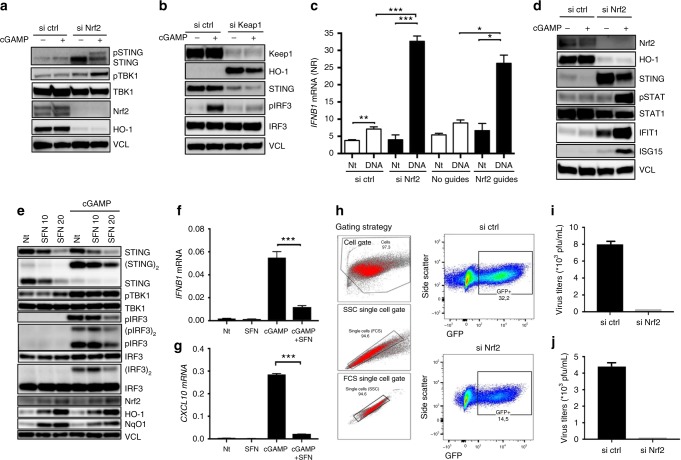
The transcription factor Nrf2 is a critical regulator of inflammatory responses. If and how Nrf2 also affects cytosolic nucleic acid sensing is currently unknown. Here we identify Nrf2 as an important negative regulator of STING and suggest a link between metabolic reprogramming and antiviral cytosolic DNA sensing in human cells. Here, Nrf2 activation decreases STING expression and responsiveness to STING agonists while increasing susceptibility to infection with DNA viruses. Mechanistically, Nrf2 regulates STING expression by decreasing STING mRNA stability. Repression of STING by Nrf2 occurs in metabolically reprogrammed cells following TLR4/7 engagement, and is inducible by a cell-permeable derivative of the TCA-cycle-derived metabolite itaconate (4-octyl-itaconate, 4-OI). Additionally, engagement of this pathway by 4-OI or the Nrf2 inducer sulforaphane is sufficient to repress STING expression and type I IFN production in cells from patients with STING-dependent interferonopathies. We propose Nrf2 inducers as a future treatment option in STING-dependent inflammatory diseases.
转录因子 Nrf2 是炎症反应的关键调节因子。目前尚不清楚 Nrf2 是否以及如何影响细胞质核酸感应。在这里,我们确定 Nrf2 是 STING 的重要负调节剂,并提出代谢重编程和抗病毒细胞质 DNA 感应之间的联系在人类细胞中。在这里,Nrf2 的激活降低了 STING 的表达和对 STING 激动剂的反应性,同时增加了对 DNA 病毒感染的易感性。从机制上讲,Nrf2 通过降低 STING mRNA 的稳定性来调节 STING 的表达。TLR4/7 结合后,代谢重编程的细胞中会发生 Nrf2 对 STING 的抑制,并且可以被 TCA 循环衍生代谢物衣康酸的细胞渗透性衍生物(4-辛基衣康酸,4-OI)诱导。此外,4-OI 或 Nrf2 诱导剂萝卜硫素通过该途径的结合足以抑制依赖 STING 的干扰素病患者细胞中的 STING 表达和 I 型 IFN 产生。我们提出 Nrf2 诱导剂是依赖 STING 的炎症性疾病的未来治疗选择。