
基于质谱的大麦叶片蛋白质组学分析的样品制备方法评估
Evaluation of sample preparation methods for mass spectrometry-based proteomic analysis of barley leaves.
作者信息
Wang Wei-Qing, Jensen Ole Nørregaard, Møller Ian Max, Hebelstrup Kim H, Rogowska-Wrzesinska Adelina
机构信息
1Department of Biochemistry and Molecular Biology and VILLUM Center for Bioanalytical Sciences, University of Southern Denmark, Campusvej 55, 5230 Odense M, Denmark.
3Key Laboratory of Plant Molecular Physiology, Institute of Botany, Chinese Academy of Sciences, Beijing, 100093 China.
出版信息
Plant Methods. 2018 Aug 25;14:72. doi: 10.1186/s13007-018-0341-4. eCollection 2018.
BACKGROUND
Sample preparation is a critical process for proteomic studies. Many efficient and reproducible sample preparation methods have been developed for mass spectrometry-based proteomic analysis of human and animal tissues or cells, but no attempt has been made to evaluate these protocols for plants. We here present an LC-MS/MS-based proteomics study of barley leaf aimed at optimization of methods to achieve efficient and unbiased trypsin digestion of proteins prior to LC-MS/MS based sequencing and quantification of peptides. We evaluated two spin filter-aided sample preparation protocols using either sodium dodecyl-sulphate or sodium deoxycholate (SDC), and three in-solution digestion (ISD) protocols using SDC or trichloroacetic acid/acetone precipitation.
RESULTS
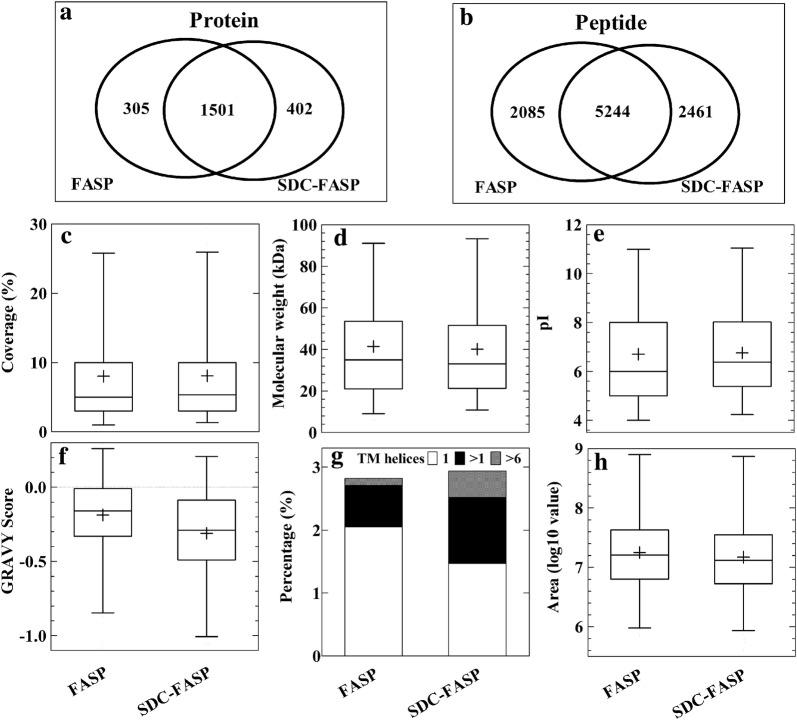
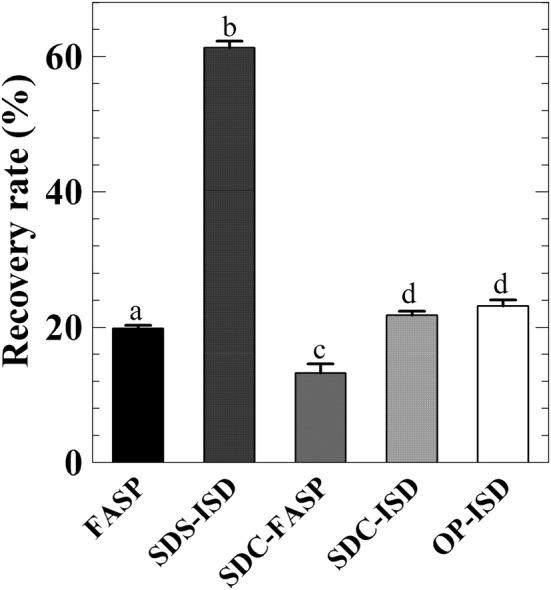
The proteomics workflow identified and quantified up to 1800 barley proteins based on sequencing of up to 6900 peptides per sample. The two spin filter-based protocols provided a 12-38% higher efficiency than the ISD protocols, including more proteins of low abundance. Among the ISD protocols, a simple one-step reduction and -alkylation method (OP-ISD) was the most efficient for barley leaf sample preparation; it identified and quantified 1500 proteins and displayed higher peptide-to-protein inference ratio and higher average amino acid sequence coverage of proteins. The two spin filter-aided sample preparation protocols are compatible with TMT labelling for quantitative proteomics studies. They exhibited complementary performance as about 30% of the proteins were identified by either one or the other protocol, but also demonstrated a positive bias for membrane proteins when using SDC as detergent.
CONCLUSIONS
We provide detailed protocols for efficient plant protein sample preparation for LC-MS/MS-based proteomics studies. Spin filter-based protocols are the most efficient for the preparation of leaf samples for MS-based proteomics. However, a simple protocol provides comparable results although with different peptide digestion profile.
背景
样品制备是蛋白质组学研究的关键过程。已经开发出许多高效且可重复的样品制备方法用于基于质谱的人和动物组织或细胞的蛋白质组分析,但尚未尝试评估这些方法对植物的适用性。我们在此展示了一项基于液相色谱-串联质谱(LC-MS/MS)的大麦叶片蛋白质组学研究,旨在优化方法,以便在基于LC-MS/MS的肽段测序和定量之前实现蛋白质的高效且无偏差的胰蛋白酶消化。我们评估了两种使用十二烷基硫酸钠或脱氧胆酸钠(SDC)的旋转过滤辅助样品制备方案,以及三种使用SDC或三氯乙酸/丙酮沉淀的溶液内消化(ISD)方案。
结果
该蛋白质组学工作流程基于每个样品多达6900个肽段的测序,鉴定并定量了多达1800种大麦蛋白质。两种基于旋转过滤的方案比ISD方案效率高12%-38%,包括更多低丰度蛋白质。在ISD方案中,一种简单的一步还原和烷基化方法(OP-ISD)对大麦叶片样品制备最为有效;它鉴定并定量了1500种蛋白质,显示出更高的肽段-蛋白质推断率和更高的蛋白质平均氨基酸序列覆盖率。两种旋转过滤辅助样品制备方案与用于定量蛋白质组学研究的TMT标记兼容。它们表现出互补性能,约30%的蛋白质可通过其中一种或另一种方案鉴定出来,但在使用SDC作为去污剂时,对膜蛋白也表现出正偏差。
结论
我们为基于LC-MS/MS的蛋白质组学研究提供了高效植物蛋白质样品制备的详细方案。基于旋转过滤的方案对于基于质谱的蛋白质组学叶片样品制备最为有效。然而,一种简单的方案虽然肽段消化谱不同,但能提供可比的结果。



 Zotero 插件