Department of Pulmonary and Critical Care Medicine, The Second Xiangya Hospital, Central South University, 139 Renmin Middle Road, Changsha, Hunan 410011, China.
Research Unit of Respiratory Disease, Central South University, 139 Renmin Middle Road, Changsha, Hunan 410011, China.
Oxid Med Cell Longev. 2018 Aug 12;2018:3529709. doi: 10.1155/2018/3529709. eCollection 2018.
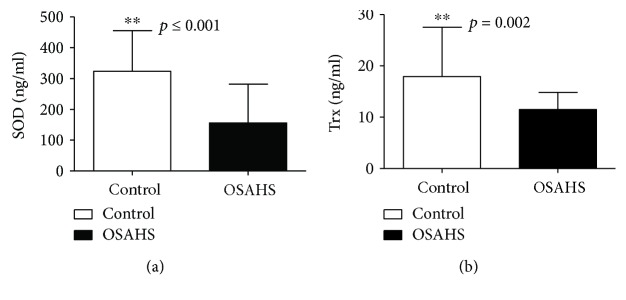
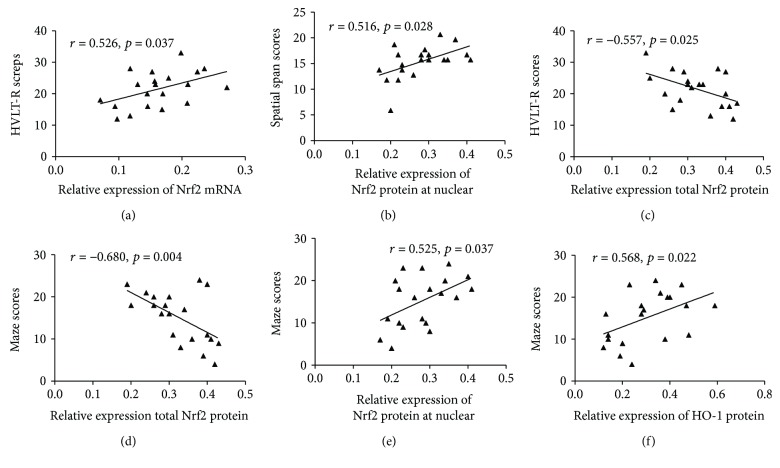
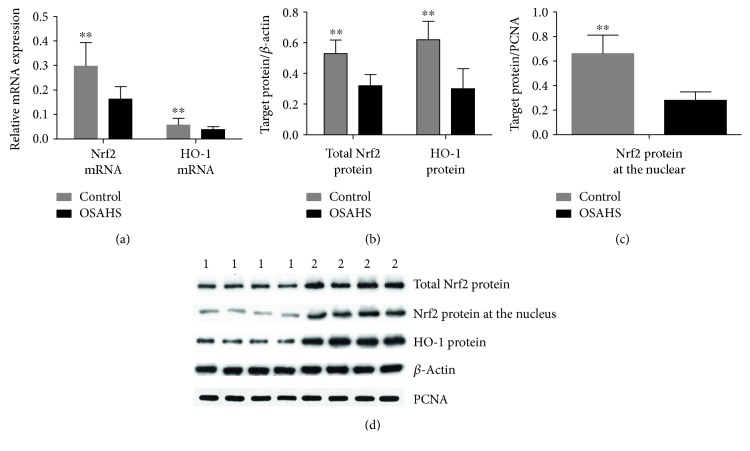
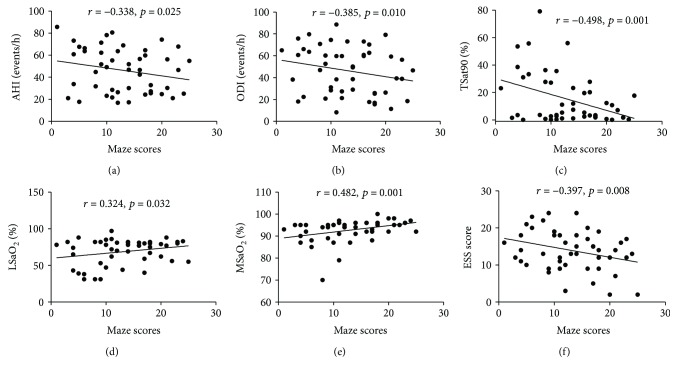
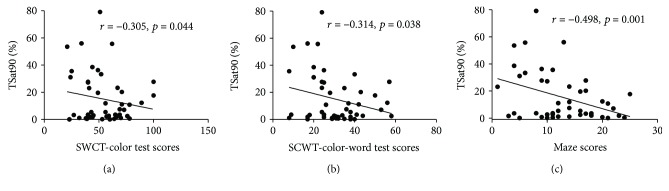
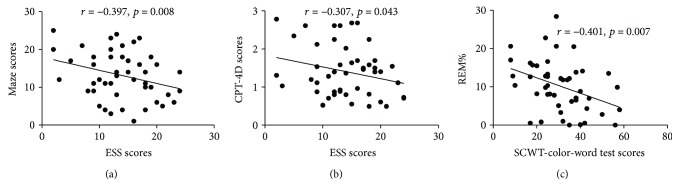
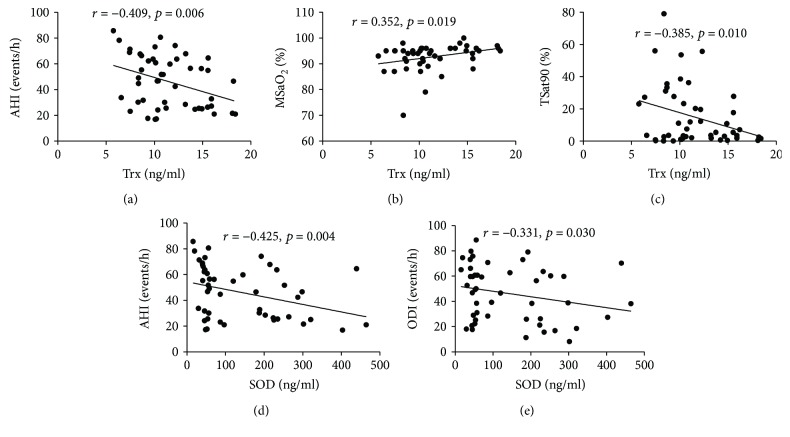
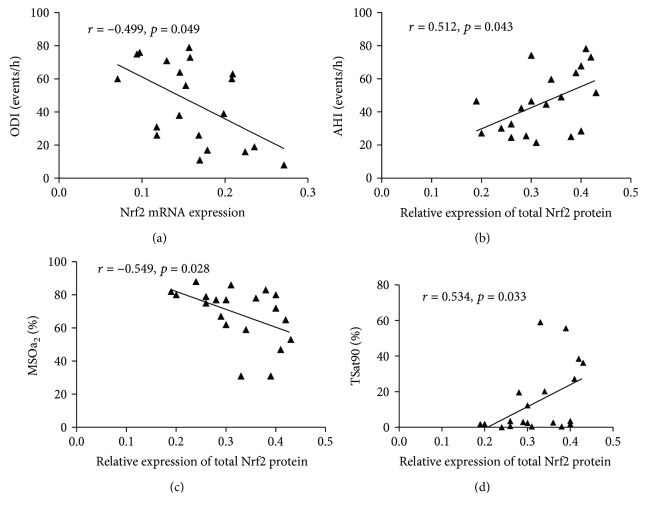
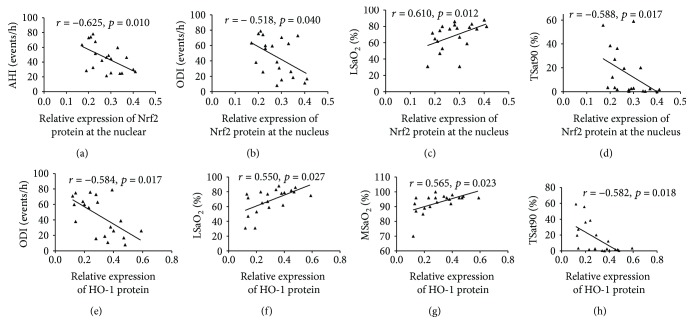
The present study investigated the nuclear factor erythroid 2-related factor 2- (Nrf2-) antioxidant response element (ARE) signaling pathway in patients with moderate to severe obstructive sleep apnea-hypopnea syndrome (OSAHS). Their correlation with neurocognitive impairment metrics was investigated to explore potential pathogenesis in OSAHS. Forty-eight patients with OSAHS and 28 controls underwent testing with the Epworth Sleep Scale (ESS), MATRICS Consensus Cognitive Battery (MCCB), Stroop Color and Word Test, polysomnography (PSG), and measurements of the concentration of plasma superoxide dismutase (SOD) and thioredoxin (Trx). Further, 20 pairs of matched patients with OSAHS and controls were selected for measurement of the expression (protein and mRNA) of Nrf2 and of its downstream antioxidase, heme oxygenase-1 (HO-1), in peripheral mononuclear cells (PBMCs). Finally, correlations between neurocognitive impairment and the above metrics were analyzed. Expression of Nrf2 and HO-1 mRNA and protein in the PBMCs, as well as plasma SOD and Trx levels, were significantly reduced in patients with OSAHS. After adjusting for education, sex, age, and smoking index, the expression of Nrf2-ARE signaling pathway proteins (or mRNA) was closely correlated with sleep respiratory parameters. An inverse relationship was demonstrated between the expression of nuclear Nrf2 in PBMCs, concentration of plasma SOD and Trx, and apnea-hypopnea index (AHI) in patients with OSAHS. Trx, nuclear Nrf2 protein, and HO-1 protein were also negatively correlated with the percent of time that SaO was less than 90% (TSat90). Total Nrf2 protein level was positively correlated with AHI and TSat90 and negatively correlated with minimum SaO (LSaO), while nuclear Nrf2 protein and HO-1 protein were positively correlated with LSaO. Moreover, significant positive correlations were found between maze scores and expression of nuclear Nrf2 protein, HO-1 protein, and SOD and Trx levels. Furthermore, inverse relationships between total Nrf2 protein in PBMCs and HVLT-R and maze scores were found. Multiple linear regression showed plasma Trx concentration as a potential predictor of maze and BVMT-R scores. In conclusion, the expression of Nrf2-ARE molecules and related antioxidases is significantly decreased in patients with OSAHS and is correlated with neurocognitive dysfunction. The Nrf2-ARE signaling pathway may play a crucial role in neurocognitive impairment in patients with moderate to severe OSAHS. Further studies are needed to explore the exact mechanisms and potential treatment interventions.
本研究探讨了中度至重度阻塞性睡眠呼吸暂停低通气综合征(OSAHS)患者的核因子红细胞 2 相关因子 2-(Nrf2-)抗氧化反应元件(ARE)信号通路。研究其与神经认知损伤指标的相关性,以探讨 OSAHS 的潜在发病机制。48 例 OSAHS 患者和 28 例对照者进行了 Epworth 睡眠量表(ESS)、MATRICS 共识认知电池(MCCB)、Stroop 颜色和文字测验、多导睡眠图(PSG)和血浆超氧化物歧化酶(SOD)和硫氧还蛋白(Trx)浓度测量。进一步,选择 20 对匹配的 OSAHS 患者和对照者,以测量外周单核细胞(PBMCs)中 Nrf2 及其下游抗氧化酶血红素加氧酶-1(HO-1)的表达(蛋白和 mRNA)。最后,分析了神经认知损伤与上述指标的相关性。OSAHS 患者 PBMCs 中 Nrf2 和 HO-1mRNA 和蛋白的表达以及血浆 SOD 和 Trx 水平显著降低。在校正教育、性别、年龄和吸烟指数后,Nrf2-ARE 信号通路蛋白(或 mRNA)的表达与睡眠呼吸参数密切相关。在 OSAHS 患者中,核 Nrf2 在 PBMCs 中的表达、血浆 SOD 和 Trx 浓度与呼吸暂停低通气指数(AHI)呈负相关。Trx、核 Nrf2 蛋白和 HO-1 蛋白与 SaO 小于 90%(TSat90)的时间百分比也呈负相关。总 Nrf2 蛋白水平与 AHI 和 TSat90 呈正相关,与最小 SaO(LSaO)呈负相关,而核 Nrf2 蛋白和 HO-1 蛋白与 LSaO 呈正相关。此外,迷宫得分与核 Nrf2 蛋白、HO-1 蛋白和 SOD 及 Trx 水平的表达呈显著正相关。此外,还发现 PBMCs 中总 Nrf2 蛋白与 HVLT-R 和迷宫得分呈负相关。多元线性回归显示血浆 Trx 浓度是迷宫和 BVMT-R 评分的潜在预测因子。总之,OSAHS 患者 Nrf2-ARE 分子及其相关抗氧化酶的表达显著降低,与神经认知功能障碍相关。Nrf2-ARE 信号通路可能在中重度 OSAHS 患者的神经认知损伤中发挥重要作用。需要进一步研究以探讨确切的机制和潜在的治疗干预措施。