Department of Maternal and Child Health, School of Public Health, Tongji Medical College, Huazhong University of Science and Technology, Wuhan, Hubei 430030, China.
Wuhan Children's Hospital (Wuhan Maternal and Child Healthcare Hospital), Tongji Medical College, Huazhong University of Science and Technology, Wuhan, Hubei 430030, China.
J Diabetes Res. 2018 Aug 7;2018:4679245. doi: 10.1155/2018/4679245. eCollection 2018.
The aim of this study was to examine the association between height and plasma glucose level, as well as risk of GDM among Chinese women.
A total of 6941 pregnant Chinese women were recruited from the Healthy Baby Cohort study in Hubei Province, China, in 2012-2014. Measured height was categorized into four groups according to the quartile distribution (≤158.0 cm, 158.1-161.0 cm, 161.1-164.0 cm, and >164.0 cm). GDM was defined based on the International Association of the Diabetes in Pregnancy Study Group criteria. Linear regression was used to estimate the association between height and plasma glucose levels. Logistic regression was used to calculate odds ratios (ORs) and 95% confidence intervals (CIs) for the association between height and GDM.
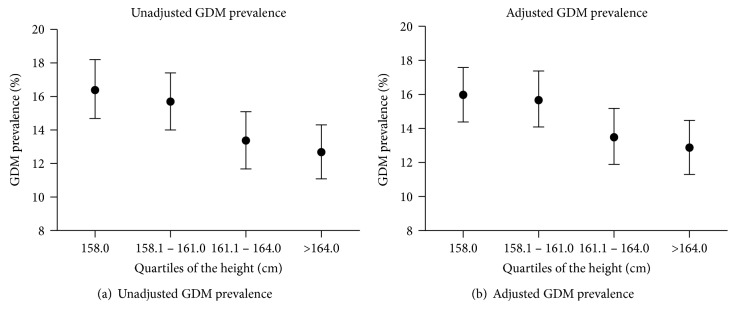
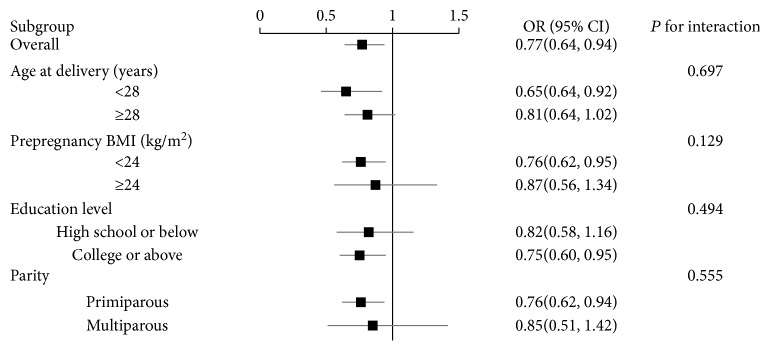
The prevalence of GDM was 14.7% in our study. Height was inversely associated with the 1 h and 2h plasma glucose levels (all value for trend < 0.05), but not with fasting plasma glucose levels. A significant negative trend was found between height and risk of GDM ( value for trend < 0.05), and each centimeter increase in height was associated with 2% (OR: 0.98; 95% CI: 0.96, 0.99) lower risk of GDM. Women in the highest quartile of height (>164.0 cm) had 23% (OR: 0.77; 95% CI: 0.64, 0.94) lower risk of developing GDM than those in the shortest quartile of height (≤158.0 cm), after adjusting for potential confounders.
Our findings suggested that height was negatively associated with risk of GDM among Chinese women. The difference in plasma glucose levels is present in the 1 h and 2 h plasma glucose, but not with fasting plasma glucose.
本研究旨在探讨身高与血浆葡萄糖水平以及中国女性患 GDM 风险之间的关系。
2012-2014 年,我们在中国湖北省的“健康婴儿队列研究”中招募了 6941 名孕妇。根据 quartile 分布(≤158.0cm、158.1-161.0cm、161.1-164.0cm 和 >164.0cm)将测量的身高分为四组。根据国际妊娠糖尿病协会研究组的标准,定义 GDM。使用线性回归估计身高与血浆葡萄糖水平之间的关系。使用 logistic 回归计算身高与 GDM 之间的比值比(OR)和 95%置信区间(CI)。
在我们的研究中,GDM 的患病率为 14.7%。身高与 1h 和 2h 血浆葡萄糖水平呈负相关(所有趋势值<0.05),但与空腹血浆葡萄糖水平无关。身高与 GDM 风险之间存在显著的负向趋势(趋势值<0.05),身高每增加 1 厘米,患 GDM 的风险降低 2%(OR:0.98;95%CI:0.96,0.99)。身高处于最高四分位(>164.0cm)的女性患 GDM 的风险比身高处于最矮四分位(≤158.0cm)的女性低 23%(OR:0.77;95%CI:0.64,0.94),在调整了潜在混杂因素后。
我们的研究结果表明,身高与中国女性 GDM 风险呈负相关。血糖水平的差异存在于 1h 和 2h 血浆葡萄糖水平,而与空腹血浆葡萄糖水平无关。