School of Nursing, Queen's University, Kingston, Ontario, Canada.
Health Expect. 2018 Dec;21(6):1122-1133. doi: 10.1111/hex.12815. Epub 2018 Aug 29.
Health care remains unacceptably error prone. Recently, efforts to address this problem have included the patient and their family as partners with providers in harm prevention. Policymakers and clinicians have created patient safety strategies to encourage patient engagement, yet they have typically not included patient perspectives in their development or been comprehensively evaluated. We do not have a good understanding of "if" and "how" patients want involvement in patient safety during clinical interactions.
The objective of this study was to gain insight into patients' perspectives about their knowledge, comfort level and behaviours in promoting their safety while receiving health care in hospital.
The study design was a descriptive, exploratory qualitative approach to inductively examine how adult patients in a community hospital describe health-care safety and see their role in preventing error.
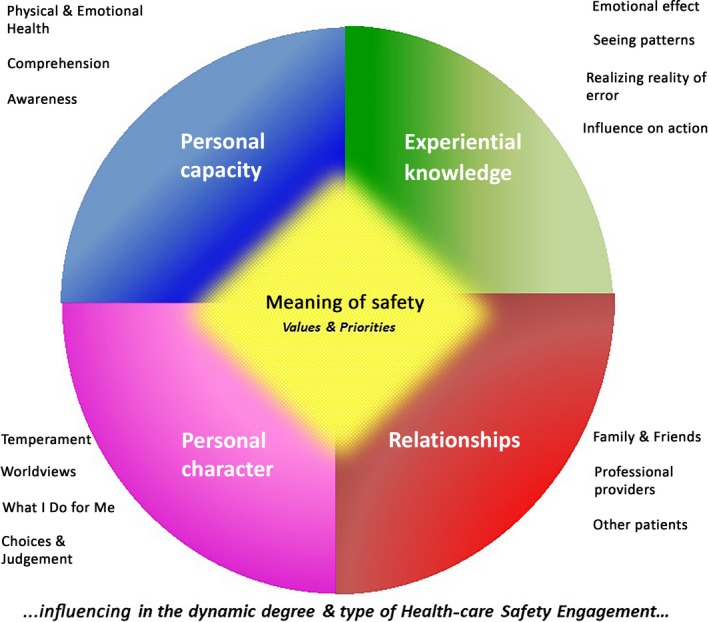
The findings, which included participation of 30 patients and four family members, indicate that although there are shared themes that influence a patient's engagement in safety, beliefs about involvement and actions taken are varied. Five conceptual themes emerged from their narratives: Personal Capacity, Experiential Knowledge, Personal Character, Relationships and Meaning of Safety.
These results will be used to develop and test a pragmatic, accessible tool to enable providers a way to collaborate with patients for determining their personal level and type of safety involvement.
The most ethical and responsible approach to health-care safety is to consider every potential way for improvement. This study provides fundamental insights into the complexity of patient engagement in safety.
医疗保健仍然存在不可接受的错误。最近,为解决这个问题,已将患者及其家属作为合作伙伴,与医护人员共同参与预防伤害。决策者和临床医生已经制定了患者安全策略以鼓励患者参与,但这些策略通常没有纳入患者的观点,也没有得到全面评估。我们并不清楚患者在临床互动中是否以及如何希望参与患者安全。
本研究旨在深入了解患者对其在医院接受医疗保健时促进自身安全的知识、舒适度和行为的看法。
该研究采用描述性、探索性定性方法,以归纳的方式检验社区医院的成年患者如何描述医疗保健安全,并了解他们在预防错误方面的角色。
研究共纳入 30 名患者和 4 名家属,研究结果表明,尽管存在影响患者参与安全的共同主题,但他们对参与和采取行动的信念存在差异。从他们的叙述中出现了五个概念主题:个人能力、经验知识、个人品格、人际关系和安全意义。
这些结果将用于开发和测试一种实用、易于使用的工具,使提供者能够与患者合作,确定他们的个人安全参与水平和类型。
考虑到每一种潜在的改进方法是医疗保健安全最具道德和责任的方法。本研究深入了解了患者参与安全的复杂性。