Department of Epidemiology, Gillings School of Global Public Health, University of North Carolina at Chapel Hill, Chapel Hill, North Carolina, United States of America.
Oak Ridge Institute for Science and Education at the U.S. Environmental Protection Agency, USEPA Human Studies Facility, Chapel Hill, North Carolina, United States of America.
PLoS One. 2018 Aug 30;13(8):e0203301. doi: 10.1371/journal.pone.0203301. eCollection 2018.
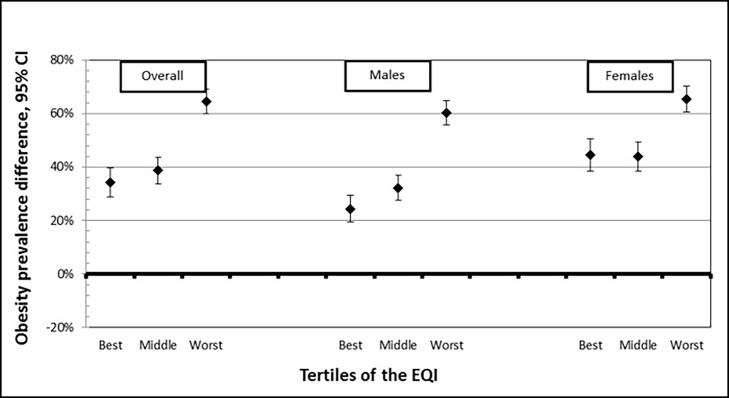
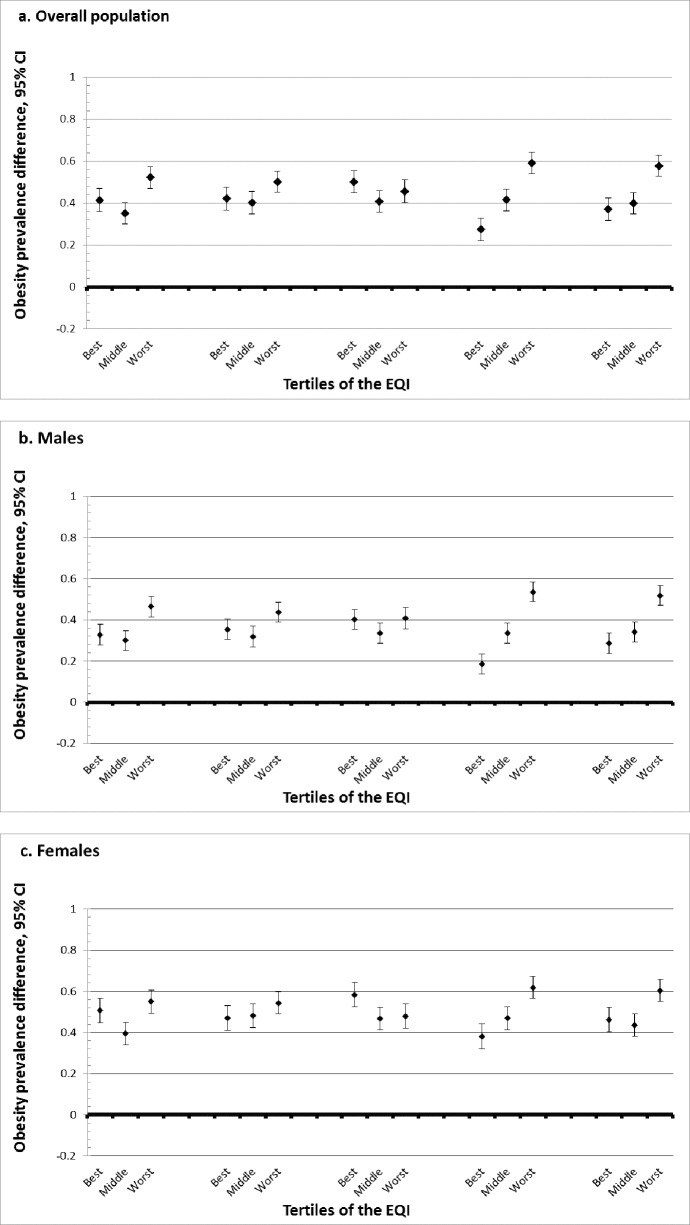
Physical inactivity is a primary contributor to the obesity epidemic, but may be promoted or hindered by environmental factors. To examine how cumulative environmental quality may modify the inactivity-obesity relationship, we conducted a cross-sectional study by linking county-level Behavioral Risk Factor Surveillance System data with the Environmental Quality Index (EQI), a composite measure of five environmental domains (air, water, land, built, sociodemographic) across all U.S. counties. We estimated the county-level association (N = 3,137 counties) between 2009 age-adjusted leisure-time physical inactivity (LTPIA) and 2010 age-adjusted obesity from BRFSS across EQI tertiles using multi-level linear regression, with a random intercept for state, adjusted for percent minority and rural-urban status. We modelled overall and sex-specific estimates, reporting prevalence differences (PD) and 95% confidence intervals (CI). In the overall population, the PD increased from best (PD = 0.341 (95% CI: 0.287, 0.396)) to worst (PD = 0.645 (95% CI: 0.599, 0.690)) EQI tertile. We observed similar trends in males from best (PD = 0.244 (95% CI: 0.194, 0.294)) to worst (PD = 0.601 (95% CI: 0.556, 0.647)) quality environments, and in females from best (PD = 0.446 (95% CI: 0.385, 0.507)) to worst (PD = 0.655 (95% CI: 0.607, 0.703)). We found that poor environmental quality exacerbates the LTPIA-obesity relationship. Efforts to improve obesity through LTPIA may benefit from considering this relationship.
身体活动不足是肥胖流行的主要原因,但可能会受到环境因素的促进或阻碍。为了研究累积环境质量如何改变不活动与肥胖的关系,我们通过将县一级的行为风险因素监测系统数据与环境质量指数(EQI)联系起来,对所有美国县的五个环境领域(空气、水、土地、建筑、社会人口统计学)进行了一项横断面研究。我们使用多层次线性回归,对 BRFSS 中 2009 年调整年龄的休闲时间体力活动不足(LTPIA)与 2010 年调整年龄的肥胖与 EQI 三分位的县一级关联(N = 3137 个县)进行了估计,使用州的随机截距进行调整,调整了少数民族比例和城乡状况。我们对总体和性别特异性进行了建模,报告了患病率差异(PD)和 95%置信区间(CI)。在总体人群中,从最好的(PD = 0.341(95%CI:0.287,0.396))到最差的(PD = 0.645(95%CI:0.599,0.690))EQI 三分位的 PD 增加。我们在男性中观察到了类似的趋势,从最好的(PD = 0.244(95%CI:0.194,0.294))到最差的(PD = 0.601(95%CI:0.556,0.647))质量环境,在女性中从最好的(PD = 0.446(95%CI:0.385,0.507))到最差的(PD = 0.655(95%CI:0.607,0.703))。我们发现,环境质量差会加剧 LTPIA 与肥胖的关系。通过 LTPIA 改善肥胖的努力可能会受益于考虑这种关系。