Lee Hyun-Sung, Jang Hee-Jin, Lo Eric M, Truong Cynthia Y, Groth Shawn S, Friedberg Joseph S, Sugarbaker David J, Burt Bryan M
Division of Thoracic Surgery, Michael E. DeBakey Department of Surgery, Baylor College of Medicine, Houston, TX, USA.
Department of Thoracic Surgery, University of Maryland Greenebaum Cancer Center, Baltimore, MD, USA.
Interact Cardiovasc Thorac Surg. 2019 Mar 1;28(3):353-359. doi: 10.1093/icvts/ivy248.
Hyperthermic pleural lavage with povidone-iodine (PVP-I) is utilized to control micrometastatic disease following cytoreductive surgery for thymic epithelial tumours (TETs). Our objective was to investigate whether PVP-I demonstrates direct cytotoxicity against human TET cells.
Human Met-5A (immortalized mesothelial cell), IU-TAB-1 (thymoma) and Ty-82 (thymic carcinoma) cell lines were treated with serial dilutions of PVP-I (0.01-10%) for 5, 30 and 60 min at 37°C and 42°C. MTT assays and flow cytometry were used to evaluate cell death and apoptosis. Membrane permeability was assayed by intracellular staining of cleaved poly-ADP-ribose polymerase. Cellular fixation was evaluated by membrane disruption of dead cells by dimethylsulphoxide and by comparing cleaved poly-ADP-ribose polymerase staining following PVP-I with known fixatives.
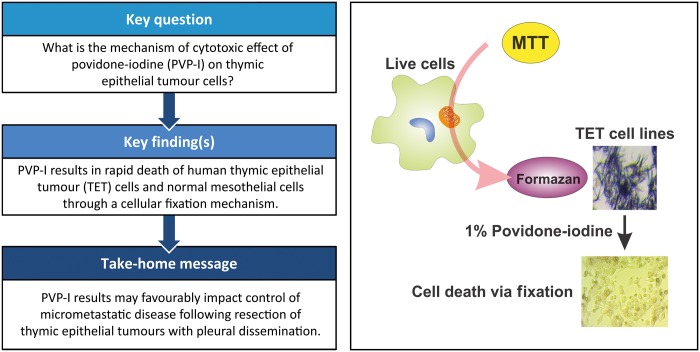
MTT assays demonstrated that PVP-I concentrations greater than 0.5% led to rapid cell death in both TET cell lines regardless of temperature. IC50 values following 5 min of exposure to PVP-I were 8.4 mM (0.3%) and 13.3 mM (0.48%) for IU-TAB-1 and Ty-82, respectively and 8.9 mM (0.32%) for MeT-5A. Flow cytometry demonstrated that 5-min exposure of either cell line to 1% PVP-I resulted in profound cell death: 74% and 58% at 5 min and 97% and 95% at 30 min, for IU-TAB-1 and Ty-82 cells, respectively. Resistance of PVP-I-treated cells to dimethylsulphoxide lysis and similar cleaved poly-ADP-ribose polymerase expression following PVP-I and known fixatives revealed cellular fixation as the mechanism of death following PVP-I exposure.
PVP-I results in rapid death of human TET cells and normal mesothelial cells through a cellular fixation mechanism and may, therefore, favourably impact the control of micrometastatic disease following resection of TETs with pleural dissemination.
采用聚维酮碘(PVP - I)进行热胸灌洗,以控制胸腺上皮肿瘤(TETs)减瘤手术后的微转移疾病。我们的目的是研究PVP - I是否对人TET细胞具有直接细胞毒性。
将人Met - 5A(永生化间皮细胞)、IU - TAB - 1(胸腺瘤)和Ty - 82(胸腺癌)细胞系在37°C和42°C下用PVP - I系列稀释液(0.01 - 10%)处理5、30和60分钟。采用MTT法和流式细胞术评估细胞死亡和凋亡。通过裂解的聚ADP - 核糖聚合酶的细胞内染色测定膜通透性。通过二甲基亚砜对死细胞膜的破坏以及比较PVP - I处理后与已知固定剂的裂解聚ADP - 核糖聚合酶染色来评估细胞固定情况。
MTT分析表明,无论温度如何,PVP - I浓度大于0.5%均导致两种TET细胞系快速死亡。暴露于PVP - I 5分钟后的IC50值,IU - TAB - 1和Ty - 82分别为8.4 mM(0.3%)和13.3 mM(0.48%)以及MeT - 5A为8.9 mM(0.32%)。流式细胞术表明,两种细胞系暴露于1% PVP - I 5分钟均导致大量细胞死亡:IU - TAB - 1和Ty - 82细胞在5分钟时分别为74%和58%,在30分钟时分别为97%和95%。PVP - I处理的细胞对二甲基亚砜裂解具有抗性,且PVP - I处理后与已知固定剂的裂解聚ADP - 核糖聚合酶表达相似,表明细胞固定是PVP - I暴露后细胞死亡的机制。
PVP - I通过细胞固定机制导致人TET细胞和正常间皮细胞快速死亡,因此,可能对切除伴有胸膜播散的TETs后微转移疾病的控制产生有利影响。