McKusick-Zhang Center for Genetic Medicine, State Key Laboratory of Medical Molecular Biology, Institute of Basic Medical Sciences, Chinese Academy of Medical Science & Peking Union Medical College, 5 Dong Dan San Tiao, Beijing, 100005, China.
Department of Cardiology, Peking Union Medical College Hospital, Chinese Academy of Medical Science & Peking Union Medical College, No. 1 Shuai Fu Yuan, Beijing, 100730, China.
J Transl Med. 2018 Aug 30;16(1):241. doi: 10.1186/s12967-018-1605-5.
Cardiomyopathies are the most common clinical and genetic heterogeneity cardiac diseases, and genetic contribution in particular plays a major role in patients with primary cardiomyopathies. The aim of this study is to investigate cases of inherited cardiomyopathy (IC) for potential disease-causing mutations in 64 genes reported to be associated with IC.
A total of 110 independent cases or families diagnosed with various primary cardiomyopathies, including hypertrophic cardiomyopathy, dilated cardiomyopathy, restrictive cardiomyopathy, arrhythmogenic right ventricular cardiomyopathy, left ventricular non-compaction, and undefined cardiomyopathy, were collected after informed consent. A custom designed panel, including 64 genes, was screened using next generation sequencing on the Ion Torrent PGM platform. The best candidate disease-causing variants were verified by Sanger sequencing.
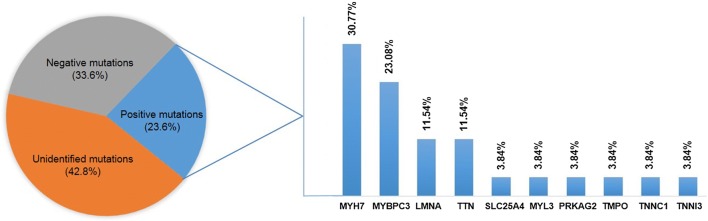
A total of 78 variants in 73 patients were identified. After excluding the variants predicted to be benign and VUS, 26 pathogenic or likely pathogenic variants were verified in 26 probands (23.6%), including a homozygous variant in the SLC25A4 gene. Of these variants, 15 have been reported in the Human Gene Mutation Database or ClinVar database, while 11 are novel. The majority of variants were observed in the MYH7 (8/26) and MYBPC3 (6/26) gene. Titin (TTN) truncating mutations account for 13% in our dilated cardiomyopathy cases (3/23).
This study provides an overview of the genetic aberrations in this cohort of Chinese IC patients and demonstrates the power of next generation sequencing in IC. Genetic results can provide precise clinical diagnosis and guidance regarding medical care for some individuals.
心肌病是最常见的临床和遗传异质性心脏疾病,遗传因素尤其在原发性心肌病患者中起着重要作用。本研究旨在调查遗传性心肌病(IC)病例中与 IC 相关的 64 个基因的潜在致病突变。
在获得知情同意后,共收集了 110 例经诊断为各种原发性心肌病(包括肥厚型心肌病、扩张型心肌病、限制型心肌病、致心律失常性右室心肌病、左室心肌致密化不全和未明原因的心肌病)的独立病例或家族。使用 Ion Torrent PGM 平台上的下一代测序对包括 64 个基因的定制设计面板进行了筛选。通过 Sanger 测序验证最佳候选致病变体。
在 73 名患者中发现了 78 个变异体。排除预测为良性和 VUS 的变异体后,在 26 名先证者中验证了 26 个致病或可能致病的变异体(23.6%),包括 SLC25A4 基因的纯合变异体。这些变异体中有 15 个已在人类基因突变数据库或 ClinVar 数据库中报道,而 11 个是新的。大多数变异体发生在 MYH7(8/26)和 MYBPC3(6/26)基因中。在我们的扩张型心肌病病例中,Titin(TTN)截断突变占 13%(3/23)。
本研究提供了中国 IC 患者队列中遗传异常的概述,并展示了下一代测序在 IC 中的强大功能。遗传结果可为某些个体提供精确的临床诊断和医疗护理指导。