Department of Respiratory and Critical Care Medicine, Tongji Hospital of Tongji Medical College, Huazhong University of Science and Technology, No.1095, Jie Fang Road, Han Kou District, Wu Han, 430030, Hu Bei Province, China.
Division of Cardiology, Departments of Internal Medicine and Genetic Diagnosis Center, Tongji Hospital, Tongji Medical College, Huazhong University of Science and Technology, Wu Han, China.
Respir Res. 2018 Aug 31;19(1):163. doi: 10.1186/s12931-018-0862-4.
Autoimmune pulmonary alveolar proteinosis (aPAP) is a rare pulmonary disease caused by functional deficiency of granulocyte-macrophage colony-stimulating factor (GM-CSF). GM-CSF therapy in aPAP has been reported effective in some studies. This meta-analyses aimed to evaluate whether GM-CSF therapy, including inhaled and subcutaneous GM-CSF have therapeutic effect in aPAP patients.
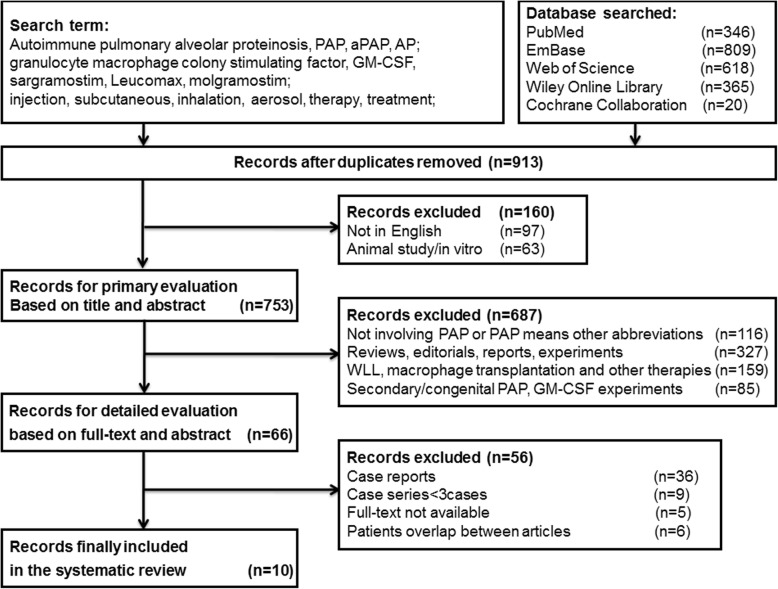
We analyzed 10 studies searched from PubMed, EmBase, Web of Science, Wiley Online Library and Cochrane Collaboration databases to evaluate the pooled effects of GM-CSF treatment in aPAP patients.
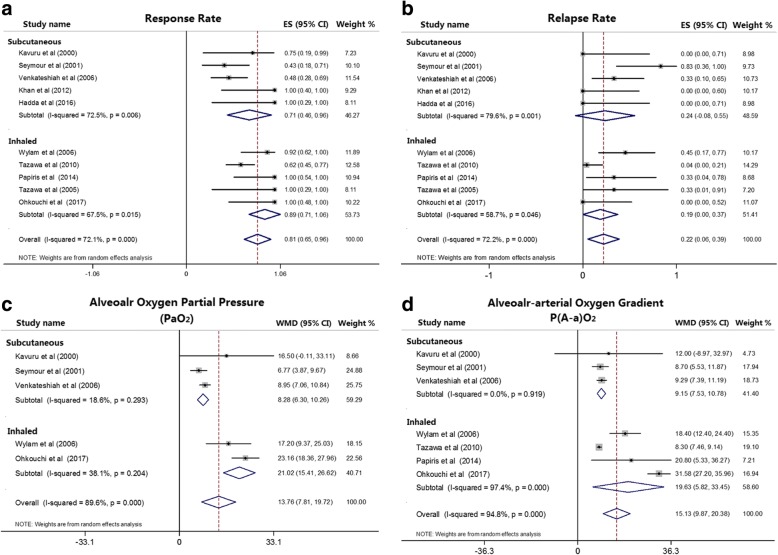
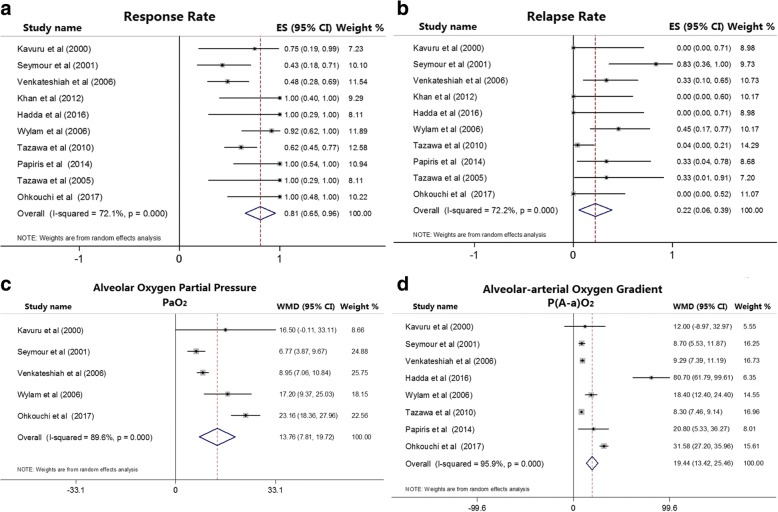
Ten observational studies involving 115 aPAP patients were included. The pooled analyses of response rate (81%, p < 0.001), relapse rate (22%, p = 0.009), PaO (13.76 mmHg, p < 0.001) and P(A-a)O (19.44 mmHg, p < 0.001) showed that GM-CSF treatment was effective on aPAP patients. Further analyses showed that inhaled GM-CSF treatment was more effective than subcutaneous GM-CSF therapy, including a higher response rate (89% vs. 71%, p = 0.023), more improvements in PaO (21.02 mmHg vs. 8.28 mmHg, p < 0.001) and P(A-a)O (19.63 mmHg vs. 9.15 mmHg, p < 0.001).
As two routes of exogenous GM-CSF treatment, inhaled and subcutaneous were both proven to have effect on aPAP patients. Furthermore, inhaled GM-CSF therapy showed a higher response rate, more improvements on PaO and P(A-a)O than subcutaneous GM-CSF treatment in aPAP patients, suggesting inhaled GM-CSF therapy could have more benefits on aPAP patients. Therefore, GM-CSF therapy, especially inhaled GM-CSF, might be a promising therapeutic option in treating aPAP.
自身免疫性肺泡蛋白沉积症(aPAP)是一种由粒细胞-巨噬细胞集落刺激因子(GM-CSF)功能缺陷引起的罕见肺部疾病。GM-CSF 治疗 aPAP 的一些研究已经证明有效。本荟萃分析旨在评估 GM-CSF 治疗,包括吸入和皮下 GM-CSF 是否对 aPAP 患者有治疗作用。
我们分析了从 PubMed、EmBase、Web of Science、Wiley Online Library 和 Cochrane 协作数据库中搜索到的 10 项研究,以评估 GM-CSF 治疗在 aPAP 患者中的汇总效果。
纳入了 10 项观察性研究,共涉及 115 例 aPAP 患者。GM-CSF 治疗反应率(81%,p<0.001)、复发率(22%,p=0.009)、PaO(13.76mmHg,p<0.001)和 P(A-a)O(19.44mmHg,p<0.001)的汇总分析表明,GM-CSF 治疗对 aPAP 患者有效。进一步分析表明,吸入 GM-CSF 治疗比皮下 GM-CSF 治疗更有效,包括更高的反应率(89%比 71%,p=0.023)、更大程度的 PaO 改善(21.02mmHg 比 8.28mmHg,p<0.001)和 P(A-a)O 改善(19.63mmHg 比 9.15mmHg,p<0.001)。
作为 GM-CSF 治疗的两种途径,吸入和皮下均被证明对 aPAP 患者有效。此外,吸入 GM-CSF 治疗在 aPAP 患者中比皮下 GM-CSF 治疗有更高的反应率、更大的 PaO 和 P(A-a)O 改善,表明吸入 GM-CSF 治疗对 aPAP 患者可能有更多益处。因此,GM-CSF 治疗,特别是吸入 GM-CSF,可能是治疗 aPAP 的一种有前途的治疗选择。