Universidad de Buenos Aires. Facultad de Ciencias Exactas y Naturales, Laboratory of Eco-Epidemiology, Ciudad Universitaria, C1428EHA, Buenos Aires, Argentina.
Consejo Nacional de Investigaciones Científicas y Técnicas-Universidad de Buenos Aires. Instituto de Ecología, Genética y Evolución de Buenos Aires (IEGEBA), Ciudad Universitaria, C1428EHA, Buenos Aires, Argentina.
Parasit Vectors. 2018 Aug 30;11(1):492. doi: 10.1186/s13071-018-3069-0.
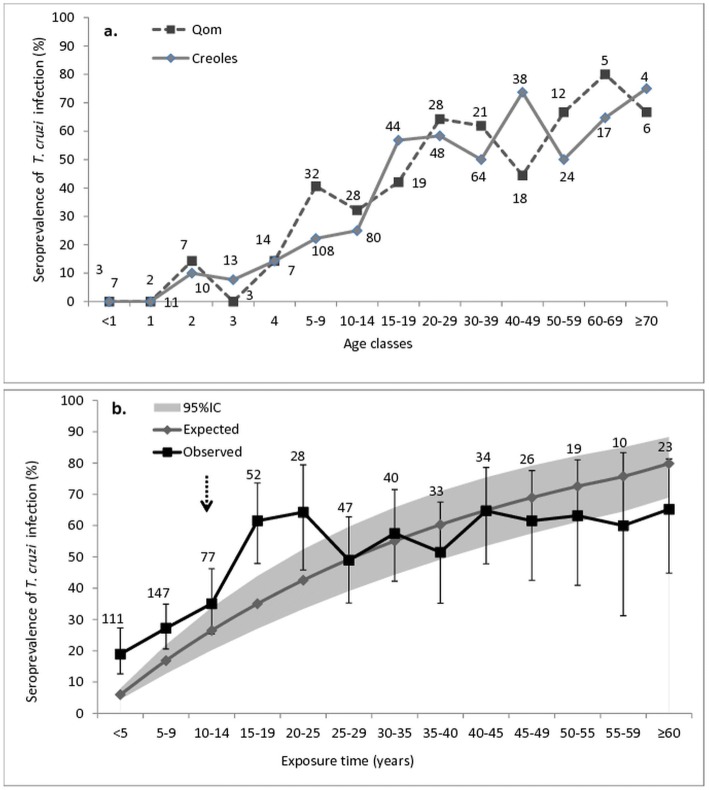
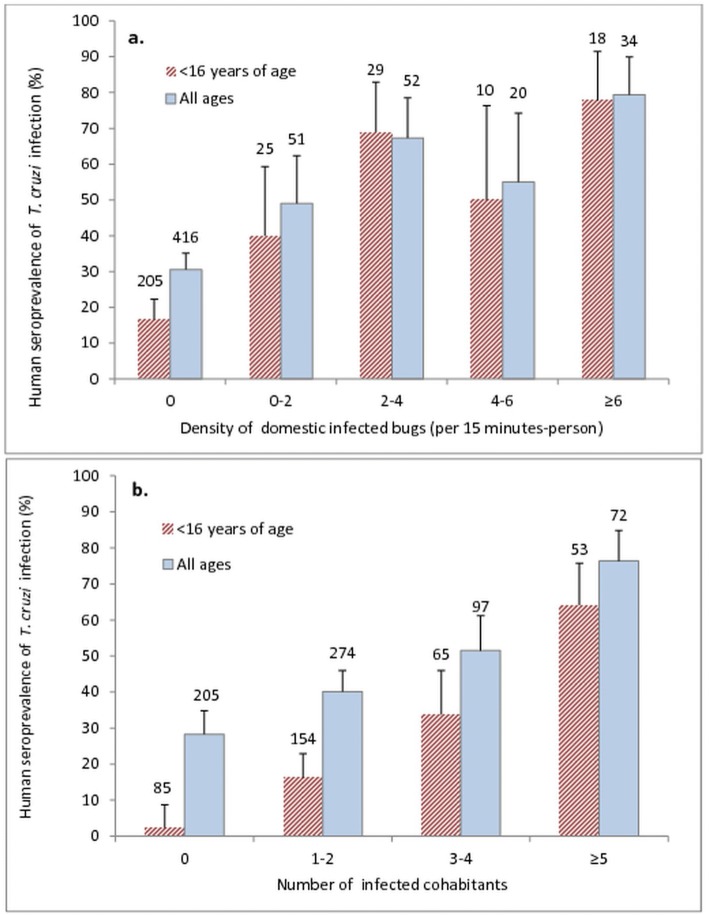
Insecticide spraying campaigns designed to suppress the principal vectors of the Chagas disease usually lack an active surveillance system that copes with house reinvasion. Following an insecticide campaign with no subsequent surveillance over a 12-year period, we implemented a longitudinal intervention programme including periodic surveys for Triatoma infestans, full-coverage house spraying with insecticides, and selective control in a well-defined rural area of the Argentinean Chaco inhabited by Creoles and one indigenous group (Qom). Here, we conducted a cross-sectional study and report the age-specific seroprevalence of human T. cruzi infection by group, and examine the association between human infection, the onset of the intervention, the relative density of infected domestic bugs, and the household number of infected people, dogs, or cats.
The seroprevalence of infection among 691 residents examined was 39.8% and increased steadily with age, reaching 53-70% in those older than 20 years. The mean annual force of infection was 2.5 per 100 person-years (95% CI: 1.8-3.3%). Infection in children younger than 16 years born before the intervention programme was two to four times higher in houses with infected T. infestans than in houses without them and was six times higher when there were both infected dogs or cats and bugs than when they were absent. The model-averaged estimate of the intervention effect suggests that the odds of seropositivity were about nine times smaller for those born after the onset of the intervention than for those born before it, regardless of ethnic background, age, gender, household wealth, and cohabitation with T. cruzi-infected vectors or human hosts. Human infection was also closely associated with the baseline abundance of infected domestic triatomines and the number of infected cohabitants. Two of 43 children born after interventions were T. cruzi-seropositive; since their mothers were seropositive and both resided in apparently uninfested houses they were attributed to vertical transmission. Alternatively, these cases could be due to non-local vector-borne transmission.
Our study reveals high levels of human infection with T. cruzi in the Argentinean Chaco, and the immediate impact of sustained vector surveillance and selective control actions on transmission.
旨在抑制恰加斯病主要传播媒介的杀虫剂喷洒运动通常缺乏应对房屋再次入侵的主动监测系统。在经过 12 年没有后续监测的杀虫剂运动后,我们实施了一项纵向干预计划,包括周期性调查布氏锥虫、全面覆盖房屋喷洒杀虫剂以及在阿根廷查科一个由克里奥尔人和一个土著群体(科姆人)居住的明确界定的农村地区进行选择性控制。在这里,我们进行了一项横断面研究,按组别报告了人类感染克氏锥虫的年龄特异性血清流行率,并检查了人类感染与干预的开始、受感染的家养臭虫的相对密度以及受感染的人、狗或猫的家庭数量之间的关联。
对 691 名受检居民的血清流行率进行了检测,结果显示,感染率为 39.8%,并随着年龄的增长而稳步上升,20 岁以上人群的感染率达到 53-70%。平均每年感染率为每 100 人年 2.5(95%CI:1.8-3.3%)。在干预前出生的 16 岁以下儿童中,感染了布氏锥虫的房屋中的感染率是未感染房屋的两到四倍,当同时存在感染的狗或猫和臭虫时,感染率是未感染时的六倍。模型平均估计的干预效果表明,出生于干预开始后的人群的阳性率大约是干预前出生的人群的九倍,无论其种族背景、年龄、性别、家庭财富以及与克氏锥虫感染的媒介或人类宿主的共同居住情况如何。人类感染也与基线受感染的家养三锥虫的丰度和受感染的共同居住者的数量密切相关。在干预后出生的 43 名儿童中有 2 名呈克氏锥虫血清阳性;由于他们的母亲呈血清阳性,并且都居住在显然未受感染的房屋中,因此将其归因于垂直传播。或者,这些病例可能是由于非本地媒介传播引起的。
我们的研究揭示了阿根廷查科地区人类感染布氏锥虫的高水平,以及持续的媒介监测和选择性控制行动对传播的直接影响。