Facultad de Ciencias Exactas y Naturales, Laboratorio de Eco-Epidemiología, Universidad de Buenos Aires, Ciudad Universitaria, Buenos Aires, Argentina.
Instituto de Ecología, Genética y Evolución de Buenos Aires, Consejo Nacional de Investigaciones Científicas y Técnicas, Ciudad Universitaria, Buenos Aires, Argentina.
Parasit Vectors. 2024 Jan 29;17(1):41. doi: 10.1186/s13071-024-06125-8.
Chagas disease is a neglected tropical disease (NTD). Cost-effective strategies for large-scale implementation of diagnosis and etiological treatment are urgently needed to comply with NTD control goals. We determined the seroprevalence of Trypanosoma cruzi infection and associated risk factors in a well-defined rural population of Pampa del Indio municipality including creole and indigenous (Qom) households and developed two indices to identify houses harboring infected children.
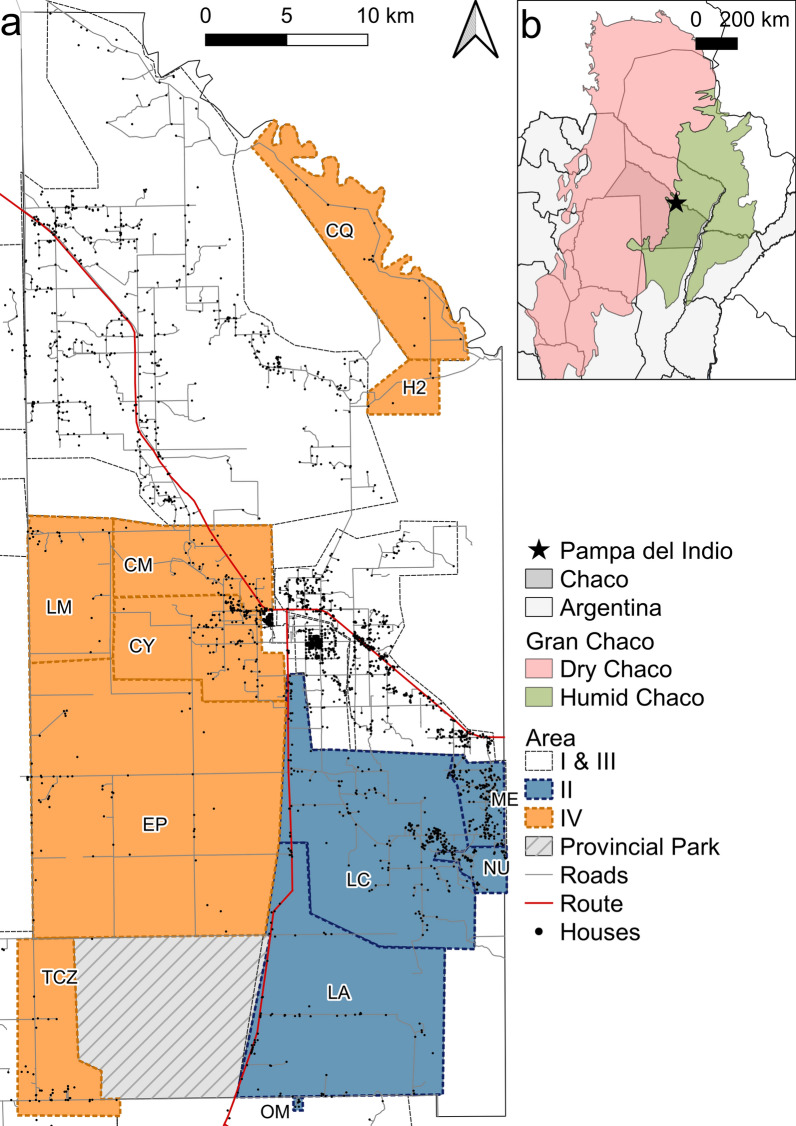
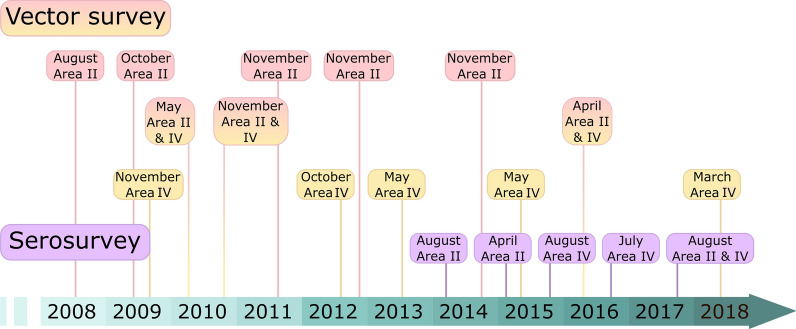
We serodiagnosed and administered a questionnaire to 1337 residents (48.2% of the listed population) in two sections of the municipality (named Areas II and IV) 6-9 years after deploying sustained vector control interventions. Multiple logistic regression models were used to evaluate the relationship between human infection and a priori selected predictors. Two risk indices were constructed based on environmental and serostatus variables, and we used spatial analysis to test whether households harboring T. cruzi-seropositive children were randomly distributed.
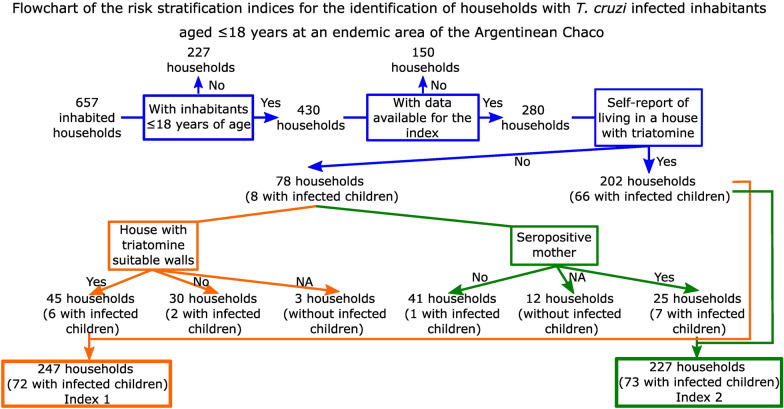
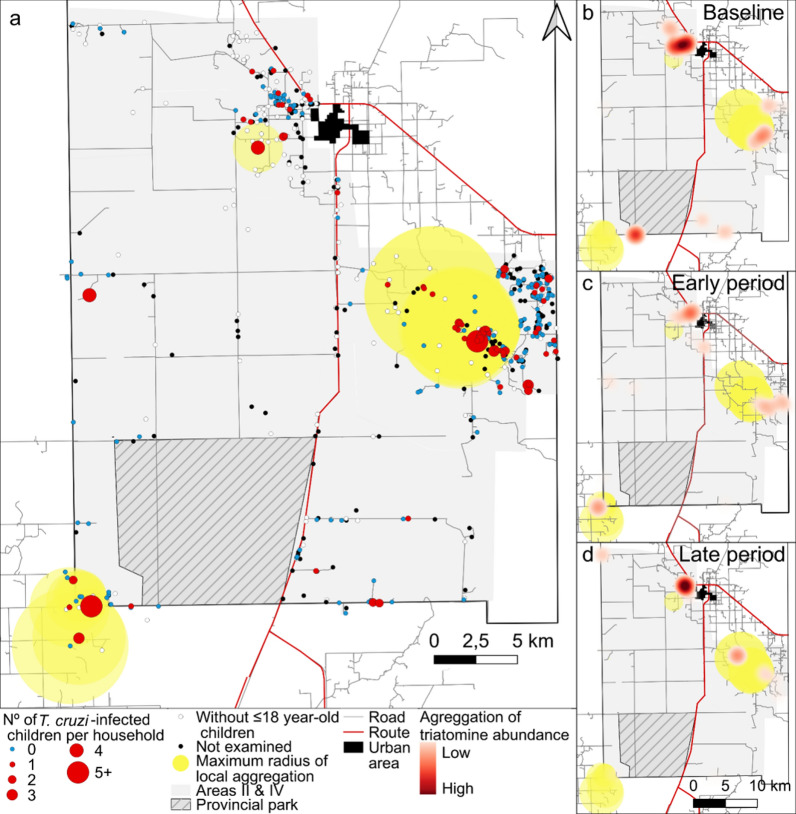
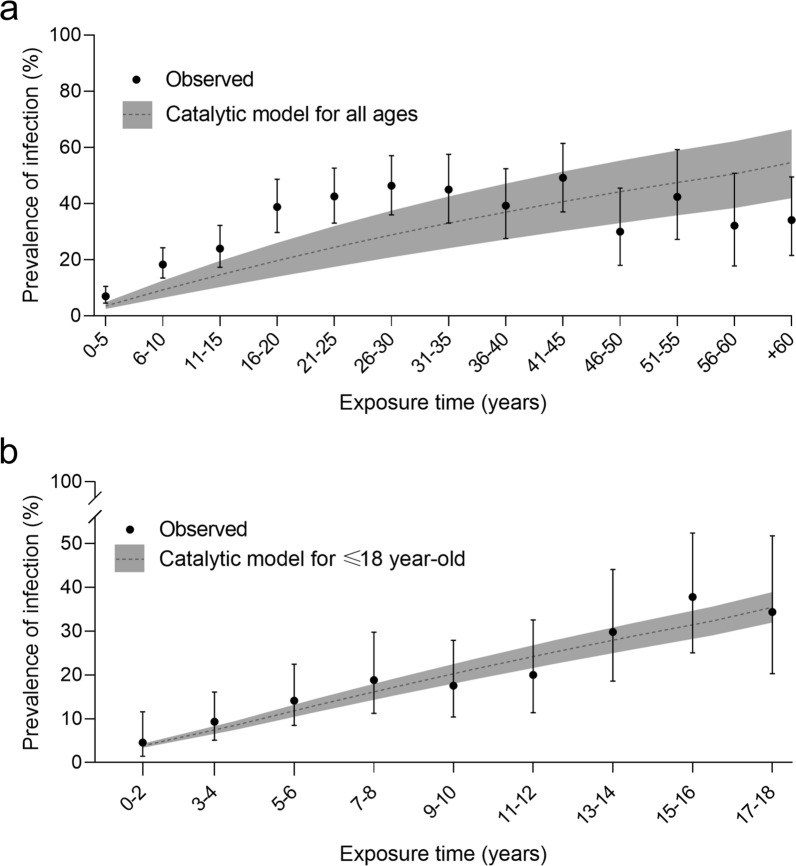
The global seroprevalence of T. cruzi infection was 24.8%. Human infection was positively and significantly associated with exposure time to triatomines, the household number of seropositive co-inhabitants, maternal seropositivity for T. cruzi, recent residence at the current house and the presence of suitable walls for triatomine colonization in the domicile. The pre-intervention mean annual force of infection (FOI) was 1.23 per 100 person-years. Creoles from Area IV exhibited the highest seroprevalence and FOI; Qom people from both areas displayed intermediate ones and creoles from Area II the lowest. Three hotspots of infected children were spatially associated with hotspots of triatomine abundance at baseline and persistent house infestation. No child born after vector control interventions was T. cruzi seropositive except for one putative transplacental case. Two simple risk indices (based on self-reported inhabiting an infested house and suitable walls for triatomines or maternal serostatus) identified 97.3-98.6% of the households with at least one T. cruzi-seropositive child.
We showed strong heterogeneity in the seroprevalence of T. cruzi infection within and between ethnic groups inhabiting neighboring rural areas. Developed indices can be used for household risk stratification and to improve access of rural residents to serodiagnosis and treatment and may be easily transferred to primary healthcare personnel.
恰加斯病是一种被忽视的热带病(NTD)。为了符合 NTD 控制目标,迫切需要具有成本效益的策略来大规模实施诊断和病因治疗。我们在印第安人镇的一个明确界定的农村地区确定了克氏锥虫感染的血清流行率和相关的危险因素,该地区包括克里奥尔人和土著(科姆)家庭,并开发了两个指数来确定携带感染儿童的房屋。
我们在该镇的两个区域(分别命名为区域 II 和 IV)中对 1337 名居民(登记人口的 48.2%)进行了血清学诊断,并进行了问卷调查,这是在持续开展病媒控制干预措施 6-9 年后进行的。我们使用多变量逻辑回归模型评估人类感染与事先选择的预测因子之间的关系。基于环境和血清状态变量构建了两个风险指数,并使用空间分析来检验是否存在携带 T. cruzi 血清阳性儿童的家庭随机分布。
全球 T. cruzi 感染的血清流行率为 24.8%。人类感染与暴露于三锥虫的时间、家庭中血清阳性共同居住者的数量、母亲对 T. cruzi 的血清阳性、最近居住在当前房屋以及住所中适合三锥虫定殖的墙壁呈正相关。干预前的平均年感染率(FOI)为每 100 人每年 1.23 人。来自区域 IV 的克里奥尔人表现出最高的血清流行率和 FOI;来自两个地区的科姆人表现出中等水平,而来自区域 II 的克里奥尔人则表现出最低水平。三个受感染儿童的热点与基线和持续的房屋侵扰时三锥虫丰度的热点在空间上相关。除了一个疑似胎盘传播的病例外,在病媒控制干预后出生的儿童中没有 T. cruzi 血清阳性。两个简单的风险指数(基于自我报告的居住在受感染的房屋中和适合三锥虫的墙壁或母亲的血清状态)确定了 97.3-98.6%的至少有一个 T. cruzi 血清阳性儿童的家庭。
我们发现,居住在邻近农村地区的不同族裔群体内部和之间的 T. cruzi 感染血清流行率存在很大差异。开发的指数可用于家庭风险分层,并改善农村居民接受血清诊断和治疗的机会,并且可能很容易转移到初级保健人员。