Rueckert-Hartman College for Health Professions, Regis University, Denver, CO, USA.
Department of Health Sciences, University of York, York, UK.
Drug Saf. 2018 Dec;41(12):1397-1410. doi: 10.1007/s40264-018-0707-6.
Adverse drug reactions (ADRs) are associated with significant health-related and financial burden, and multiple sources are currently utilized to actively discover them. Social media has been proposed as a potential resource for monitoring ADRs, but drug-specific analytical studies comparing social media with other sources are scarce.
Our objective was to develop methods to compare ADRs mentioned in social media with those in traditional sources: the US FDA Adverse Event Reporting System (FAERS), drug information databases (DIDs), and systematic reviews.
A total of 10,188 tweets mentioning adalimumab collected between June 2014 and August 2016 were included. ADRs in the corpus were extracted semi-automatically and manually mapped to standardized concepts in the Unified Medical Language System. ADRs were grouped into 16 biologic categories for comparisons. Frequencies, relative frequencies, disproportionality analyses, and rank ordering were used as metrics.
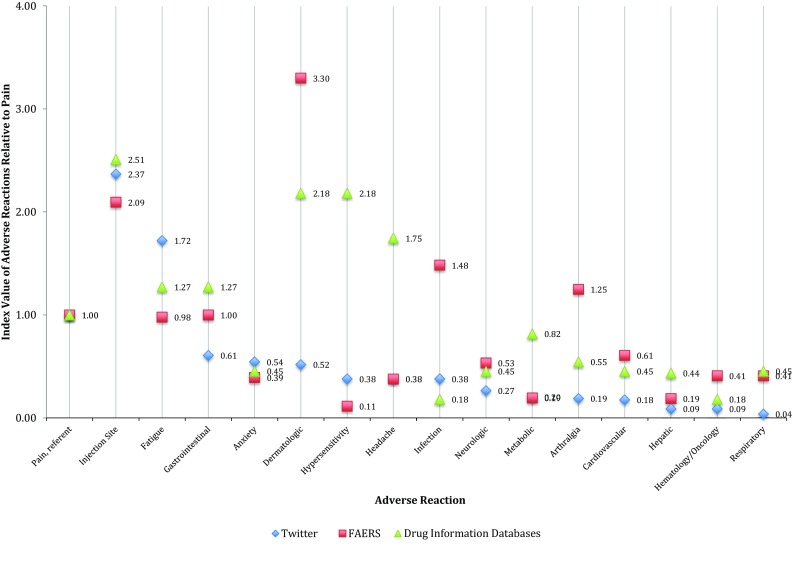
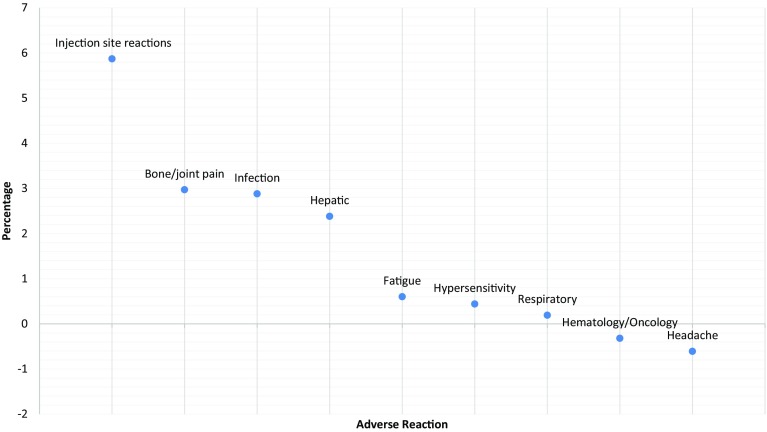
There was moderate agreement between ADRs in social media and traditional sources. "Local and injection site reactions" was the top ADR in Twitter, DIDs, and systematic reviews by frequency, ranked frequency, and index ranking. The next highest ADR in Twitter-fatigue-ranked fifth and seventh in FAERS and DIDs.
Social media posts often express mild and symptomatic ADRs, but rates are measured differently in scientific sources. ADRs in FAERS are reported as absolute numbers, in DIDs as percentages, and in systematic reviews as percentages, risk ratios, or other metrics, which makes comparisons challenging; however, overlap is substantial. Social media analysis facilitates open-ended investigation of patient perspectives and may reveal concepts (e.g. anxiety) not available in traditional sources.
药物不良反应(ADR)与重大的健康相关和经济负担有关,目前有多种来源被用于积极发现它们。社交媒体已被提议作为监测 ADR 的潜在资源,但比较社交媒体与其他来源的药物特异性分析研究很少。
我们的目的是开发方法来比较社交媒体和传统来源(美国 FDA 不良事件报告系统(FAERS)、药物信息数据库(DID)和系统评价)中提到的 ADR。
共纳入了 2014 年 6 月至 2016 年 8 月期间收集的 10188 条提及阿达木单抗的推文。使用半自动和手动方法从语料库中提取 ADR,并将其映射到统一医学语言系统中的标准化概念。将 ADR 分为 16 个生物类别进行比较。使用频率、相对频率、比例失调分析和排序作为指标。
社交媒体和传统来源中的 ADR 之间存在中度一致性。“局部和注射部位反应”是 Twitter、DID 和系统评价中按频率、排名频率和指数排名的最高 ADR。Twitter 中排名第二的最高 ADR 是疲劳,在 FAERS 和 DID 中排名第五和第七。
社交媒体帖子通常表达轻度和症状性 ADR,但在科学来源中以不同的方式衡量。FAERS 中的 ADR 以绝对值报告,DID 中以百分比报告,系统评价中以百分比、风险比或其他指标报告,这使得比较具有挑战性;然而,重叠是实质性的。社交媒体分析促进了对患者观点的开放式调查,并且可能会揭示传统来源中不可用的概念(例如焦虑)。