Human Science Research Council, Pretoria, South Africa.
Development Studies, University of South Africa, Pretoria, South Africa.
BMC Public Health. 2018 Aug 15;18(Suppl 1):956. doi: 10.1186/s12889-018-5832-8.
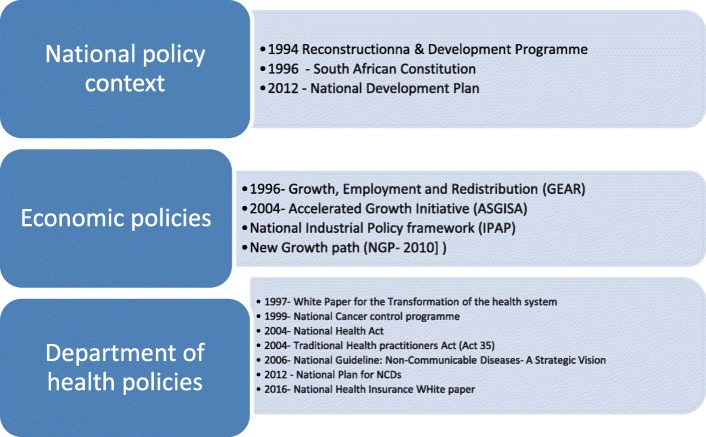
Redressing structural inequality within the South African society in the post-apartheid era became the central focus of the democratic government. Policies on social and economic transformation were guided by the government's blueprint, the Reconstruction and Development Programme. The purpose of this paper is to trace the evolution of non-communicable disease (NCD) policies in South Africa and the extent to which the multi-sectoral approach was utilised, while explicating the underlying rationale for "best buy" interventions adopted to reduce and control NCDs in South Africa. The paper critically engages with the political and ideological factors that influenced design of particular NCD policies.
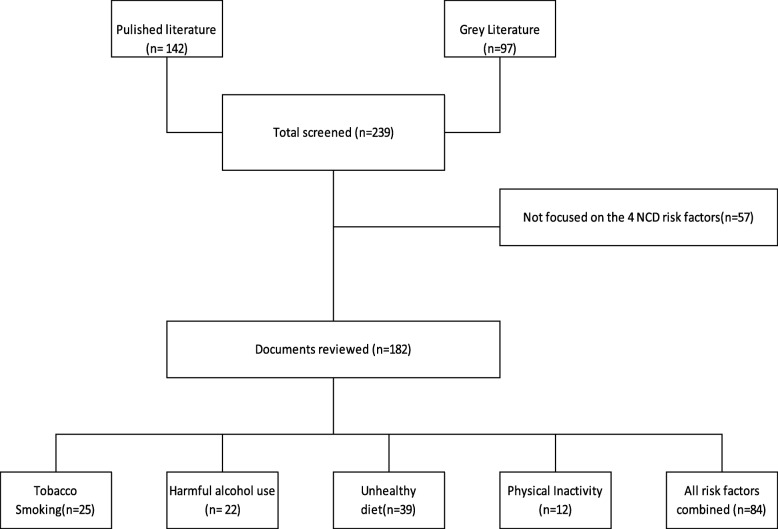
Through a case study design, policies targeting specific NCD risk factors (tobacco smoking, unhealthy diets, harmful use of alcohol and physical inactivity) were assessed. This involved reviewing documents and interviewing 44 key informants (2014-2016) from the health and non-health sectors. Thematic analysis was used to draw out the key themes that emerged from the key informant interviews and the documents reviewed.
South Africa had comprehensive policies covering all the major NCD risk factors starting from the early 1990's, long before the global drive to tackle NCDs. The plethora of NCD policies is attributable to the political climate in post-apartheid South Africa that set a different trajectory for the state that was mandated to tackle entrenched inequalities. However, there has been an increase in prevalence of NCD risk factors within the general population. About 60% of women and 30% of men are overweight or obese. While a multi-sectoral approach is part of public policy discourse, its application in the implementation of NCD policies and programmes is a challenge.
NCD prevalence remains high in South Africa. There is need to adopt the multi-sectoral approach in the implementation of NCD policies and programmes.
在种族隔离时代后,南非社会中的结构性不平等问题成为了民主政府的核心关注点。社会和经济转型政策以政府的蓝图《重建与发展计划》为指导。本文旨在追溯南非非传染性疾病(NCD)政策的演变过程,以及多部门方法的应用程度,同时阐述为减少和控制南非 NCD 而采用的“最佳购买”干预措施的基本原理。本文批判性地探讨了影响特定 NCD 政策设计的政治和意识形态因素。
通过案例研究设计,评估了针对特定 NCD 风险因素(吸烟、不健康饮食、有害使用酒精和缺乏身体活动)的政策。这涉及审查文件和采访卫生和非卫生部门的 44 名关键知情者(2014-2016 年)。主题分析用于从关键知情者访谈和审查的文件中提取出现的关键主题。
南非从 20 世纪 90 年代初就开始制定涵盖所有主要 NCD 风险因素的综合政策,远早于全球应对 NCD 的行动。大量的 NCD 政策归因于后种族隔离时代南非的政治氛围,为解决根深蒂固的不平等问题设定了不同的轨迹。然而,普通人群中 NCD 风险因素的流行率有所增加。约 60%的女性和 30%的男性超重或肥胖。虽然多部门方法是公共政策讨论的一部分,但在实施 NCD 政策和计划方面应用该方法具有挑战性。
南非的 NCD 患病率仍然很高。需要在实施 NCD 政策和计划方面采用多部门方法。