Chowdhury Fahmida, Sturm-Ramirez Katharine, Mamun Abdullah Al, Iuliano A Danielle, Chisti Mohammod Jobayer, Ahmed Makhdum, Bhuiyan Mejbah Uddin, Hossain Kamal, Haider Mohammad Sabbir, Aziz Shaikh Abdul, Rahman Mahmudur, Azziz-Baumgartner Eduardo
International Centre for Diarrhoeal Disease Research, (icddr,b), Bangladesh, Dhaka, Bangladesh.
Centers for Disease Control and Prevention (CDC), Atlanta, USA.
BMC Health Serv Res. 2018 Aug 31;18(1):676. doi: 10.1186/s12913-018-3486-y.
Inappropriate dispensing of antibiotics for acute respiratory illness (ARI) is common among drug sellers in Bangladesh. In this study, we evaluated the impact of an educational intervention to promote guidelines for better ARI management among drug sellers.
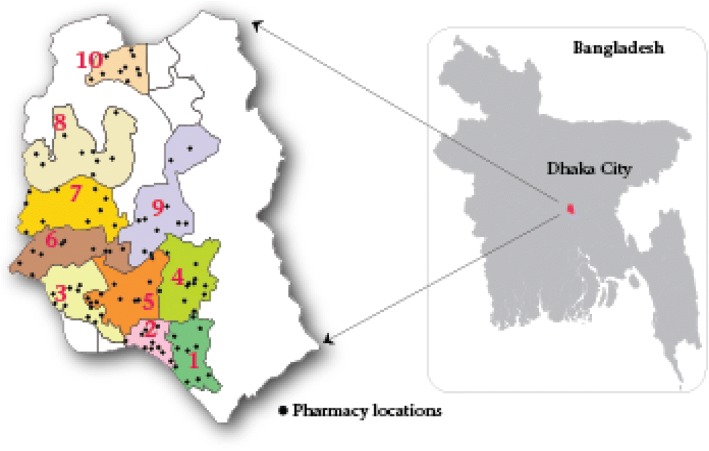
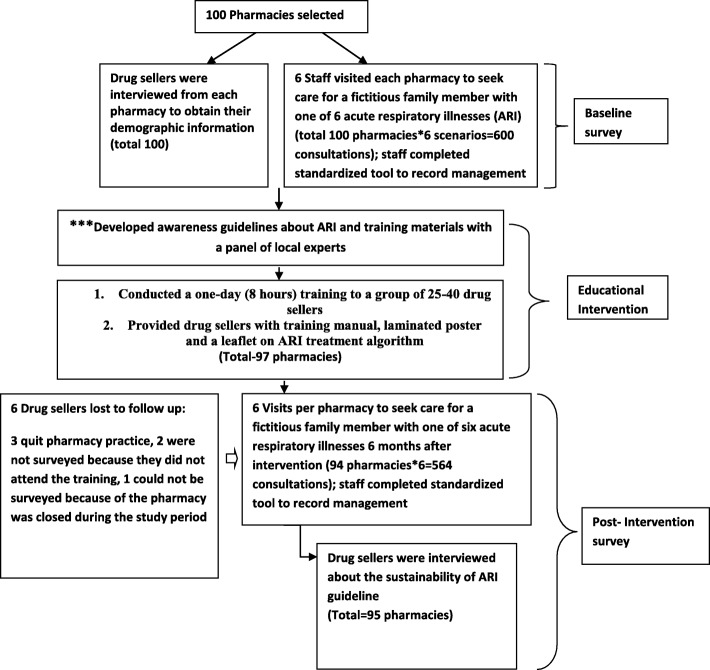
From June 2012 to December 2013, we conducted baseline and post-intervention surveys on dispensing practices in 100 pharmacies within Dhaka city. In these surveys, drug sellers participated in 6 standardized role-playing scenarios led by study staffs acting as caregivers of ARI patients and drug sellers were blinded to these surveys. After the baseline survey, we developed ARI guidelines and facilitated a one-day educational intervention about ARI management for drug sellers. Our guidelines only recommended antibiotics for children with complicated ARI. Finally, we conducted the six month post-intervention survey using the same scenarios to record changes in drug dispensing practices.
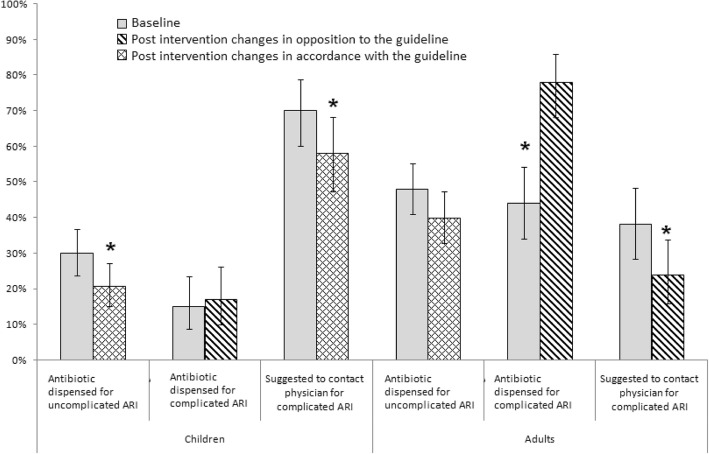
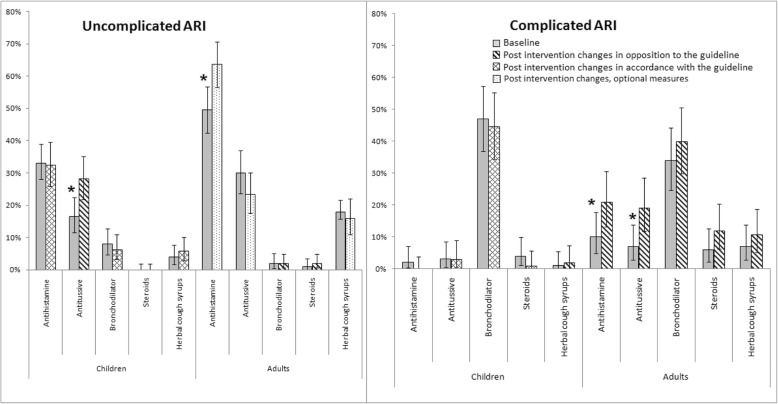
Only 2/3 of participating pharmacies were licensed and few (11%) of drug sellers had pharmacy training. All the drug sellers were male, had a median age of 34 years (IQR 28-41). For children, dispensing of antibiotics for uncomplicated ARI decreased (30% baseline vs. 21% post-intervention; p = 0.04), but drug sellers were equally likely to dispense antibiotics for complicated ARI (15% baseline vs. 17% post-intervention; p = 0.6) and referrals to physicians for complicated ARIs decreased (70% baseline vs. 58% post-intervention; p = 0.03). For adults, antibiotic dispensing remained similar for uncomplicated ARI (48% baseline vs. 40% post-intervention; p = 0.1) but increased among those with complicated ARI (44% baseline vs. 78% post-intervention; p < 0.001). Although our evidence-based guidelines recommended against prescribing antihistamines for children, drug sellers continued to sell similar amounts for uncomplicated ARI (33% baseline vs. 32% post-intervention; p = 0.9).
Despite the intervention, drug sellers continued to frequently dispense antibiotics for ARI, except for children with uncomplicated ARI. Pairing educational interventions among drug sellers with raising awareness about proper antibiotic use among general population should be further explored. In addition, annual licensing and an reaccreditation system with comprehensive monitoring should be enforced, using penalties for non-compliant pharmacies as possible incentives for appropriate dispensing practices.
在孟加拉国,药品销售商对急性呼吸道疾病(ARI)不恰当配用抗生素的情况很常见。在本研究中,我们评估了一项教育干预措施对促进药品销售商更好地管理ARI指南的影响。
2012年6月至2013年12月,我们对达卡市内100家药店的配药行为进行了基线调查和干预后调查。在这些调查中,药品销售商参与了由研究人员扮演ARI患者护理人员所主导的6个标准化角色扮演场景,且药品销售商对这些调查不知情。基线调查后,我们制定了ARI指南,并为药品销售商开展了为期一天的ARI管理教育干预。我们的指南仅推荐为患有复杂ARI的儿童使用抗生素。最后,我们使用相同场景进行了干预后六个月的调查,以记录药品配药行为的变化。
只有三分之二的参与药店持有执照,很少有药品销售商(11%)接受过药学培训。所有药品销售商均为男性,年龄中位数为34岁(四分位间距28 - 41岁)。对于儿童,单纯性ARI的抗生素配用量有所减少(基线时为30%,干预后为21%;p = 0.04),但药品销售商为患有复杂ARI的儿童配用抗生素的可能性相同(基线时为15%,干预后为17%;p = 0.6),并且将患有复杂ARI的儿童转诊给医生的比例有所下降(基线时为70%,干预后为58%;p = 0.03)。对于成年人,单纯性ARI的抗生素配用量保持相似(基线时为48%,干预后为40%;p = 0.1),但患有复杂ARI的成年人中抗生素配用量增加(基线时为44%,干预后为78%;p < 0.001)。尽管我们基于证据的指南不建议为儿童开具抗组胺药,但药品销售商在单纯性ARI中继续销售相近数量的抗组胺药(基线时为33%,干预后为32%;p = 0.9)。
尽管进行了干预,但药品销售商仍继续频繁为ARI配用抗生素,患有单纯性ARI的儿童除外。应进一步探索将针对药品销售商的教育干预与提高普通人群对抗生素合理使用的认识相结合。此外,应实施年度许可和具有全面监测的再认证系统,对不符合规定的药店进行处罚,以此作为促进恰当配药行为的可能激励措施。