Division of Population Health Sciences, Medical Research Institute, University of Dundee, The Mackenzie Building, Kirsty Semple Way, Dundee, DD2 4BF, UK.
Nottingham University Hospitals Trust, Nottingham, UK.
Diabetologia. 2018 Dec;61(12):2590-2597. doi: 10.1007/s00125-018-4723-y. Epub 2018 Aug 31.
AIMS/HYPOTHESIS: Our aim was to investigate amputation-free survival in people at high risk for foot ulceration in diabetes ('high-risk foot'), and to compare different subcategories of high-risk foot.
Overall, 17,353 people with diabetes and high-risk foot from January 2008 to December 2011 were identified from the Scotland-wide diabetes register (Scottish Care Information-Diabetes: N = 247,278). Participants were followed-up for up to 2 years from baseline and were categorised into three groups: (1) those with no previous ulcer, (2) those with an active ulcer or (3) those with a healed previous ulcer. Participants with prior minor or major amputation were excluded. Accelerated failure time models were used to compare amputation-free survival up to 2 years between the three exposure groups.
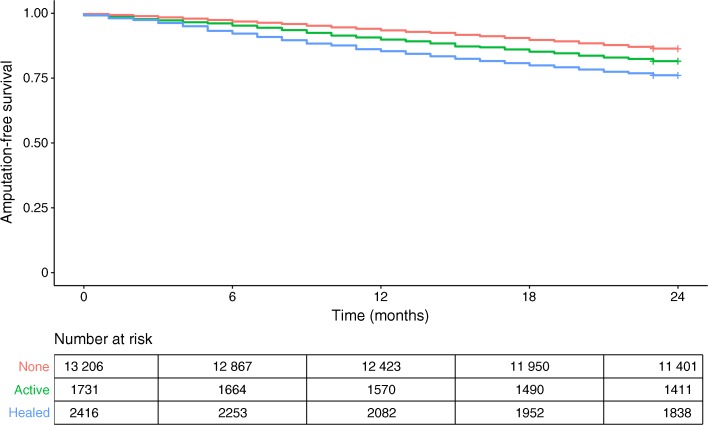
The 2 year amputation-free survival rate in all people with diabetes with high-risk foot was 84.5%. In this study group, 270 people (10.0%) had an amputation and 2424 (90.0%) died during the 2 year follow-up period. People who had active and healed previous ulcers at baseline had significantly lower 2 year amputation-free survival compared with those who had no previous ulcer (both p < 0.0001). The percentage of people who died within 2 years for those with healed ulcer, active ulcer or no baseline ulcer was 22.8%, 16% and 12.1%, respectively.
CONCLUSIONS/INTERPRETATION: In people judged to be at high risk of foot ulceration, the risk of death was up to nine times the risk of amputation. Death rates were higher for people with diabetes who had healed ulcers than for those with active ulcers. However, people with active ulcers had the highest risk of amputation.
目的/假设:我们的目的是研究糖尿病高危足溃疡人群(“高危足”)的无截肢生存率,并比较高危足的不同亚类。
总体而言,2008 年 1 月至 2011 年 12 月期间,从苏格兰糖尿病注册处(苏格兰护理信息-糖尿病:N=247278)中确定了 17353 名患有糖尿病和高危足的患者。参与者从基线开始随访长达 2 年,并分为三组:(1)无既往溃疡者,(2)有活动性溃疡者,(3)有既往愈合溃疡者。有既往小截肢或大截肢的患者被排除在外。使用加速失效时间模型比较三组暴露者在 2 年内的无截肢生存率。
所有患有糖尿病高危足的患者在 2 年内的无截肢生存率为 84.5%。在该研究组中,270 人(10.0%)进行了截肢,2424 人(90.0%)在 2 年随访期间死亡。与无既往溃疡者相比,基线时患有活动性和愈合性既往溃疡者的 2 年无截肢生存率显著降低(均 p<0.0001)。在 2 年内死亡的患者中,愈合性溃疡、活动性溃疡和无基线溃疡的比例分别为 22.8%、16%和 12.1%。
结论/解释:在被判断为有高危足溃疡风险的人群中,死亡风险是截肢风险的九倍。对于患有愈合性溃疡的糖尿病患者,死亡率高于活动性溃疡患者。然而,活动性溃疡患者的截肢风险最高。