Xiao Bingkun, Wang Weilan, Zhang Dezhi
Department of Pharmaceutical Sciences, Beijing Institute of Radiation Medicine, Beijing, China.
Department of Pharmacy, Chinese PLA General Hospital, Beijing, China,
Onco Targets Ther. 2018 Aug 21;11:5059-5074. doi: 10.2147/OTT.S166151. eCollection 2018.
Bevacizumab and ramucirumab are antiangiogenic monoclonal antibodies, which target vascular endothelial growth factor-A and vascular endothelial growth factor receptor-2, respectively, used in various cancers. Bleeding events have been described with these two agents. We conducted an up-to-date meta-analysis to determine the relative risk (RR) associated with the use of antiangiogenic monoclonal antibodies, bevacizumab and ramucirumab.
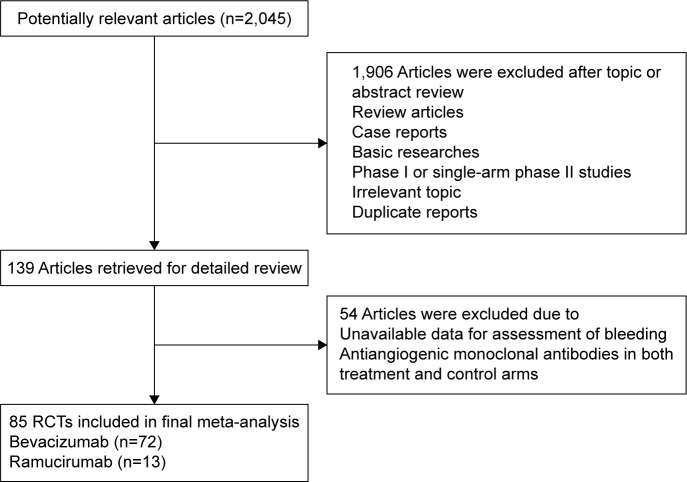
This meta-analysis of randomized controlled trials was performed after searching PubMed, American Society for Clinical Oncology Abstracts, European Society for Medical Oncology Abstracts, and the proceedings of major conferences for relevant clinical trials. RR and 95% CIs were calculated by random-effects or fixed-effects models for all-grade and high-grade bleeding events related to the angiogenesis inhibitors.
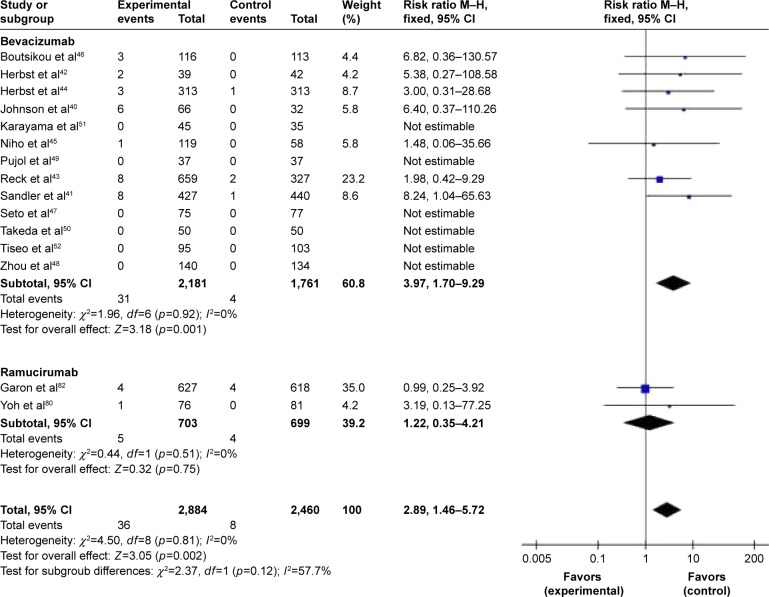
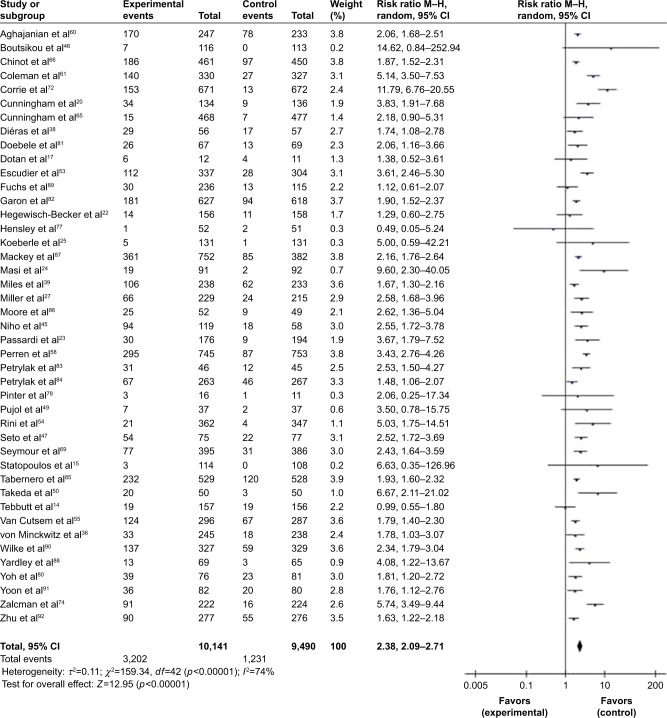
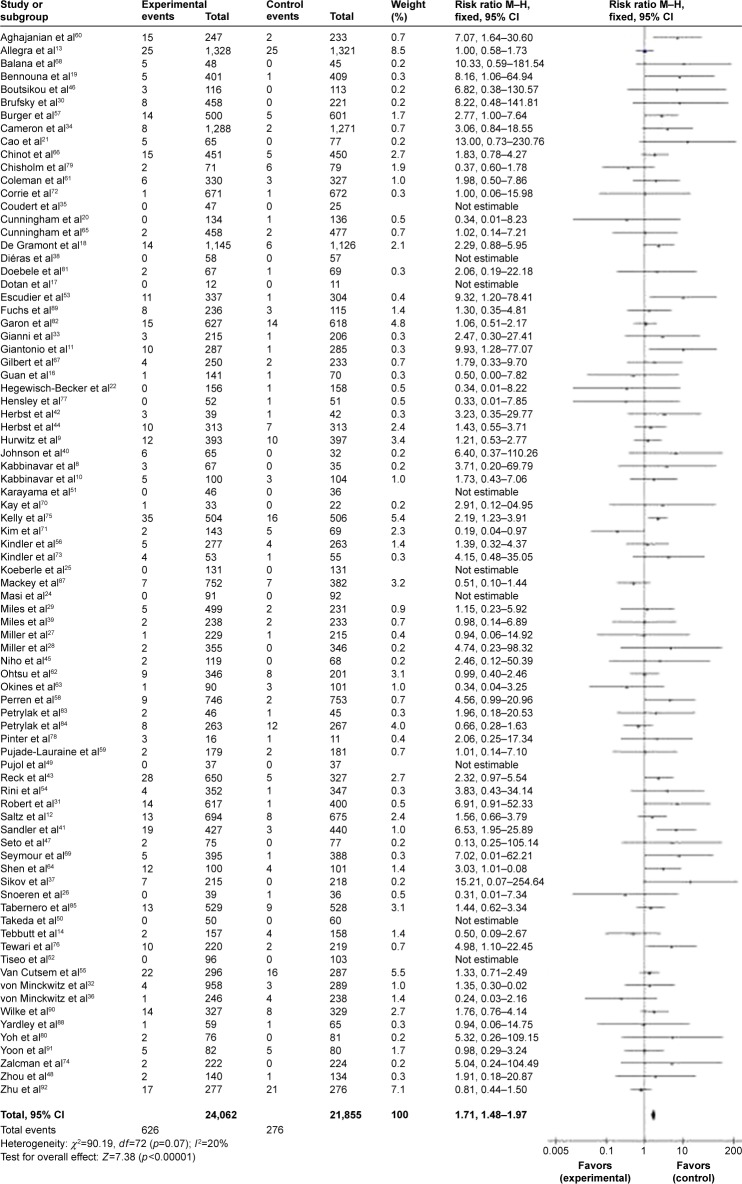
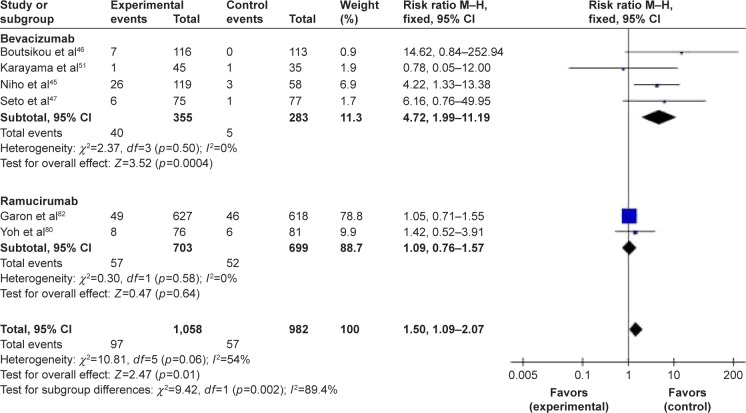
Eighty-five randomized controlled trials were selected for the meta-analysis, covering 46,630 patients. The results showed that antiangiogenic monoclonal antibodies significantly increased the risk of all-grade (RR: 2.38, 95% CI: 2.09-2.71, <0.00001) and high-grade (RR: 1.71, 95% CI: 1.48-1.97, <0.00001) bleeding compared with control arms. In the subgroup analysis, bevacizumab significantly increased the risk of all-grade (RR: 2.73, 95% CI: 2.24-3.33, <0.00001) and high-grade bleeding (RR: 1.98, 95% CI: 1.68-2.34, <0.00001), but ramucirumab only increased the risk of all-grade bleeding (RR: 1.94, 95% CI: 1.76-2.13, <0.00001) and no difference was observed for the risk of high-grade bleeding (RR: 1.04, 95% CI: 0.78-1.39, =0.79) compared with the control group. For lung cancer patients, bevacizumab significantly increased the risk of all-grade (RR: 4.72, 95% CI: 1.99-11.19, =0.0004) and high-grade pulmonary hemorrhage (RR: 3.97, 95% CI: 1.70-9.29, =0.001), but no significant differences in the risk of all-grade (RR: 1.09, 95% CI: 0.76-1.57, =0.64) and high-grade (RR: 1.22, 95% CI: 0.35-4.21, =0.75) pulmonary hemorrhage were observed for ramucirumab. The increased risk of all-grade and high-grade bleeding was also observed in colorectal cancer or non-colorectal tumors and low-dose or high-dose angiogenesis inhibitors.
Antiangiogenic monoclonal antibodies are associated with a significant increase in the risk of all-grade and high-grade bleeding. Ramucirumab may be different from bevacizumab in terms of the risk of high-grade bleeding and the risk of all-grade and high-grade pulmonary hemorrhage in lung cancer patients.
贝伐单抗和雷莫西尤单抗是抗血管生成单克隆抗体,分别靶向血管内皮生长因子-A和血管内皮生长因子受体-2,用于多种癌症的治疗。已有关于这两种药物引起出血事件的报道。我们进行了一项最新的荟萃分析,以确定使用抗血管生成单克隆抗体贝伐单抗和雷莫西尤单抗相关的相对风险(RR)。
在检索了PubMed、美国临床肿瘤学会摘要、欧洲医学肿瘤学会摘要以及主要会议的会议记录以查找相关临床试验后,对随机对照试验进行了这项荟萃分析。采用随机效应或固定效应模型计算与血管生成抑制剂相关的所有级别和高级别出血事件的RR及95%置信区间(CI)。
选择了85项随机对照试验进行荟萃分析,涵盖46,630例患者。结果显示,与对照组相比,抗血管生成单克隆抗体显著增加了所有级别出血(RR:2.38,95%CI:2.09 - 2.71,<0.00001)和高级别出血(RR:1.71,95%CI:1.48 - 1.97,<0.00001)的风险。在亚组分析中,贝伐单抗显著增加了所有级别出血(RR:2.73,9%CI:2.24 - 3.33,<0.00001)和高级别出血(RR:1.98,95%CI:1.68 - 2.34,<0.00001)的风险,但雷莫西尤单抗仅增加了所有级别出血的风险(RR:1.94,95%CI:1.76 - 2.13,<0.00001),与对照组相比,高级别出血风险无差异(RR:1.04,95%CI:0.78 - 1.39,=0.79)。对于肺癌患者,贝伐单抗显著增加了所有级别(RR:4.72,95%CI:1.99 - 11.19,=0.0004)和高级别肺出血(RR:3.97,95%CI:1.70 - 9.29,=0.001)风险,但雷莫西尤单抗在所有级别(RR:1.09,95%CI:0.76 - 1.57,=0.64)和高级别(RR:1.22,95%CI:0.35 - 4.21,=0.75)肺出血风险方面未观察到显著差异。在结直肠癌或非结直肠癌肿瘤以及低剂量或高剂量血管生成抑制剂中,也观察到了所有级别和高级别出血风险增加。
抗血管生成单克隆抗体与所有级别和高级别出血风险的显著增加相关。雷莫西尤单抗在高级别出血风险以及肺癌患者所有级别和高级别肺出血风险方面可能与贝伐单抗不同。