Ritschl Lucas M, Heinrich Veronika, Grill Florian D, Roth Maximilian, Hedderich Dennis M, Rau Andrea, Wolff Klaus-Dietrich, Bauer Franz X, Loeffelbein Denys J
Department of Oral and Maxillofacial Surgery, Klinikum rechts der Isar, Technische Universität München, Germany.
Institute of Medical and Polymer Engineering, Technische Universität München, Germany.
Plast Reconstr Surg Glob Open. 2018 Jul 17;6(7):e1832. doi: 10.1097/GOX.0000000000001832. eCollection 2018 Jul.
The purpose of this study was to evaluate the stress distribution patterns within the viscero- and neurocranium of neonates during nasoalveolar molding.
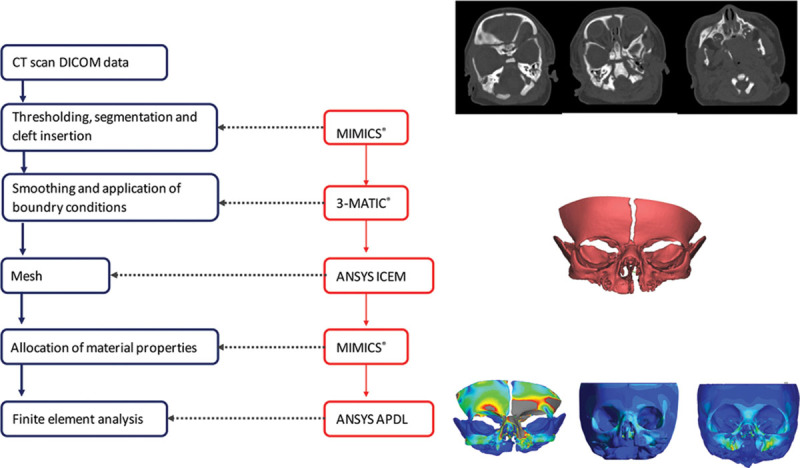
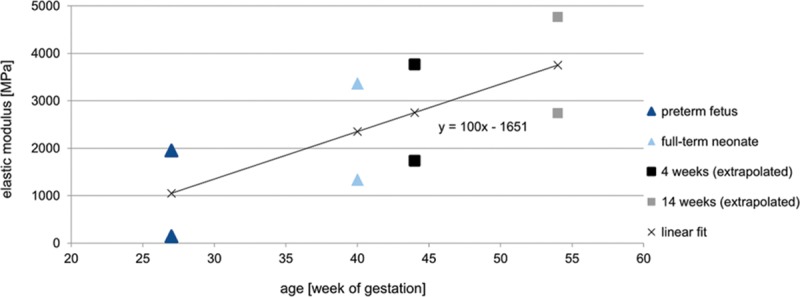
Finite element models of 3 different healthy neonates at different times of life (date of birth, 4 weeks, and 3.5 months) were generated on the basis of computed tomography scans. A validated workflow, including segmentation, meshing, setting of boundary conditions, and implementation of a bone density-dependent material model, was carried out for each model. A small and a large unilateral alveolar and hard palatal cleft were virtually cut in each model. The stress distribution pattern in each model was then analyzed by using Ansys APDL.
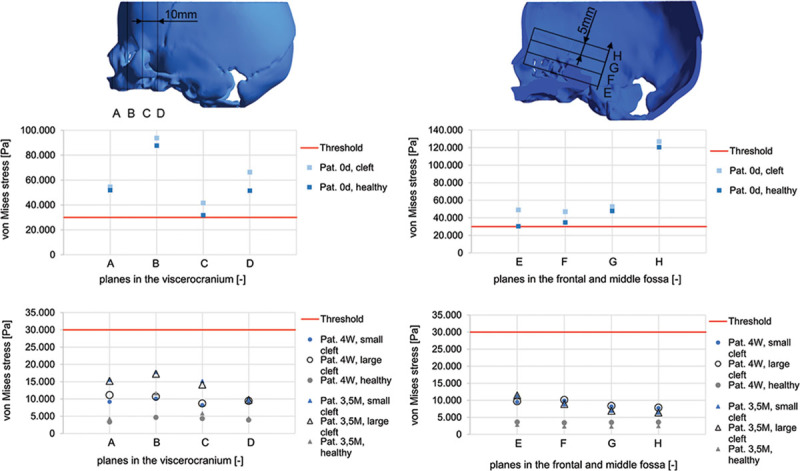
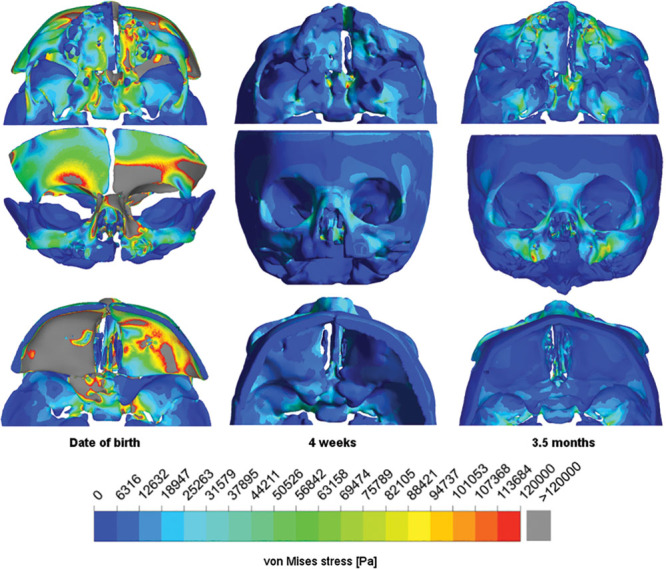
Convergence analysis validated the results. The virtual experiments at the date of birth showed a stress pattern above a previously defined threshold value of 30,000 Pa in the ipsilateral naso-orbital-complex, frontal sinus, and the anterior fossa of the base of the skull, with von Mises values > 35,000 Pa. Stress patterns at the age of 4 weeks and 3.5 months showed reduced von Mises values at < 15,000 Pa.
Nasoalveolar molding therapy is a safe presurgical treatment modality without significant influence on the viscero- and neurocranium of neonates. Treatment, considering the stress distribution at the naso-orbital-complex and anterior fossa of the base of the skull, should begin in the second week of life, and treatment initiation of preterm infants should be adapted respectively.
本研究的目的是评估新生儿鼻牙槽塑形过程中面颅骨和脑颅骨内的应力分布模式。
基于计算机断层扫描生成3名不同生命阶段(出生时、4周和3.5个月)健康新生儿的有限元模型。对每个模型执行经过验证的工作流程,包括分割、网格化、边界条件设置以及实施与骨密度相关的材料模型。在每个模型中虚拟切割一个小的和一个大的单侧牙槽和硬腭裂。然后使用Ansys APDL分析每个模型中的应力分布模式。
收敛分析验证了结果。出生时的虚拟实验显示,同侧鼻眶复合体、额窦和颅底前窝的应力模式高于先前定义的30000 Pa阈值,冯·米塞斯值>35000 Pa。4周和3.5个月龄时的应力模式显示冯·米塞斯值降低至<15000 Pa。
鼻牙槽塑形治疗是一种安全的术前治疗方式,对新生儿的面颅骨和脑颅骨没有显著影响。考虑到鼻眶复合体和颅底前窝的应力分布,治疗应在出生后第二周开始,早产儿的治疗起始时间应相应调整。