Department of Medical Sciences, Respiratory, Allergy and Sleep Research, Uppsala University, 751 85, Uppsala, Sweden.
Department of Public Health and Caring Sciences, Family Medicine and Preventive Medicine, Uppsala University, Uppsala, Sweden.
Respir Res. 2018 Sep 3;19(1):168. doi: 10.1186/s12931-018-0855-3.
Patients with severe uncontrolled asthma may receive oral corticosteroid (OCS) treatment regularly. The present study investigated the health care resource utilization and cost in regularly OCS treated Swedish asthma patients.
Primary care medical records data were linked to data from Swedish national health registries. Patients ≥18 years with a drug claim for obstructive pulmonary diseases during 2007-2009 (index date) and a prior asthma diagnosis, were classified by their OCS claims during the 12-months' post index period: regular OCS equals ≥5 mg per day; periodic OCS less than 5 mg per day; or non-OCS users. Cost of asthma- and OCS-morbidity-related health care resource utilization were calculated.
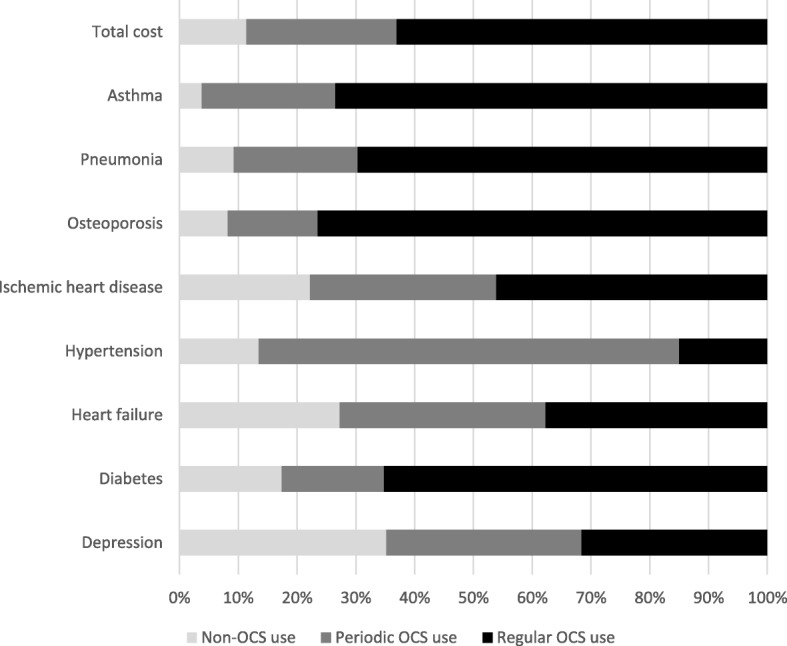
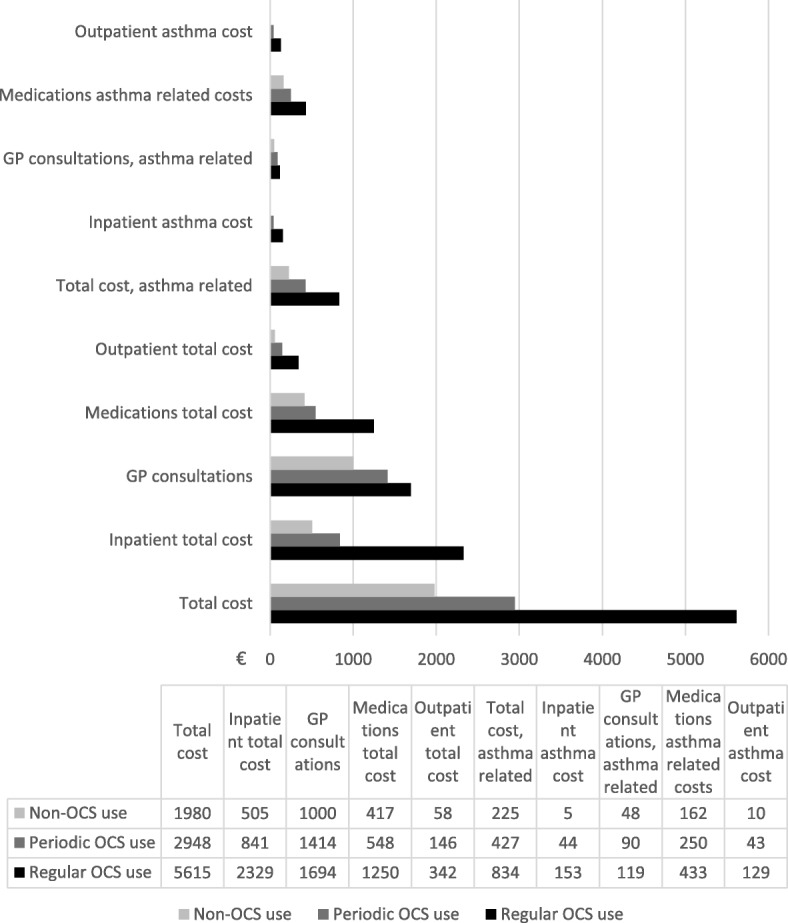
A total of 15,437 asthma patients (mean age 47.8, female 62.6%), whereof 223 (1.44%) were regular OCS users, 3054 (19.7%) were periodic, and 12,160 (78.7%) were non-OCS users. Regular OCS users were older and more often females, had lower lung function, greater eosinophil count and more co-morbidities at baseline compared with the other groups. Age-adjusted annual total health care cost was three-times greater in the regular OCS group (€5615) compared with the non-OCS users (€1980) and twice as high as in the periodic OCS group (€2948). The major cost driver in the non-OCS and periodic OCS groups were primary care consultations, whereas inpatient costs were the major cost driver in the regular OCS group. The asthma related costs represented 10-12% of the total cost in all three groups.
In this real-life asthma study in Sweden, the total yearly cost of health care resource utilization for a regular OCS user was three times greater than for a patient with no OCS use, indicating substantial economic and health care burden for asthma patients on regular oral steroid treatment.
重度未控制的哮喘患者可能需要定期接受口服皮质类固醇(OCS)治疗。本研究旨在调查瑞典经常接受 OCS 治疗的哮喘患者的医疗资源利用情况和成本。
将初级保健医疗记录数据与瑞典国家健康登记处的数据相联系。选择在 2007-2009 年(索引日期)期间有药物治疗阻塞性肺病记录,且在索引日期前有哮喘诊断的年龄≥18 岁患者,根据索引日期后 12 个月内的 OCS 用药情况进行分类:每日 OCS 剂量≥5mg 为常规 OCS 组;每日 OCS 剂量<5mg 为周期性 OCS 组;未使用 OCS 者为非 OCS 组。计算哮喘和 OCS 相关疾病的医疗资源利用成本。
共纳入 15437 例哮喘患者(平均年龄 47.8 岁,女性占 62.6%),其中 223 例(1.44%)为常规 OCS 使用者,3054 例(19.7%)为周期性 OCS 使用者,12160 例(78.7%)为非 OCS 使用者。常规 OCS 使用者年龄较大,女性更多,在基线时的肺功能更低,嗜酸性粒细胞计数更高,合并症更多。校正年龄后,常规 OCS 组的年总医疗费用(€5615)是未使用 OCS 组(€1980)的三倍,是周期性 OCS 组(€2948)的两倍。在非 OCS 组和周期性 OCS 组中,主要成本驱动因素是初级保健咨询,而在常规 OCS 组中,主要成本驱动因素是住院费用。在所有三组中,哮喘相关费用占总费用的 10-12%。
在这项瑞典真实世界的哮喘研究中,常规 OCS 使用者的年度医疗资源利用总成本是未使用 OCS 患者的三倍,这表明定期接受口服类固醇治疗的哮喘患者的经济和医疗负担巨大。