de Groot Jantina C, Storm Huib, Amelink Marijke, de Nijs Selma B, Eichhorn Edwin, Reitsma Bennie H, Bel Elisabeth H D, Ten Brinke Anneke
Dept of Respiratory Medicine, Medical Centre Leeuwarden, Leeuwarden, The Netherlands.
Dept of Clinical Chemistry, Medical Centre Leeuwarden, Leeuwarden, The Netherlands.
ERJ Open Res. 2016 May 26;2(2). doi: 10.1183/23120541.00100-2015. eCollection 2016 Apr.
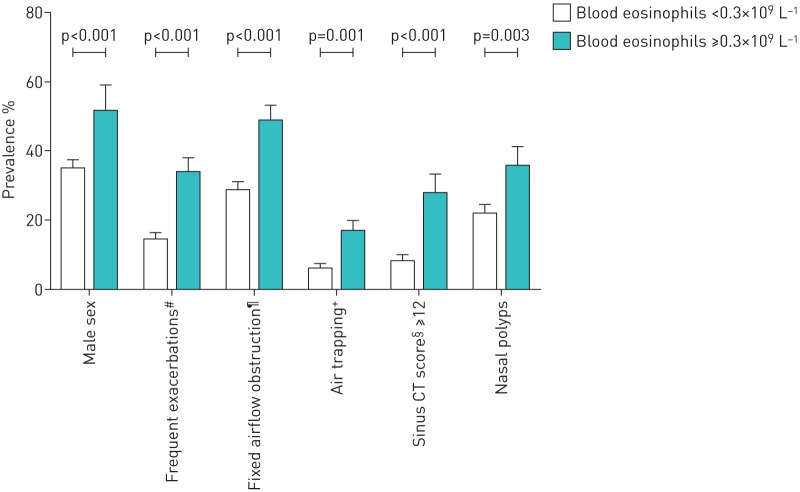
Adult-onset eosinophilic asthma is increasingly recognised as a severe and difficult-to-treat subtype of asthma. In clinical practice, early recognition of patients with this asthma subtype is important because it may have treatment implications. Therefore, physicians need to know the distinct characteristics of this asthma phenotype. The objective of the present study was to determine the characteristic profile of patients with adult-onset eosinophilic asthma. 130 patients with adult-onset (>18 years of age) asthma and high blood eosinophil counts (≥0.3×10 L) were compared with 361 adult-onset asthma patients with low (<0.3×10 L) blood eosinophils. Measurements included a series of clinical, functional and imaging parameters. Patients with high blood eosinophils were more often male, had less well controlled asthma and higher exacerbation rates, despite the use of higher doses of inhaled corticosteroids. They had higher levels of total IgE without more sensitisation to common inhaled allergens. In addition, these patients had worse lung function, and more often showed fixed airflow limitation, air trapping, nasal polyposis and abnormalities on sinus computed tomography scanning. Chronic rhinosinusitis, air trapping and male sex were three independent factors associated with blood eosinophilia (adjusted OR 3.8 (95% CI 1.7-8.1), 3.0 (95% CI 1.1-8.1) and 2.4 (95% CI 1.3-4.4), respectively). Patients with adult-onset asthma with elevated blood eosinophils exhibit a distinct profile, which can readily be recognised in clinical practice.
成人发病的嗜酸性粒细胞性哮喘日益被认为是一种严重且难以治疗的哮喘亚型。在临床实践中,早期识别这种哮喘亚型的患者很重要,因为这可能对治疗有影响。因此,医生需要了解这种哮喘表型的独特特征。本研究的目的是确定成人发病的嗜酸性粒细胞性哮喘患者的特征概况。将130例成人发病(年龄>18岁)且血液嗜酸性粒细胞计数高(≥0.3×10⁹/L)的哮喘患者与361例血液嗜酸性粒细胞计数低(<0.3×10⁹/L)的成人发病哮喘患者进行比较。测量包括一系列临床、功能和影像学参数。血液嗜酸性粒细胞计数高的患者男性居多,哮喘控制较差且加重率较高,尽管使用了更高剂量的吸入性糖皮质激素。他们的总IgE水平较高,但对常见吸入性过敏原的致敏情况并未增加。此外,这些患者的肺功能较差,更常表现为固定性气流受限、气体潴留、鼻息肉以及鼻窦计算机断层扫描异常。慢性鼻窦炎、气体潴留和男性是与血液嗜酸性粒细胞增多相关的三个独立因素(校正比值比分别为3.8(95%可信区间1.7 - 8.1)、3.0(95%可信区间1.1 - 8.1)和2.4(95%可信区间1.3 - 4.4))。血液嗜酸性粒细胞增多的成人发病哮喘患者表现出独特的特征概况,在临床实践中很容易识别。