Ssematimba Amos, Malladi Sasidhar, Bonney Peter J, Flores-Figueroa Cristian, Muñoz-Aguayo Jeannette, Halvorson David A, Cardona Carol J
Secure Food Systems Team, University of Minnesota, Veterinary and Biomedical Sciences, 301C Veterinary Science Building, 1971 Commonwealth Avenue, Saint Paul, MN, 55108, USA.
Department of Mathematics, Faculty of Science, Gulu University, P.O. Box 166, Gulu, Uganda.
BMC Vet Res. 2018 Sep 3;14(1):265. doi: 10.1186/s12917-018-1602-1.
Timely diagnosis of influenza A virus infections is critical for outbreak control. Due to their rapidity and other logistical advantages, lateral flow immunoassays can support influenza A virus surveillance programs and here, their field performance was proactively assessed. The performance of real-time polymerase chain reaction and two lateral flow immunoassay kits (FluDETECT and VetScan) in detecting low pathogenicity influenza A virus in oropharyngeal swab samples from experimentally inoculated broiler chickens was evaluated and at a flock-level, different testing scenarios were analyzed.
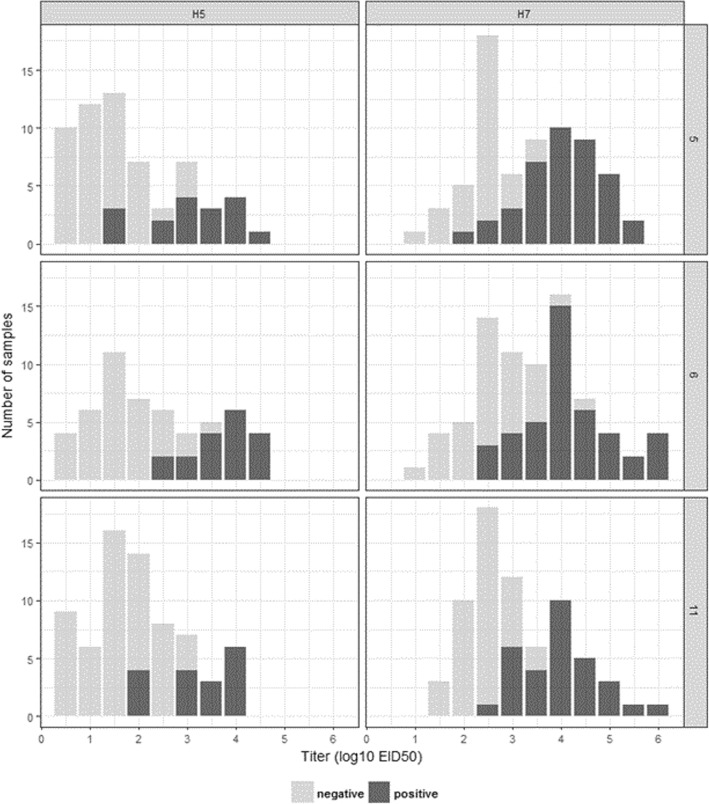
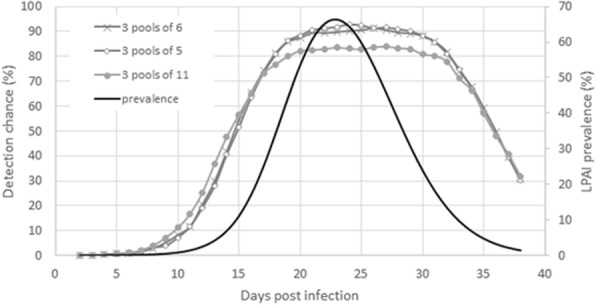
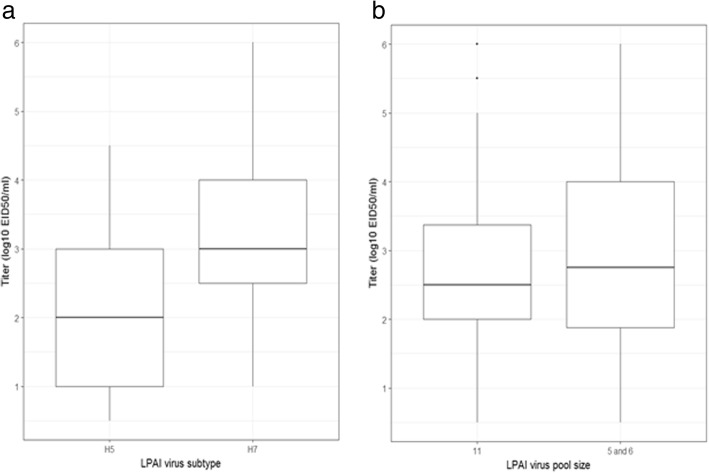
For real-time polymerase chain reaction positive individual-swabs, FluDETECT respectively detected 37% and 58% for the H5 and H7 LPAIV compared to 28% and 42% for VetScan. The mean virus titer in H7 samples was higher than for H5 samples. For real-time polymerase chain reaction positive pooled swabs (containing one positive), detections by FluDETECT were significantly higher in the combined 5- and 6-swab samples compared to 11-swab samples. FluDETECT detected 58%, 55.1% and 44.9% for the H7 subtype and 28.3%, 34.0% and 24.6% for the H5 in pools of 5, 6 and 11 respectively. In our testing scenario analysis, at low flock-level LPAIV infection prevalence, testing pools of 11 detected slightly more infections while at higher prevalence, testing pools of 5 or 6 performed better. For highly pathogenic avian influenza virus, testing pools of 11 (versus 5 or 6) detected up to 5% more infections under the assumption of similar sensitivity across pools and detected less by 3% when its sensitivity was assumed to be lower.
Much as pooling a bigger number of swab samples increases the chances of having a positive swab included in the sample to be tested, this study's outcomes indicate that this practice may actually reduce the chances of detecting the virus since it may result into lowering the virus titer of the pooled sample. Further analysis on whether having more than one positive swab in a pooled sample would result in increased sensitivity for low pathogenicity avian influenza virus is needed.
及时诊断甲型流感病毒感染对于疫情控制至关重要。由于其快速性和其他后勤优势,侧向流动免疫测定可支持甲型流感病毒监测计划,在此,对其现场性能进行了主动评估。评估了实时聚合酶链反应和两种侧向流动免疫测定试剂盒(FluDETECT和VetScan)在检测实验接种肉鸡的口咽拭子样本中低致病性甲型流感病毒的性能,并在鸡群水平上分析了不同的检测方案。
对于实时聚合酶链反应阳性的单个拭子,FluDETECT分别检测到H5和H7低致病性禽流感病毒的比例为37%和58%,而VetScan为28%和42%。H7样本中的平均病毒滴度高于H5样本。对于实时聚合酶链反应阳性的混合拭子(包含一个阳性样本),与11个拭子的样本相比,FluDETECT在5个和6个拭子的组合样本中的检测率显著更高。FluDETECT在5个、6个和11个拭子的混合样本中分别检测到H7亚型的比例为58%、55.1%和44.9%,H5亚型的比例为28.3%、34.0%和24.6%。在我们的检测方案分析中,在鸡群低致病性禽流感病毒感染率较低时,检测11个拭子的混合样本检测到的感染略多,而在感染率较高时,检测5个或6个拭子的混合样本表现更好。对于高致病性禽流感病毒,在假设各混合样本敏感性相似的情况下,检测11个拭子的混合样本(与5个或6个拭子相比)检测到的感染多5%,而在假设其敏感性较低时,检测到的感染少3%。
尽管汇集更多的拭子样本会增加待检测样本中包含阳性拭子的机会,但本研究结果表明,这种做法实际上可能会降低检测到病毒的机会,因为这可能会导致混合样本的病毒滴度降低。需要进一步分析混合样本中是否有多个阳性拭子会提高低致病性禽流感病毒的检测敏感性。