Department of Urology, Gundersen Health System, 1900 South Ave, La Crosse, WI, 54601, USA.
Department of Mathematics and Computer Science, Eastern Connecticut State University, 83 Windham Street, Willimantic, CT, 06226, USA.
BMC Urol. 2018 Sep 3;18(1):74. doi: 10.1186/s12894-018-0386-8.
We present a rare case where distant metastasis of a low grade bladder tumor was observed. We carried out detailed genomic analysis and cell based experiments on patient tumor samples to study tumor evolution, possible cause of disease and provide personalized treatment strategies.
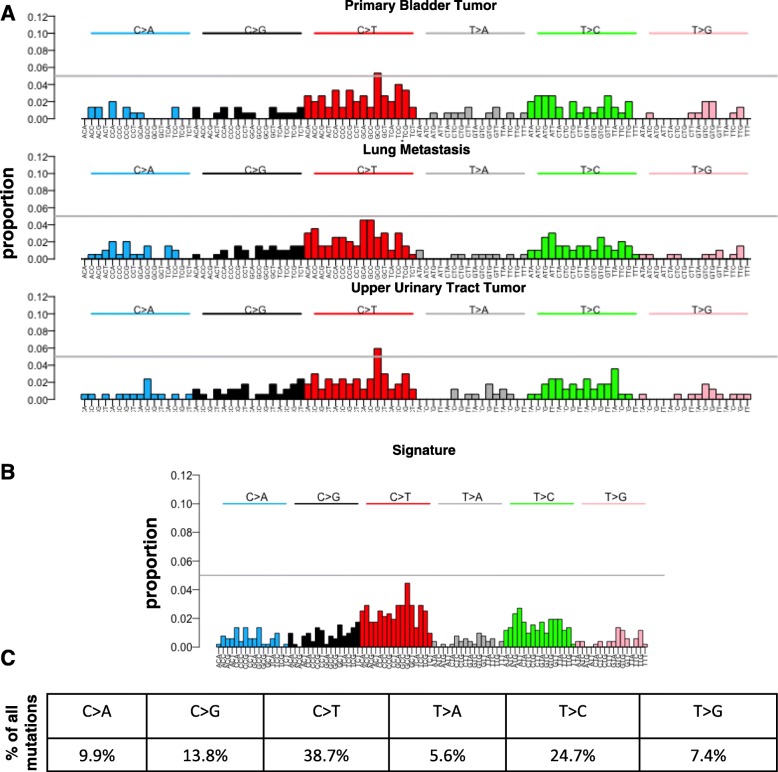
A man with a smoking history was diagnosed with a low-grade urothelial carcinoma of the bladder and a concurrent high-grade upper urinary tract tumor. Seven years later he had a lung metastasis. We carried out exome sequencing on all the patient's tumors and peripheral blood (germline) to identify somatic variants. We constructed a phylogenetic tree to capture how the tumors are related and to identify somatic changes important for metastasis. Although distant metastasis of low-grade bladder tumor is rare, the somatic variants in the tumors and the phylogenetic tree showed that the metastasized tumor had a mutational profile most similar to the low grade urothelial carcinoma. The primary and the metastatic tumors shared several important mutations, including in the KMT2D and the RXRA genes. The metastatic tumor also had an activating MTOR mutation, which may be important for tumor metastasis. We developed a mutational signature to understand the biologic processes responsible for tumor development. The mutational signature suggests that the tumor mutations are associated with tobacco carcinogen exposure, which is concordant with the patient's smoking history. We cultured cells from the lung metastasis to examine proliferation and signaling mechanisms in response to treatment. The mTOR inhibitor Everolimus inhibited downstream mTOR signaling and induced cytotoxicity in the metastatic tumor cells.
We used genomic analysis to examine a rare case of low grade bladder tumor metastasis to distant organ (lung). Our analysis also revealed exposure to carcinogens found is tobacco as a possible cause in tumor development. We further validated that the patient might benefit from mTOR inhibition as a potential salvage therapy in an adjuvant or recurrent disease setting.
我们报告了一例罕见的低级膀胱癌远处转移病例。我们对患者肿瘤样本进行了详细的基因组分析和细胞实验,以研究肿瘤的进化、可能的病因,并提供个性化的治疗策略。
一名有吸烟史的男性被诊断为低级膀胱尿路上皮癌和同时存在的高级上尿路肿瘤。7 年后,他出现了肺部转移。我们对患者所有的肿瘤和外周血(胚系)进行了外显子组测序,以鉴定体细胞变异。我们构建了一个系统发育树来捕获肿瘤之间的关系,并确定与转移相关的体细胞变化。虽然低级膀胱癌的远处转移很少见,但肿瘤中的体细胞变异和系统发育树表明,转移的肿瘤具有与低级尿路上皮癌最相似的突变特征。原发肿瘤和转移肿瘤共享了几个重要的突变,包括 KMT2D 和 RXRA 基因。转移瘤还存在一个激活的 MTOR 突变,这可能对肿瘤转移很重要。我们开发了一个突变特征来了解导致肿瘤发展的生物学过程。突变特征表明,肿瘤突变与烟草致癌物质暴露有关,这与患者的吸烟史一致。我们从肺部转移瘤中培养细胞,以研究对治疗的增殖和信号转导机制。mTOR 抑制剂依维莫司抑制了下游 mTOR 信号,并诱导转移瘤细胞的细胞毒性。
我们使用基因组分析来检查一例罕见的低级膀胱癌远处转移到远处器官(肺)的病例。我们的分析还揭示了暴露于烟草中发现的致癌物质可能是肿瘤发生的一个原因。我们进一步验证了患者可能受益于 mTOR 抑制作为辅助或复发性疾病治疗的潜在挽救疗法。