University of Oxford, Nuffield Department of Primary Care Health Sciences, Oxford, UK.
University of Cambridge, Department of Zoology, Cambridge, UK.
Lancet Planet Health. 2018 Sep;2(9):e384-e397. doi: 10.1016/S2542-5196(18)30188-8.
Reducing meat consumption could help to protect the natural environment and promote population health. Interventions restructuring physical micro-environments might help to change habitual behaviour. We synthesised the scientific evidence pertaining to whether, and which, interventions restructuring physical micro-environments effectively reduce the demand for meat.
We did a systematic review of quantitative studies evaluating the effectiveness of interventions restructuring physical micro-environments to reduce the demand for meat. We identified relevant records by searching six electronic databases (CAB Abstracts, Embase, PsycINFO, Science Citation Index, MEDLINE, and Dissertations & Theses) on Aug 31, 2017, contacting experts, screening publicly accessible online resources, and searching references. We included studies that evaluated the effectiveness of interventions restructuring physical micro-environments to reduce the demand for meat, defined as the actual or intended consumption, purchase, or selection of meat in real or virtual environments. We extracted data pertaining to the study samples, the interventions, and meat demand at the follow-up closest to intervention completion and at the longest follow-up, with the former representing our primary outcome. We synthesised data narratively and did a qualitative comparative analysis to identify configurations of intervention characteristics associated with, and those not found to be associated with, significant reductions in meat demand. Our Systematic Review is registered with PROSPERO, number CRD42017081532.
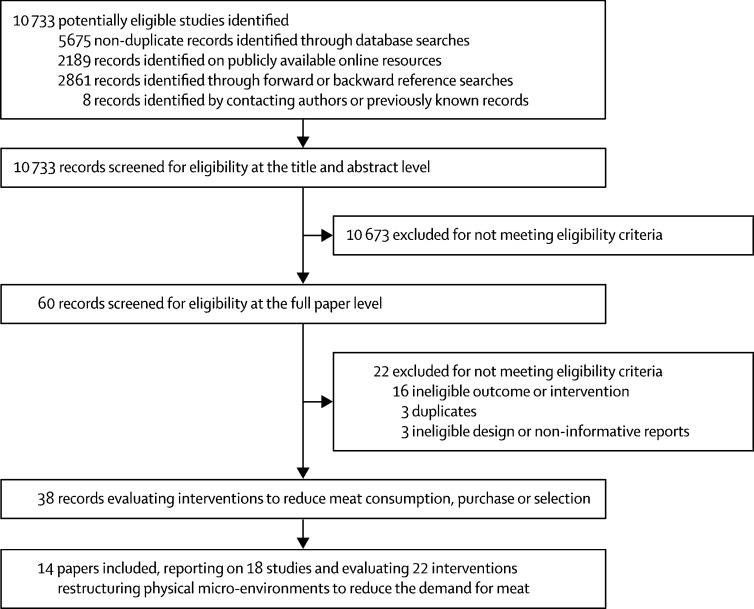
Of 10 733 titles and abstracts screened for eligibility, we assessed 60 full papers and included 14 papers reporting on 18 studies with 22 intervention conditions. Three interventions reducing the portion size of meat servings reduced meat consumption in randomised trials. Three interventions providing meat alternatives with supporting educational material were associated with reduced meat demand in pre-post design studies. Three of four interventions altering the sensory properties (eg, visual presentation) of meat or meat alternatives at point of purchase reduced meat demand in randomised trials. Four interventions repositioning meat products to be less prominent at point of purchase were associated with lower meat demand, but only two such interventions reached statistical significance in a randomised trial and a multiple treatment reversal design. Only one of five interventions manipulating the description of meat or meat alternatives at point of purchase was associated with lower meat demand in a multiple treatment reversal design. Evidence from randomised trials evaluating a pricing intervention or interventions restructuring several aspects of micro-environments was too scarce or inconsistent to be conclusive. The results from our qualitative comparative analysis supported the findings of this narrative synthesis.
Some interventions restructuring physical micro-environments could help to promote lower demand for meat. Interventions reducing portion sizes of meat servings, providing meat alternatives, or changing the sensory properties of meat and meat alternatives at point of purchase offered the most promise in the context of experimental studies.
None.
减少肉类消费有助于保护自然环境和促进人口健康。改变物质微观环境的干预措施可能有助于改变习惯性行为。我们综合了有关改变物质微观环境的干预措施是否有效减少肉类需求,以及哪些干预措施有效的科学证据。
我们对评估改变物质微观环境以减少肉类需求的干预措施有效性的定量研究进行了系统评价。我们于 2017 年 8 月 31 日通过检索 6 个电子数据库(CAB 摘要、Embase、PsycINFO、科学引文索引、医学文献在线数据库和论文)、联系专家、筛选公开获取的在线资源以及检索参考文献来确定相关记录。我们纳入了评估改变物质微观环境以减少肉类需求的干预措施有效性的研究,定义为在真实或虚拟环境中实际或预期的肉类消费、购买或选择。我们提取了与研究样本、干预措施以及干预完成后随访期间和最长随访期间肉类需求相关的数据,前者代表我们的主要结果。我们以叙述性方式综合数据,并进行了定性比较分析,以确定与显著减少肉类需求相关和不相关的干预措施特征配置。我们的系统评价已在 PROSPERO 注册,注册号为 CRD42017081532。
在筛选出的 10733 个标题和摘要中,我们评估了 60 篇全文,并纳入了 14 篇论文,报道了 18 项研究,涉及 22 种干预措施。三项减少肉类份量的干预措施在随机试验中减少了肉类消费。三项提供带有支持性教育材料的肉类替代品的干预措施在前后设计研究中与减少肉类需求相关。四项改变购买点肉类或肉类替代品感官特性(如视觉呈现)的干预措施在随机试验中减少了肉类需求。四项将肉类产品重新定位在购买点不太突出的干预措施与较低的肉类需求相关,但只有两项此类干预措施在随机试验和多次治疗反转设计中达到了统计学意义。五项干预措施中只有一项通过改变购买点的肉类或肉类替代品描述与降低肉类需求相关,这是在多次治疗反转设计中得出的。评估价格干预措施或改变微观环境几个方面的干预措施的随机试验的证据太少或不一致,无法得出结论。我们的定性比较分析结果支持了这一叙述性综合分析的结果。
一些改变物质微观环境的干预措施可能有助于促进肉类需求的降低。在实验研究中,减少肉类份量、提供肉类替代品或改变购买点肉类和肉类替代品的感官特性的干预措施最有希望。
无。
