Department of Biotechnology, Faculty of Biological Sciences, Quaid-i-Azam University, Islamabad, Pakistan.
Bobby R Alford Department of Otolaryngology-Head and Neck Surgery, Baylor College of Medicine, Houston, TX, USA.
J Hum Genet. 2018 Nov;63(11):1099-1107. doi: 10.1038/s10038-018-0502-3. Epub 2018 Sep 3.
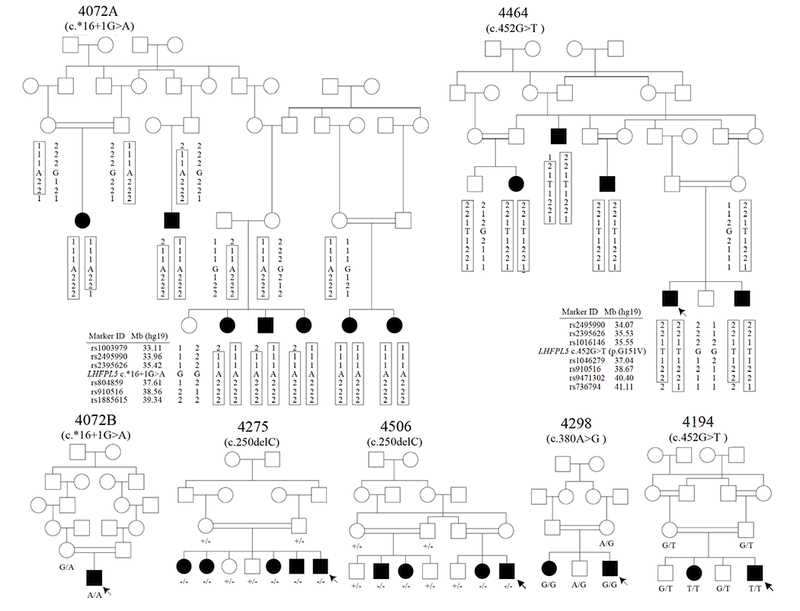
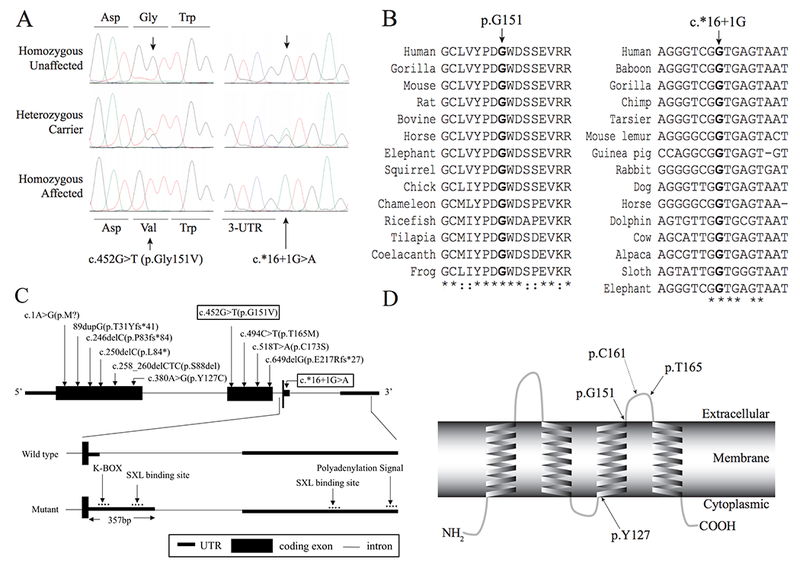
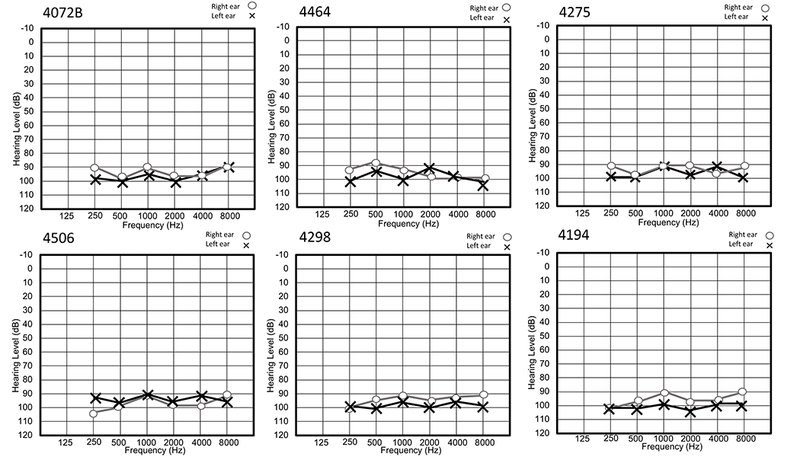
LHFPL5, the gene for DFNB67, underlies autosomal recessive nonsyndromic hearing impairment. We identified seven Pakistani families that mapped to 6p21.31, which includes the LHFPL5 gene. Sanger sequencing of LHFPL5 using DNA samples from hearing impaired and unaffected members of these seven families identified four variants. Among the identified variants, two were novel: one missense c.452 G > T (p.Gly151Val) and one splice site variant (c.16 + 1 G > A) were each identified in two families. Two known variants: c.250delC (p.Leu84) and c.380 A > G (p.Tyr127Cys) were also observed in two families and a single family, respectively. Nucleotides c.452G and c.*16 + 1G and amino-acid residue p.Gly151 are under strong evolutionary conservation. In silico bioinformatics analyses predicted these variants to be damaging. The splice site variant (c.*16 + 1 G > A) is predicted to affect pre-mRNA splicing and a loss of the 5' donor splice site in the 3'-untranslated region (3'-UTR). Further analysis supports the activation of a cryptic splice site approximately 357-bp downstream, leading to an extended 3'-UTR with additional regulatory motifs. In conclusion, we identified two novel variants in LHFPL5, including a unique 3'-UTR splice site variant that is predicted to impact pre-mRNA splicing and regulation through an extended 3'-UTR.
LHFPL5 基因是 DFNB67 的致病基因,位于常染色体隐性非综合征型听力损失。我们鉴定了七个巴基斯坦家系,它们定位于 6p21.31,其中包括 LHFPL5 基因。对这七个家系中听力受损和听力正常成员的 DNA 样本进行 LHFPL5 的 Sanger 测序,鉴定出了四个变异。在鉴定的变异中,有两个是新的:一个错义变异 c.452G>T(p.Gly151Val)和一个剪接位点变异(c.16+1G>A),每个变异都在两个家系中发现。两个已知的变异 c.250delC(p.Leu84)和 c.380A>G(p.Tyr127Cys)也分别在两个家系和一个家系中观察到。核苷酸 c.452G 和 c.*16+1G 以及氨基酸残基 p.Gly151 在进化上受到强烈的保守。计算机生物信息学分析预测这些变异是有害的。剪接位点变异(c.*16+1G>A)预计会影响前体 mRNA 的剪接,并导致 3'-非翻译区(3'-UTR)中 5'供体位点的缺失。进一步的分析支持激活大约 357 个碱基下游的隐蔽剪接位点,导致 3'-UTR 延长,并增加了额外的调节基序。总之,我们在 LHFPL5 中鉴定出两个新的变异,包括一个独特的 3'-UTR 剪接位点变异,预计会通过延长的 3'-UTR 影响前体 mRNA 的剪接和调控。