Rui Yue, Chen Yintong, Kandemir Baris, Yi Hojae, Wang James Z, Puri Virendra M, Anderson Charles T
Department of Biology, The Pennsylvania State University, University Park, PA, United States.
Intercollege Graduate Degree Program in Plant Biology, The Pennsylvania State University, University Park, PA, United States.
Front Plant Sci. 2018 Aug 20;9:1202. doi: 10.3389/fpls.2018.01202. eCollection 2018.
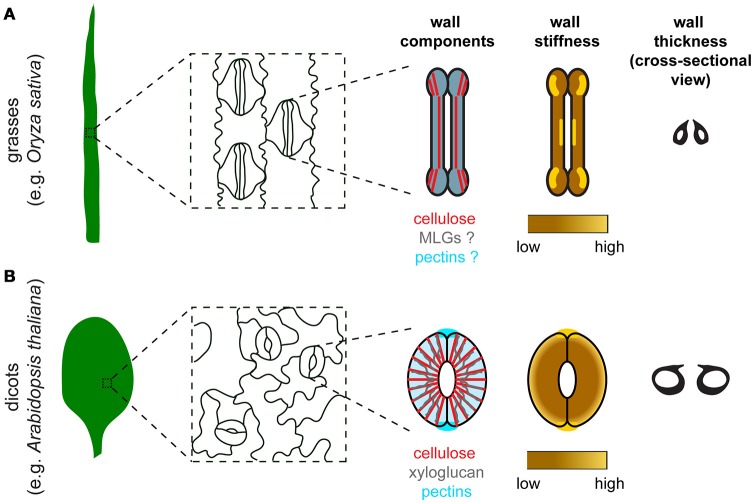
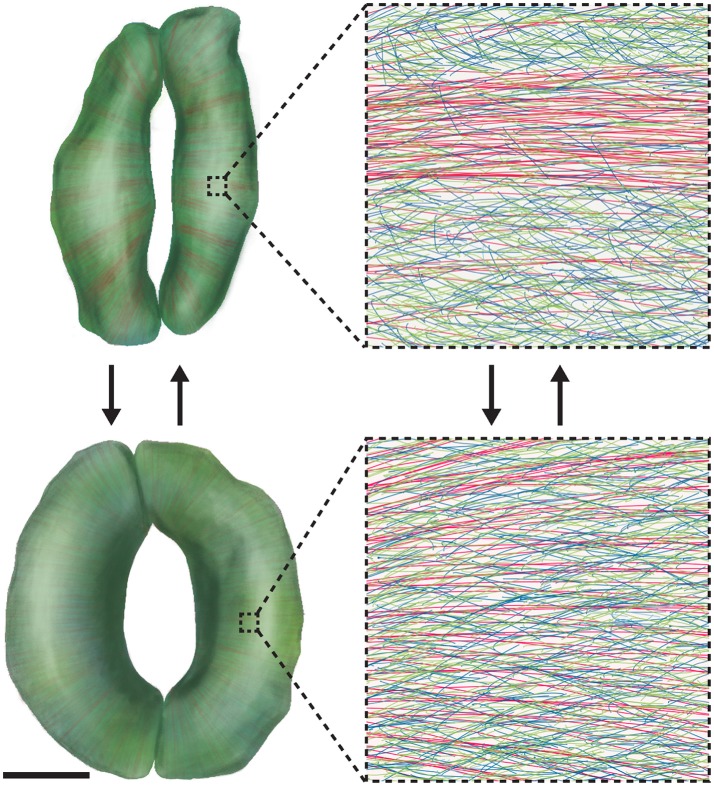
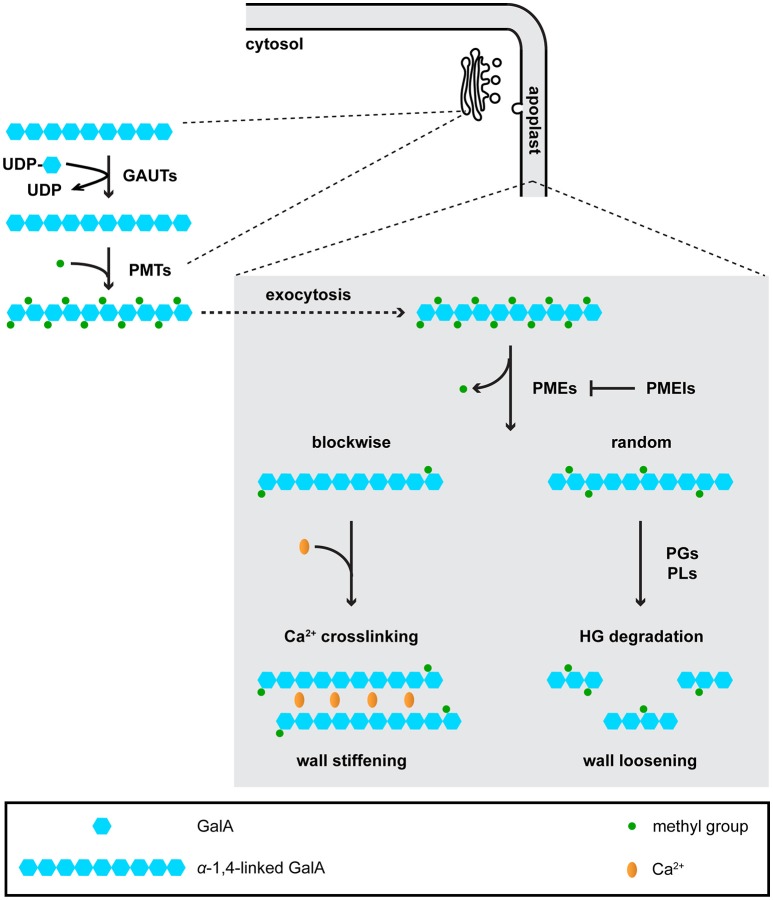
Guard cells are pairs of epidermal cells that control gas diffusion by regulating the opening and closure of stomatal pores. Guard cells, like other types of plant cells, are surrounded by a three-dimensional, extracellular network of polysaccharide-based wall polymers. In contrast to the walls of diffusely growing cells, guard cell walls have been hypothesized to be uniquely strong and elastic to meet the functional requirements of withstanding high turgor and allowing for reversible stomatal movements. Although the walls of guard cells were long underexplored as compared to extensive studies of stomatal development and guard cell signaling, recent research has provided new genetic, cytological, and physiological data demonstrating that guard cell walls function centrally in stomatal development and dynamics. In this review, we highlight and discuss the latest evidence for how wall polysaccharides are synthesized, deposited, reorganized, modified, and degraded in guard cells, and how these processes influence stomatal form and function. We also raise open questions and provide a perspective on experimental approaches that could be used in the future to shed light on the composition and architecture of guard cell walls.
保卫细胞是成对的表皮细胞,通过调节气孔孔口的开闭来控制气体扩散。保卫细胞与其他类型的植物细胞一样,被基于多糖的壁聚合物组成的三维细胞外网络所包围。与扩散生长细胞的细胞壁不同,据推测保卫细胞壁具有独特的高强度和弹性,以满足承受高膨压并允许气孔进行可逆运动的功能需求。尽管与对气孔发育和保卫细胞信号传导的广泛研究相比,保卫细胞壁长期以来未得到充分探索,但最近的研究提供了新的遗传学、细胞学和生理学数据,表明保卫细胞壁在气孔发育和动态变化中起着核心作用。在这篇综述中,我们重点介绍并讨论了有关壁多糖在保卫细胞中如何合成、沉积、重组、修饰和降解,以及这些过程如何影响气孔形态和功能的最新证据。我们还提出了一些未解决的问题,并对未来可用于阐明保卫细胞壁组成和结构的实验方法提供了一个观点。