Li Ka Shing Knowledge Institute, St Michael's Hospital, University of Toronto, Toronto, ON, Canada.
Department of Clinical Endocrinology and Nutrition (IBIMA), Hospital Virgen de la Victoria, University of Málaga, CIBER Fisiopatología de la Obesidad y Nutrición (CIBERobn), Instituto de Salud Carlos III, Málaga, Spain.
Diabet Med. 2018 Dec;35(12):1742-1751. doi: 10.1111/dme.13817. Epub 2018 Oct 9.
To evaluate the safety of the proprotein convertase subtilisin/kexin type 9 (PCSK9) inhibitor alirocumab according to diabetes mellitus status.
Safety data from 14 trials (8-104-week durations) were analysed by treatment (alirocumab or placebo/ezetimibe control) and diabetes status (yes/no, defined by medical history). Adverse event data were assessed using descriptive statistics and Cox models.
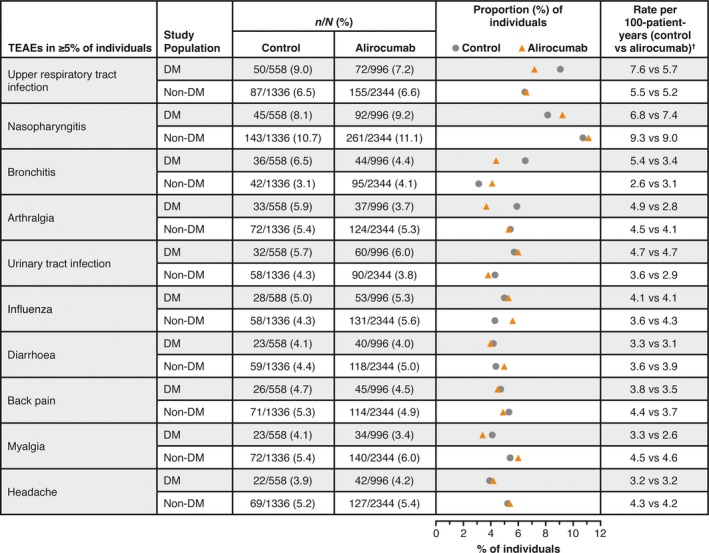
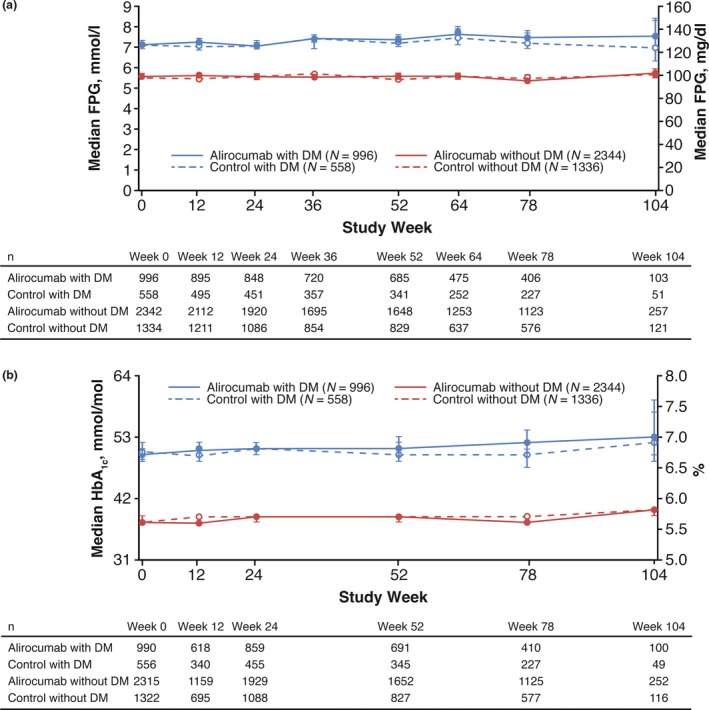
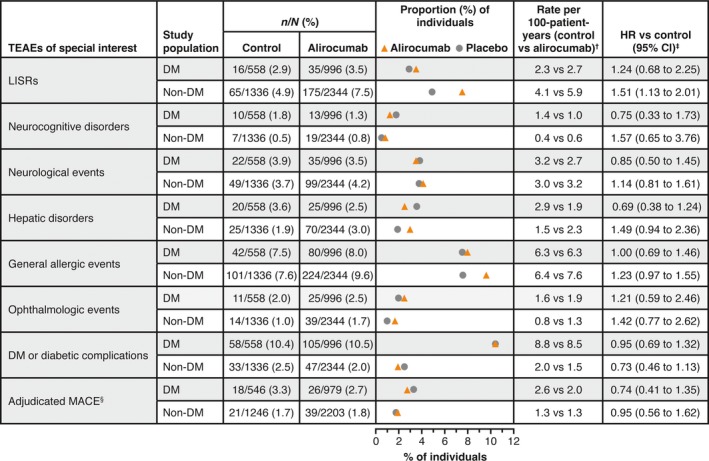
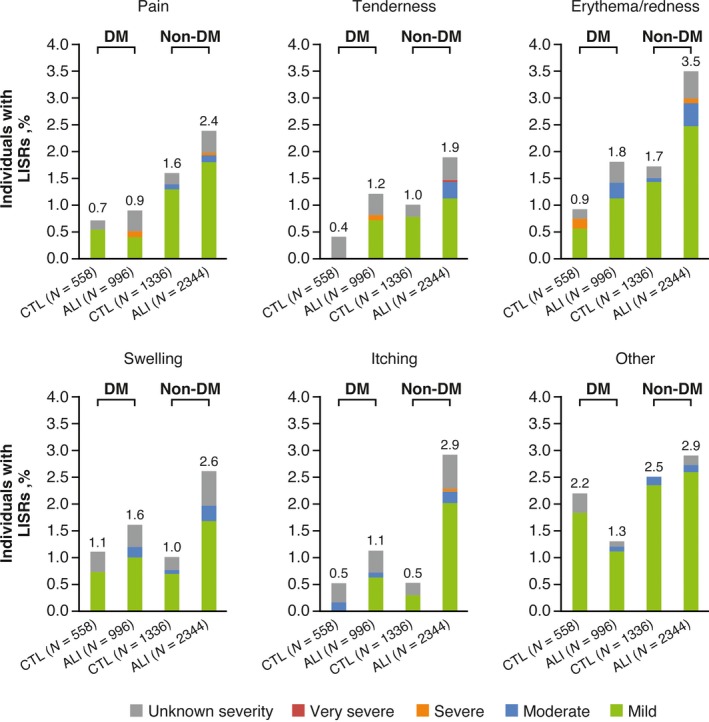
Of the 5234 trial participants, 1554 (29.7%) had diabetes. Overall, treatment-emergent adverse events were similar in the alirocumab and control groups, except for more frequent local injection site reactions with alirocumab. Fewer people with diabetes experienced local injection site reactions [alirocumab, 3.5%, control, 2.9%; hazard ratio 1.24 (95% CI 0.68-2.25)] than those without diabetes [alirocumab, 7.5%; control, 4.9%; hazard ratio 1.51 (95% CI 1.13-2.01)]. Those with diabetes reported a greater number of serious adverse events (alirocumab, 19.4%; control, 19.7%) than those without diabetes (alirocumab, 14.5%; control, 13.5%). In people with diabetes, major adverse cardiac events occurred in 2.7% of alirocumab-treated people [control, 3.3%; hazard ratio 0.74 (95% CI 0.41-1.35)]; in those without diabetes, 1.8% of alirocumab-treated people had major adverse cardiac events [control, 1.7%; hazard ratio 0.95 (95% CI 0.56-1.62)]. Overall, no increase in HbA or fasting plasma glucose vs control treatment groups was observed, regardless of diabetes status.
This pooled analysis across 14 trials demonstrated similar safety for alirocumab vs control treatment, irrespective of diabetes status, except for more frequent local injection site reactions with alirocumab. People with diabetes reported fewer local injection site reactions than those without diabetes.
根据糖尿病状态评估前蛋白转化酶枯草溶菌素/ kexin 9(PCSK9)抑制剂阿利西尤单抗的安全性。
分析了 14 项试验(8-104 周持续时间)的安全性数据,这些试验的治疗方法(阿利西尤单抗或安慰剂/依折麦布对照)和糖尿病状态(有/无,根据病史定义)。使用描述性统计和 Cox 模型评估不良事件数据。
在 5234 名试验参与者中,有 1554 名(29.7%)患有糖尿病。总体而言,阿利西尤单抗组和对照组的治疗相关不良事件相似,除了阿利西尤单抗组更频繁地出现局部注射部位反应。患有糖尿病的患者比没有糖尿病的患者更少出现局部注射部位反应[阿利西尤单抗组 3.5%,对照组 2.9%;危险比 1.24(95%CI 0.68-2.25)]。患有糖尿病的患者报告的严重不良事件数量(阿利西尤单抗组 19.4%,对照组 19.7%)多于没有糖尿病的患者(阿利西尤单抗组 14.5%,对照组 13.5%)。在患有糖尿病的患者中,阿利西尤单抗治疗的患者中有 2.7%发生主要不良心脏事件[对照组为 3.3%;危险比 0.74(95%CI 0.41-1.35)];在没有糖尿病的患者中,阿利西尤单抗治疗的患者中有 1.8%发生主要不良心脏事件[对照组为 1.7%;危险比 0.95(95%CI 0.56-1.62)]。总体而言,无论糖尿病状态如何,与对照组治疗相比,阿利西尤单抗治疗组的 HbA 或空腹血浆葡萄糖均未增加。
这项来自 14 项试验的汇总分析表明,阿利西尤单抗与对照组治疗的安全性相似,无论糖尿病状态如何,除了阿利西尤单抗更频繁地出现局部注射部位反应外。患有糖尿病的患者报告的局部注射部位反应比没有糖尿病的患者少。