Santaguida Pasqualina, Dolovich Lisa, Oliver Doug, Lamarche Larkin, Gilsing Anne, Griffith Lauren E, Richardson Julie, Mangin Dee, Kastner Monika, Raina Parminder
Department of Health Research Methods, Evidence and Impact, McMaster University, HSC 3N50-G, 1280 Main Street West, Hamilton, Ontario, L8S 4L7, Canada.
Department of Family Medicine, DBHSC, McMaster University, 5th Floor 100 Main St West, Hamilton, ON, L8P 1H6, Canada.
BMC Fam Pract. 2018 Sep 4;19(1):152. doi: 10.1186/s12875-018-0831-5.
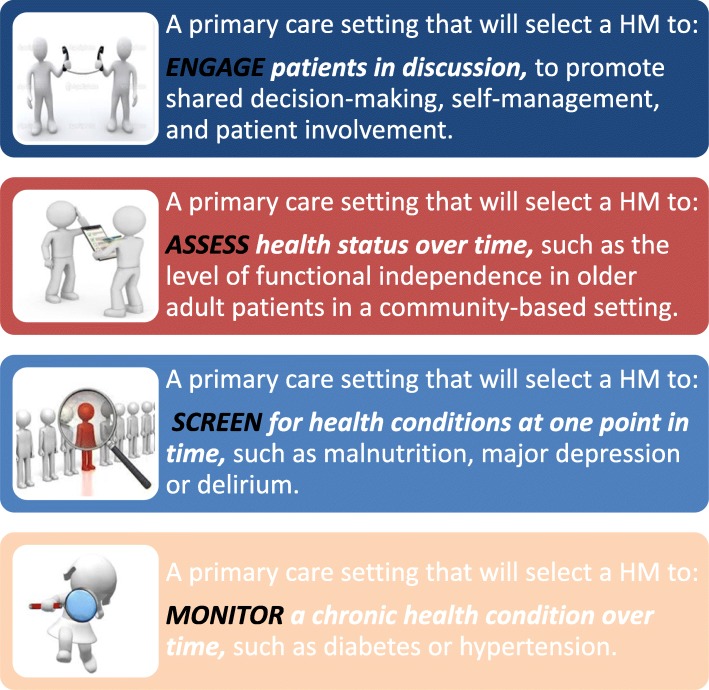
Promoting the collection and use of health related outcome measures (HROM) in daily practice has long been a goal for improving and assessing the effectiveness of care provided to patients. However, there has been a lack of consensus on what criteria to use to select outcomes or instruments, particularly in the context of primary health care settings where patients present with multiple concurrent health conditions and interventions are whole-health and person-focused. The purpose of this proposed study is to undertake a formal consensus exercise to establish criteria for selecting HROM (including patient-reported (PRO or PROM), observer-reported (ObsR)), clinician-reported (ClinRO) and performance related outcomes (PerfO) for use in shared decision-making, or in assessing, screening or monitoring health status in primary health care settings.
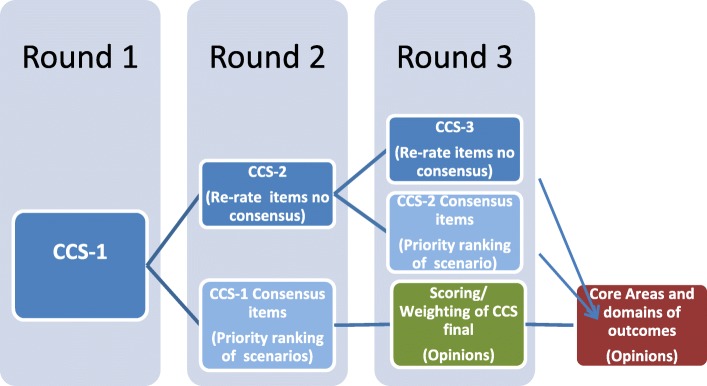
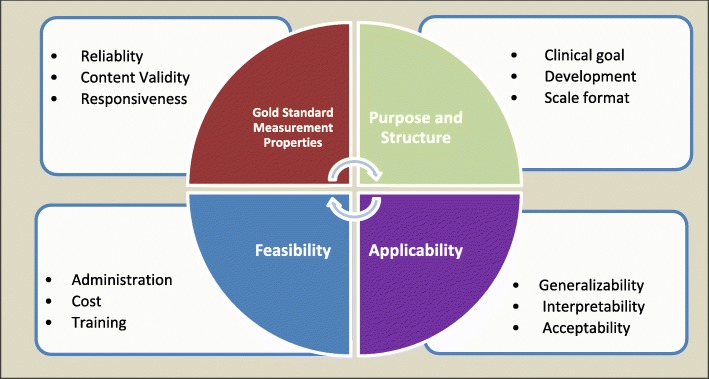
A Delphi consensus online survey will be developed. Criteria for the Delphi panel participants to consider were selected from a targeted literature search. These initial criteria (n = 35) were grouped into four categories within which items will be presented in the Delphi survey, with the option to suggest additional items. Panel members invited to participate will include primary health care practitioners and administrators, policy-makers, researchers, and experts in HROM development; patients will be excluded. Standard Delphi methodology will be employed with an expectation of at least 3 rounds to achieve consensus (75% agreement). As the final list of criteria for selecting HROM emerges, panel members will be asked to provide opinions about potential weighting of items. The Delphi survey was approved by the Ethics Committee in the Faculty of Health Sciences at McMaster University.
Previous literature establishing criteria for selecting HROM were developed with a focus on patient reported outcomes, psychological/ behavioural outcomes or outcomes for minimum core outcome sets in clinical trials. Although helpful, these criteria may not be applicable and feasible for application in a primary health care context where patients with multi-morbidity and complex interventions are typical and the constraints of providing health services differ from those in research studies. The findings from this Delphi consensus study will address a gap for establishing consensus on criteria for selecting HROM for use across primary health care settings.
长期以来,促进在日常实践中收集和使用健康相关结局指标(HROM)一直是改善和评估患者护理效果的目标。然而,对于使用何种标准来选择结局指标或工具,尚未达成共识,尤其是在初级卫生保健环境中,患者同时存在多种健康状况,干预措施是以整体健康和患者为中心的。本拟开展研究的目的是进行一次正式的共识达成活动,以确定用于共同决策,或评估、筛查或监测初级卫生保健环境中健康状况的HROM(包括患者报告结局(PRO或PROM)、观察者报告结局(ObsR)、临床医生报告结局(ClinRO)和绩效相关结局(PerfO))的选择标准。
将开展一项德尔菲共识在线调查。德尔菲专家小组参与者要考虑的标准是从有针对性的文献检索中选取的。这些初始标准(n = 35)被分为四类,德尔菲调查中将按类别呈现各项内容,并可选择提出其他项目。受邀参与的专家小组成员将包括初级卫生保健从业者和管理人员、政策制定者、研究人员以及HROM开发方面的专家;患者将被排除在外。将采用标准的德尔菲方法,预计至少进行3轮以达成共识(75%的一致意见)。随着HROM选择标准的最终清单确定,将要求专家小组成员对各项内容的潜在权重提供意见。该德尔菲调查已获得麦克马斯特大学健康科学学院伦理委员会的批准。
以往确立HROM选择标准的文献主要侧重于患者报告结局、心理/行为结局或临床试验中最小核心结局集的结局。尽管这些标准有帮助,但可能不适用于初级卫生保健环境,也不可行,因为在该环境中,多病共存和复杂干预的患者很常见,且提供卫生服务的限制与研究环境不同。这项德尔菲共识研究的结果将填补在初级卫生保健环境中选择HROM的标准方面达成共识的空白。