International AIDS Vaccine Initiative Neutralizing Antibody Center, The Scripps Research Institute, La Jolla, CA, 92037, USA.
Department of Immunology and Microbiology, The Scripps Research Institute, La Jolla, CA, 92037, USA.
Retrovirology. 2018 Sep 5;15(1):61. doi: 10.1186/s12977-018-0443-0.
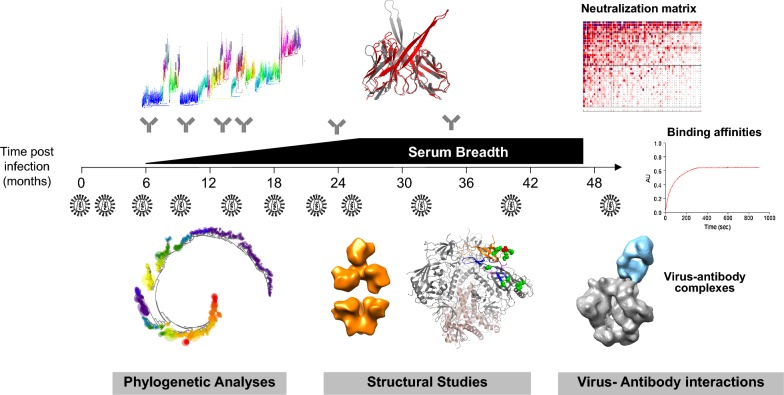
Broadly neutralizing antibodies (bNAbs), able to prevent viral entry by diverse global viruses, are a major focus of HIV vaccine design, with data from animal studies confirming their ability to prevent HIV infection. However, traditional vaccine approaches have failed to elicit these types of antibodies. During chronic HIV infection, a subset of individuals develops bNAbs, some of which are extremely broad and potent. This review describes the immunological and virological factors leading to the development of bNAbs in such "elite neutralizers". The features, targets and developmental pathways of bNAbs from their precursors have been defined through extraordinarily detailed within-donor studies. These have enabled the identification of epitope-specific commonalities in bNAb precursors, their intermediates and Env escape patterns, providing a template for vaccine discovery. The unusual features of bNAbs, such as high levels of somatic hypermutation, and precursors with unusually short or long antigen-binding loops, present significant challenges in vaccine design. However, the use of new technologies has led to the isolation of more than 200 bNAbs, including some with genetic profiles more representative of the normal immunoglobulin repertoire, suggesting alternate and shorter pathways to breadth. The insights from these studies have been harnessed for the development of optimized immunogens, novel vaccine regimens and improved delivery schedules, which are providing encouraging data that an HIV vaccine may soon be a realistic possibility.
广谱中和抗体(bNAbs)能够预防各种全球病毒的病毒进入,是 HIV 疫苗设计的主要重点,动物研究数据证实了它们预防 HIV 感染的能力。然而,传统的疫苗方法未能引发这些类型的抗体。在慢性 HIV 感染期间,一部分个体产生了 bNAbs,其中一些具有极强的广谱性和效力。本文综述了导致此类“精英中和者”中产生 bNAbs 的免疫和病毒学因素。通过极其详细的供体内研究,已经确定了 bNAb 从其前体的特征、靶标和发育途径。这些研究使我们能够识别 bNAb 前体、中间体和Env 逃逸模式的表位特异性共性,为疫苗发现提供了模板。bNAbs 的独特特征,如高水平的体细胞超突变和具有异常短或长抗原结合环的前体,给疫苗设计带来了重大挑战。然而,新技术的应用已经导致了 200 多种 bNAbs 的分离,其中一些具有更能代表正常免疫球蛋白库的遗传特征,这表明存在替代的、更短的广谱途径。这些研究的见解已被用于开发优化的免疫原、新型疫苗方案和改进的接种方案,这些方案提供了令人鼓舞的数据,表明 HIV 疫苗可能很快成为现实。