Department of Neurology, Neurological Institute, Graduate School of Medical Sciences, Kyushu University, 3-1-1 Maidashi, Higashi-ku, Fukuoka, 812-8582, Japan.
Medical Image Analysis Center (MIAC AG), Marktgasse 8, 4051, Basel, Switzerland.
J Neuroinflammation. 2018 Sep 5;15(1):255. doi: 10.1186/s12974-018-1295-1.
We compared the magnetic resonance imaging (MRI) features between Japanese and Caucasian patients with multiple sclerosis (MS), and identified the relationships between MRI features and disability.
From the baseline data of phase II fingolimod trials, 95 Japanese and 246 Caucasian relapsing-remitting MS patients were enrolled. The number, volume, and distribution of brain MRI lesions were evaluated using T2-weighted (T2W) images. Cross-sectional total normalized brain volume (NBV), normalized cortical gray matter volume, normalized deep gray matter volume (NDGMV), normalized white matter volume (NWMV), and normalized thalamic volume were measured.
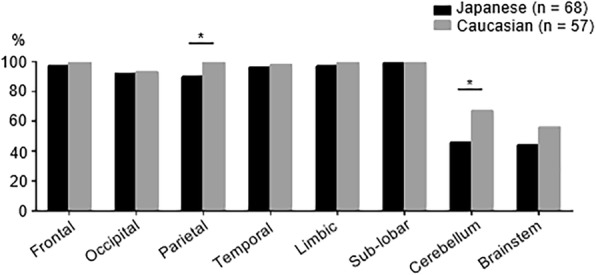
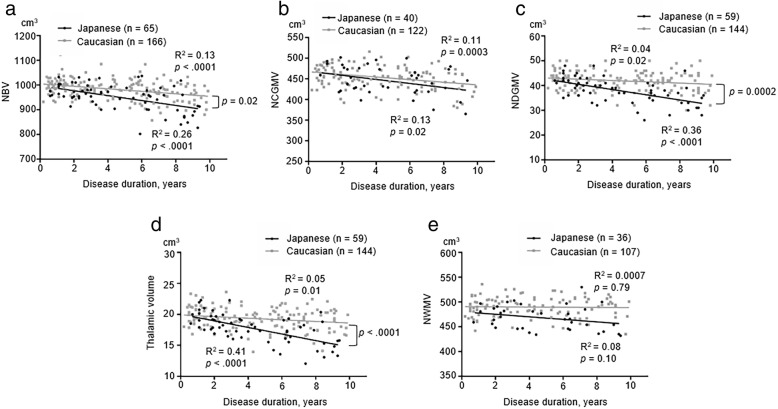
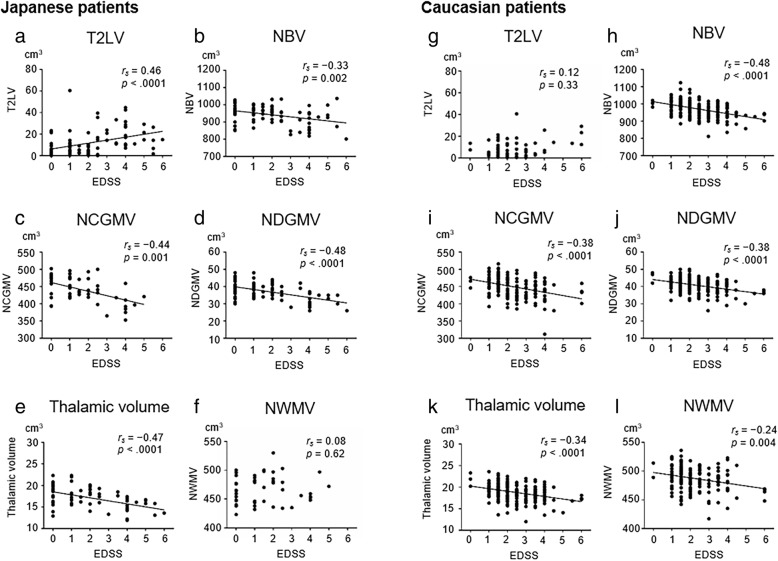
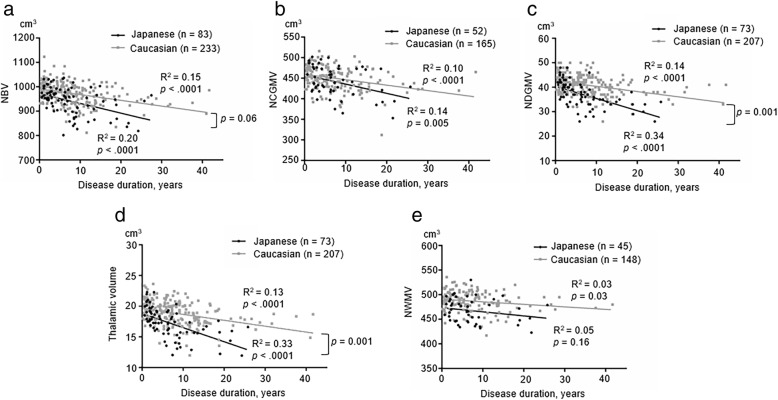
Japanese patients had significantly lower Expanded Disability Status Scale (EDSS) scores than Caucasian patients (mean 2.0 vs. 2.3, p = 0.008), despite a similar disease duration. Japanese patients showed a trend towards fewer T2W-lesions (median 50 vs. 65, p = 0.08) and significantly lower frequencies of cerebellar and parietal lobe lesions (p = 0.02 for both) than Caucasian patients. There were no differences in T2W-lesion volume between races, whereas Japanese patients had a significantly larger T2W-lesion volume per lesion compared with Caucasian patients (median 140 mm vs. 85 mm, p < 0.0001). T2W-lesion volumes were positively correlated with EDSS scores in Japanese patients (p < 0.0001). In both races, NBV, normalized cortical gray matter volume, NDGMV, and thalamic volume were negatively correlated with disease duration and EDSS scores (p < 0.01 for all). NWMV was negatively correlated with disease duration and EDSS scores only in Caucasian patients (p = 0.03 and p = 0.004, respectively). NBV, NDGMV, NWMV, and thalamic volume were consistently smaller in Japanese compared with Caucasian patients throughout the entire examined disease duration (p = 0.046, p = 0.01, p = 0.005, and p = 0.04, respectively). Japanese patients had a significantly faster reduction in NDGMV (p = 0.001), particularly for thalamic volume (p = 0.001), with disease duration compared with Caucasian patients.
Gray matter atrophy is a common denominator for disability in Japanese and Caucasian patients. Additional contributory factors for disability include T2W-lesion volume in Japanese patients and white matter atrophy in Caucasian patients. Less frequent parietal and cerebellar involvement with fewer T2W-lesions may underlie milder disability in Japanese patients.
我们比较了多发性硬化症(MS)中日裔和高加索患者的磁共振成像(MRI)特征,并确定了 MRI 特征与残疾之间的关系。
从 II 期芬戈莫德试验的基线数据中,纳入了 95 名日本裔和 246 名高加索裔复发缓解型 MS 患者。使用 T2 加权(T2W)图像评估脑 MRI 病变的数量、体积和分布。测量了脑的横截面积标准化脑体积(NBV)、标准化皮质灰质体积、标准化深部灰质体积(NDGMV)、标准化白质体积(NWMV)和标准化丘脑体积。
尽管疾病持续时间相似,但日本裔患者的扩展残疾状态量表(EDSS)评分明显低于高加索裔患者(平均 2.0 与 2.3,p=0.008)。与高加索裔患者相比,日本裔患者 T2W 病变数量较少(中位数 50 与 65,p=0.08),小脑和顶叶病变的频率也明显较低(两者均为 p=0.02)。两种族之间 T2W 病变体积无差异,但日本裔患者的 T2W 病变体积每病变明显大于高加索裔患者(中位数 140mm 与 85mm,p<0.0001)。T2W 病变体积与日本裔患者的 EDSS 评分呈正相关(p<0.0001)。在两种族中,NBV、标准化皮质灰质体积、NDGMV 和丘脑体积与疾病持续时间和 EDSS 评分呈负相关(p<0.01)。仅在高加索裔患者中,NWMV 与疾病持续时间和 EDSS 评分呈负相关(p=0.03 和 p=0.004)。与高加索裔患者相比,日本裔患者在整个检查期间 NBV、NDGMV、NWMV 和丘脑体积始终较小(p=0.046、p=0.01、p=0.005 和 p=0.04,分别)。与高加索裔患者相比,日本裔患者的 NDGMV 下降速度更快(p=0.001),尤其是丘脑体积(p=0.001),这与疾病持续时间有关。
灰质萎缩是日本裔和高加索裔患者残疾的共同决定因素。日本裔患者残疾的其他促成因素包括 T2W 病变体积,而高加索裔患者残疾的促成因素包括白质萎缩。较少的顶叶和小脑受累,较少的 T2W 病变可能是日本裔患者残疾程度较轻的原因。