Pacurariu Alexandra, Plueschke Kelly, McGettigan Patricia, Morales Daniel R, Slattery Jim, Vogl Dagmar, Goedecke Thomas, Kurz Xavier, Cave Alison
Department of Surveillance and Epidemiology Service, European Medicines Agency, London, UK.
William Harvey Research Institute, Queen Mary University of London, London, UK.
BMJ Open. 2018 Sep 5;8(9):e023090. doi: 10.1136/bmjopen-2018-023090.
Electronic healthcare databases (EHDs) are useful tools for drug development and safety evaluation but their heterogeneity of structure, validity and access across Europe complicates the conduct of multidatabase studies. In this paper, we provide insight into available EHDs to support regulatory decisions on medicines.
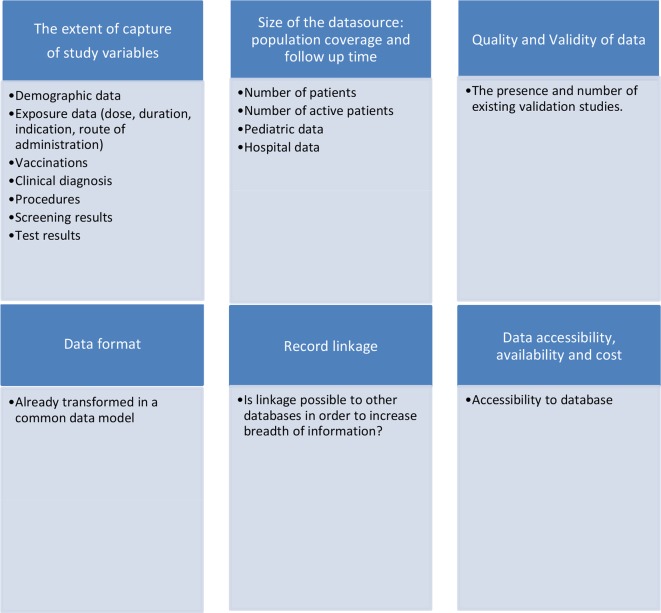
EHDs were identified from publicly available information from the European Network of Centres for Pharmacoepidemiology and Pharmacovigilance resources database, textbooks and web-based searches. Databases were selected using criteria related to accessibility, longitudinal dimension, recording of exposure and outcomes, and generalisability. Extracted information was verified with the database owners.
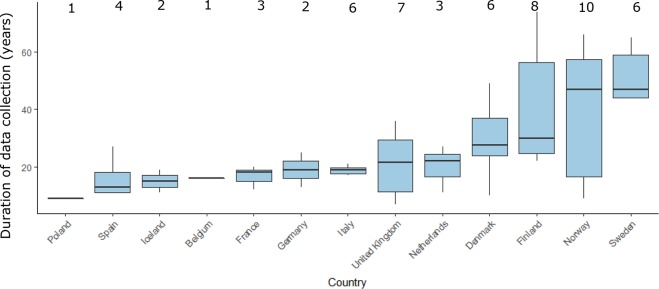
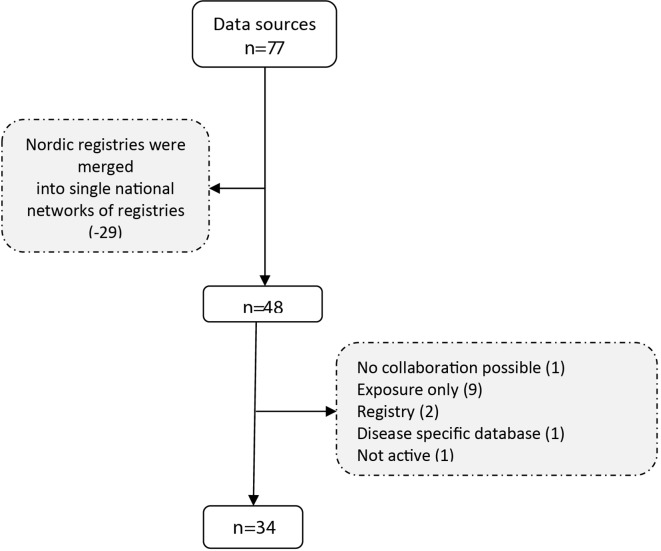
A total of 34 EHDs were selected after applying key criteria relevant for regulatory purposes. The most represented regions were Northern, Central and Western Europe. The most frequent types of data source were electronic medical records (44.1%) and record linkage systems (29.4%). The median number of patients registered in the 34 data sources was 5 million (range 0.07-15 million) while the median time covered by a database was 18.5 years. Paediatric patients were included in 32 databases (94%). Completeness of information on drug exposure was variable. Published validation studies were found for only 17 databases (50%). Some level of access exists for 25 databases (73.5%), and 23 databases (67.6%) can be linked through a personal identification number to other databases with parent-child linkage possible in 7 (21%) databases. Eight databases (23.5%) were already transformed or were in the process of being transformed into a common data model that could facilitate multidatabase studies.
A Few European databases meet minimal regulatory requirements and are readily available to be used in a regulatory context. Accessibility and validity information of the included information needs to be improved. This study confirmed the fragmentation, heterogeneity and lack of transparency existing in many European EHDs.
电子医疗数据库(EHDs)是药物研发和安全性评估的有用工具,但它们在欧洲各地的结构、有效性和获取方式存在异质性,这使得多数据库研究的开展变得复杂。在本文中,我们深入了解现有的电子医疗数据库,以支持药品监管决策。
从欧洲药物流行病学和药物警戒中心网络资源数据库的公开信息、教科书以及基于网络的搜索中识别电子医疗数据库。根据与可及性、纵向维度、暴露和结局记录以及普遍性相关的标准选择数据库。提取的信息与数据库所有者进行了核实。
在应用与监管目的相关的关键标准后,共选择了34个电子医疗数据库。分布最多的地区是北欧、中欧和西欧。最常见的数据来源类型是电子病历(44.1%)和记录链接系统(29.4%)。34个数据源中注册患者的中位数为500万(范围为0.07 - 1500万),而一个数据库涵盖的中位数时间为18.