Wu Bing, Liu Nan, Wintermark Max, Parsons Mark W, Chen Hui, Lin Longting, Zhou Shuai, Hu Gang, Zhang Yongwei, Hu Jun, Li Ying, Su Zihua, Wu Xinhuai, Zhu Guangming
Department of Radiology, PLA Army General Hospital, Beijing, China.
Department of Neurology, PLA Army General Hospital, Beijing, China.
Front Neurol. 2018 Aug 21;9:680. doi: 10.3389/fneur.2018.00680. eCollection 2018.
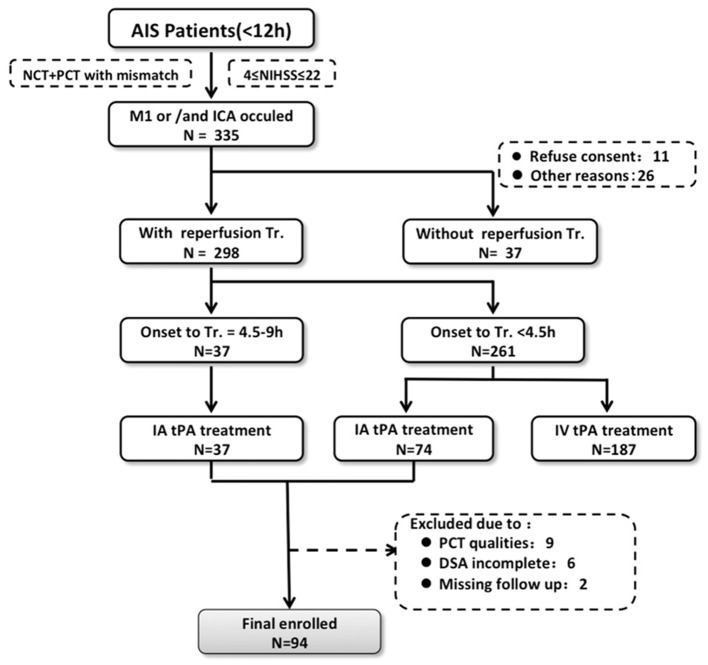
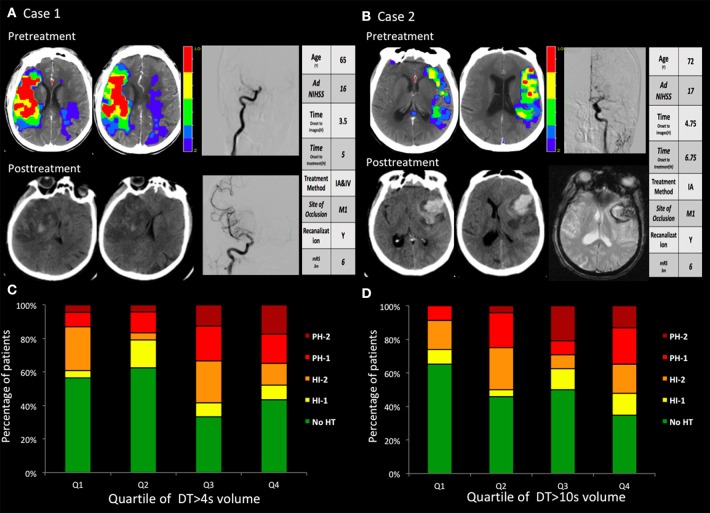
Cerebral hemorrhage is a serious potential complication of stroke revascularization, especially in patients receiving intra-arterial tissue-type plasminogen activator (tPA) therapy. We investigated the optimal pre-intervention delay time (DT) of computed tomography perfusion (CTP) measurement to predict cerebral parenchymal hematoma (PH) in acute ischemic stroke (AIS) patients after intra-arterial tissue plasminogen activator (tPA) treatment. The study population consisted of a series of patients with AIS who received intra-arterial tPA treatment and had CTP and follow-up computed tomography/magnetic resonance imaging (CT/MRI) to identify hemorrhagic transformation. The association of increasing DT thresholds (>2, >4, >6, >8, and >10 s) with PH was examined using receiver operating characteristic (ROC) analysis and logistic regression. Of 94 patients, 23 developed PH on follow-up imaging. Receiver operating characteristic analysis revealed that the greatest area under the curve for predicting PH occurred at DT > 4 s (area under the curve, 0.66). At this threshold of > 4 s, DT lesion volume ≥ 30.85 mL optimally predicted PH with 70% sensitivity and 59% specificity. DT > 4 s volume was independently predictive of PH in a multivariate logistic regression model ( < 0.05). DT > 4 s was the parameter most strongly associated with PH. The volume of moderate, not severe, hypo-perfusion on DT is more strongly associated and may allow better prediction of PH after intra-arterial tPA thrombolysis.
脑出血是卒中血管重建的一种严重潜在并发症,尤其是在接受动脉内组织型纤溶酶原激活剂(tPA)治疗的患者中。我们研究了计算机断层扫描灌注(CTP)测量的最佳干预前延迟时间(DT),以预测急性缺血性卒中(AIS)患者在接受动脉内组织纤溶酶原激活剂(tPA)治疗后的脑实质血肿(PH)。研究人群包括一系列接受动脉内tPA治疗并进行了CTP以及后续计算机断层扫描/磁共振成像(CT/MRI)以确定出血性转化的AIS患者。使用受试者操作特征(ROC)分析和逻辑回归检查了增加的DT阈值(>2、>4、>6、>8和>10秒)与PH的关联。在94例患者中,23例在随访成像时出现了PH。ROC分析显示,预测PH的曲线下面积在DT>4秒时最大(曲线下面积,0.66)。在这个>4秒的阈值下,DT病变体积≥30.85 mL对PH的预测最佳,灵敏度为70%,特异度为59%。在多变量逻辑回归模型中,DT>4秒的体积可独立预测PH(<0.05)。DT>4秒是与PH关联最密切的参数。DT上中度而非重度灌注不足的体积与之关联更强,可能有助于更好地预测动脉内tPA溶栓后的PH。