Olivares Marta, Schüppel Valentina, Hassan Ahmed M, Beaumont Martin, Neyrinck Audrey M, Bindels Laure B, Benítez-Páez Alfonso, Sanz Yolanda, Haller Dirk, Holzer Peter, Delzenne Nathalie M
Metabolism and Nutrition Research Group, Louvain Drug Research Institute, Université catholique de Louvain, Brussels, Belgium.
ZIEL Institute for Food and Health, Technical University of Munich, Freising-Weihenstephan, Germany.
Front Microbiol. 2018 Aug 22;9:1900. doi: 10.3389/fmicb.2018.01900. eCollection 2018.
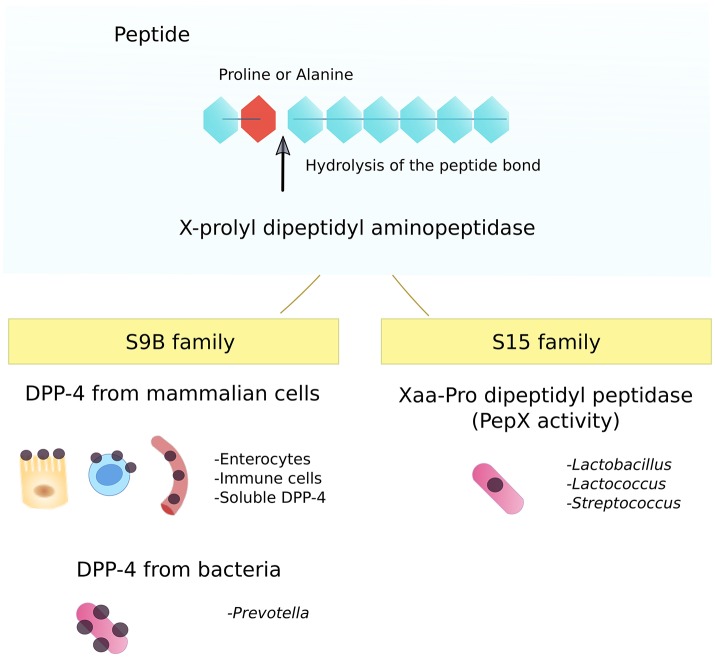
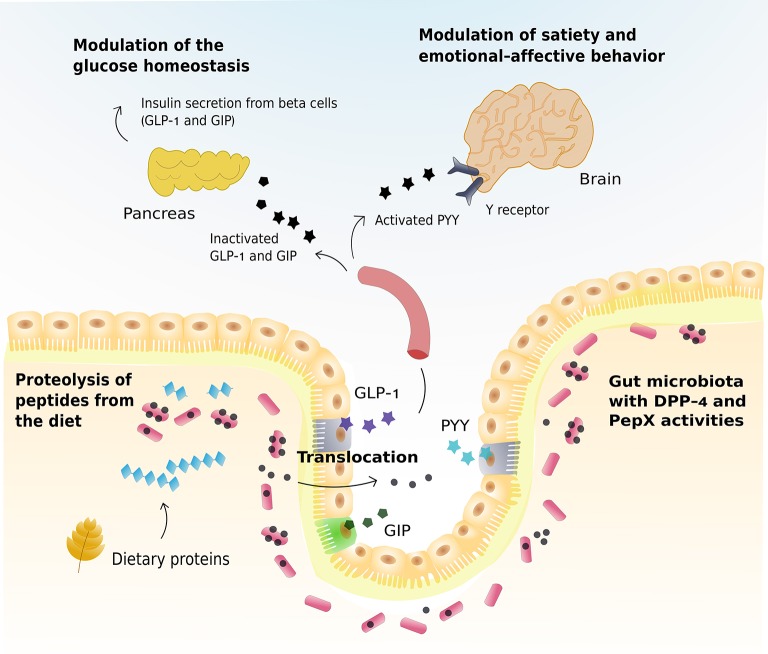
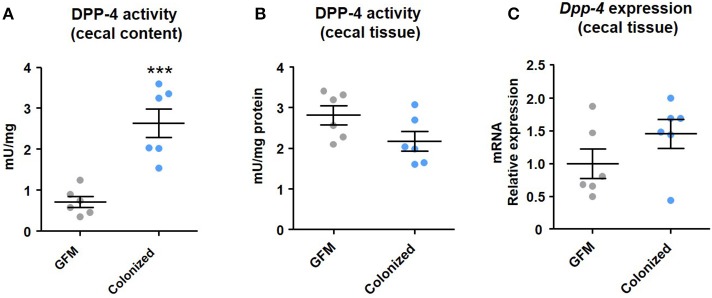
The Dipeptidyl peptidase-4 (DPP-4) activity influences metabolic, behavioral and intestinal disorders through the cleavage of key hormones and peptides. Some studies describe the existence of human DPP-4 homologs in commensal bacteria, for instance in or . However, the role of the gut microbiota as a source of DPP-4-like activity has never been investigated. Through the comparison of the DPP-4 activity in the cecal content of germ-free mice (GFM) and gnotobiotic mice colonized with the gut microbiota of a healthy subject, we bring the proof of concept that a significant DPP-4-like activity occurs in the microbiota. By analyzing the existing literature, we propose that DPP-4-like activity encoded by the intestinal microbiome could constitute a novel mechanism to modulate protein digestion as well as host metabolism and behavior.
二肽基肽酶4(DPP-4)的活性通过切割关键激素和肽来影响代谢、行为及肠道紊乱。一些研究描述了共生菌中存在人类DPP-4同源物,例如在[具体文献1]或[具体文献2]中。然而,肠道微生物群作为DPP-4样活性来源的作用从未被研究过。通过比较无菌小鼠(GFM)盲肠内容物与定殖有健康受试者肠道微生物群的悉生小鼠的DPP-4活性,我们证实了微生物群中存在显著的DPP-4样活性这一概念。通过分析现有文献,我们提出肠道微生物组编码的DPP-4样活性可能构成一种调节蛋白质消化以及宿主代谢和行为的新机制。