Ding Lei, Lu Zhifeng, Gao Limin, Guo Shiwei, Shen Qirong
Jiangsu Provincial Key Lab for Organic Solid Waste Utilization, National Engineering Research Center for Organic-based Fertilizers, Jiangsu Collaborative Innovation Center for Solid Organic Waste Resource Utilization, Nanjing Agricultural University, Nanjing, China.
Louvain Institute of Biomolecular Science and Technology, Université catholique de Louvain, Louvain-la-Neuve, Belgium.
Front Plant Sci. 2018 Aug 22;9:1143. doi: 10.3389/fpls.2018.01143. eCollection 2018.
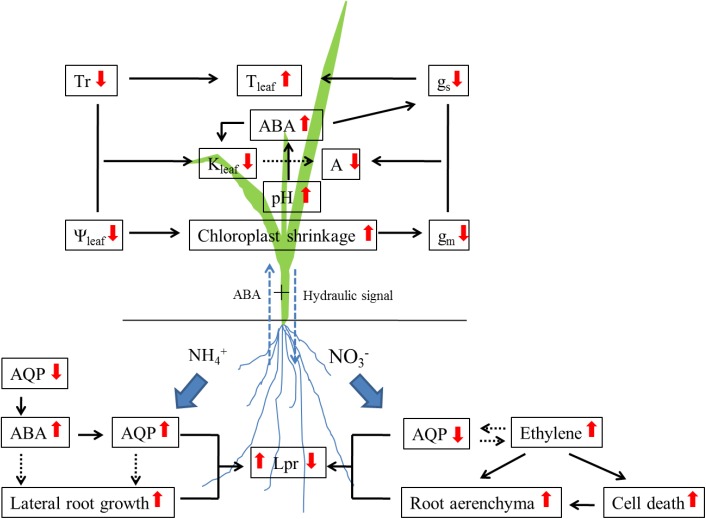
Drought stress is a major global issue limiting agricultural productivity. Plants respond to drought stress through a series of physiological, cellular, and molecular changes for survival. The regulation of water transport and photosynthesis play crucial roles in improving plants' drought tolerance. Nitrogen (N, ammonium and nitrate) is an essential macronutrient for plants, and it can affect many aspects of plant growth and metabolic pathways, including water relations and photosynthesis. This review focuses on how drought stress affects water transport and photosynthesis, including the regulation of hydraulic conductance, aquaporin expression, and photosynthesis. It also discusses the cross talk between N, water transport, and drought stress in higher plants.
干旱胁迫是限制农业生产力的一个主要全球性问题。植物通过一系列生理、细胞和分子变化来应对干旱胁迫以求得生存。水分运输和光合作用的调节在提高植物耐旱性方面起着关键作用。氮(N,铵和硝酸盐)是植物必需的大量营养素,它会影响植物生长和代谢途径的许多方面,包括水分关系和光合作用。本综述重点关注干旱胁迫如何影响水分运输和光合作用,包括水力导度、水通道蛋白表达和光合作用的调节。它还讨论了高等植物中氮、水分运输和干旱胁迫之间的相互作用。