Pérez-Moncada Urley A, Santander Christian, Ruiz Antonieta, Vidal Catalina, Santos Cledir, Cornejo Pablo
Doctorado en Ciencias de Recursos Naturales, Universidad de La Frontera, P.O. Box 54-D, Temuco 4811230, Chile.
Departamento de Ciencias Químicas y Recursos Naturales, Universidad de La Frontera, P.O. Box 54-D, Temuco 4780000, Chile.
Plants (Basel). 2024 Jun 4;13(11):1556. doi: 10.3390/plants13111556.
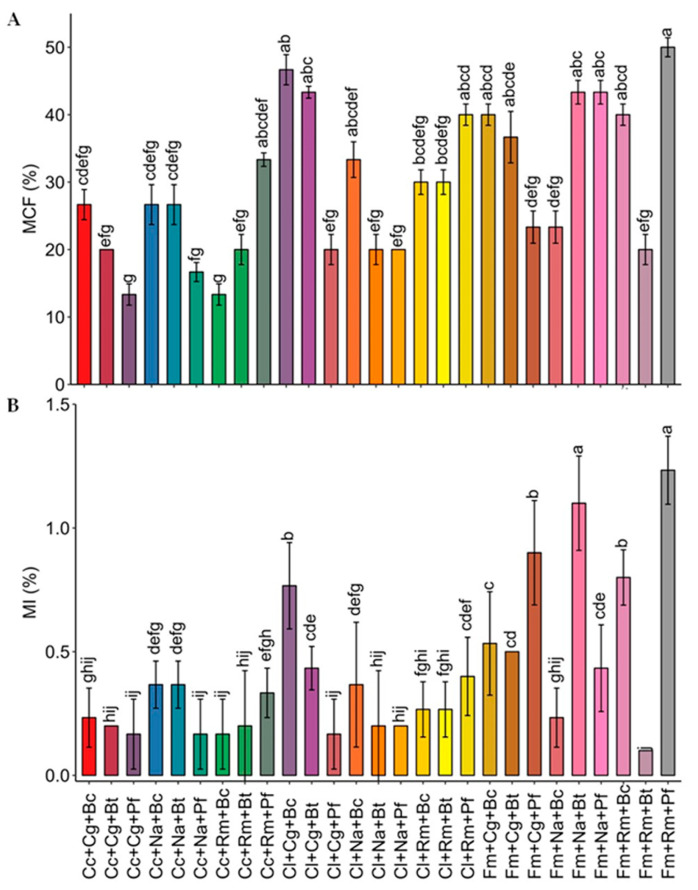
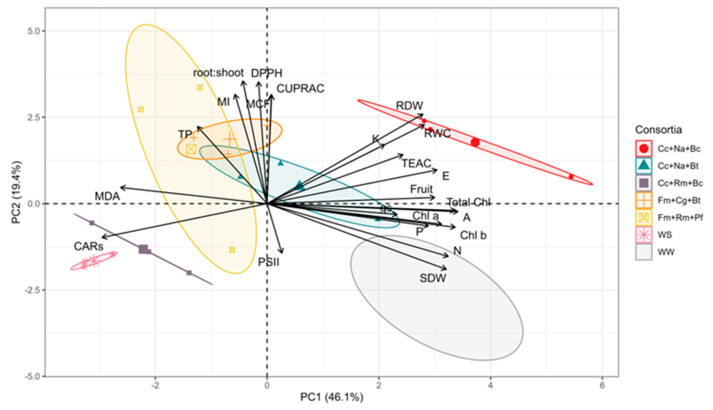
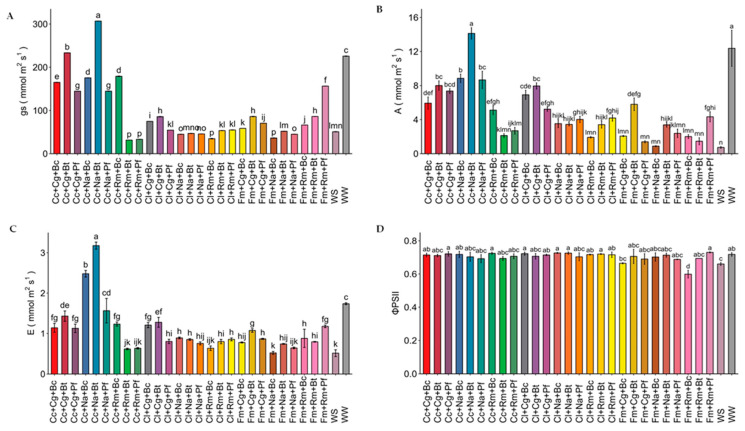
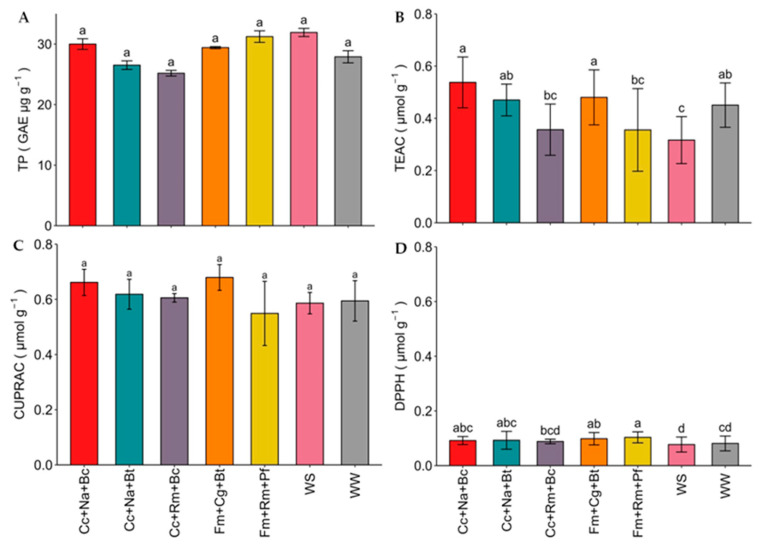
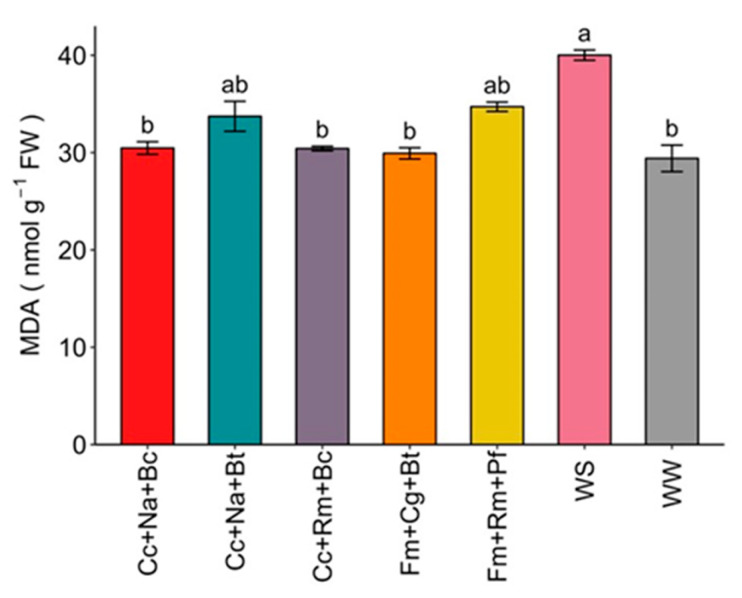
Drought affects several plant physiological characteristics such as photosynthesis, carbon metabolism, and chlorophyll content, causing hormonal and nutritional imbalances and reducing nutrient uptake and transport, which inhibit growth and development. The use of bioinoculants based on plant growth-promoting microorganisms such as plant growth-promoting rhizobacteria (PGPR), yeasts, and arbuscular mycorrhizal fungi (AMF) has been proposed as an alternative to help plants tolerate drought. However, most studies have been based on the use of a single type of microorganism, while consortia studies have been scarcely performed. Therefore, the aim of this study was to evaluate different combinations of three PGPR, three AMF, and three yeasts with plant growth-promoting attributes to improve the biochemical, nutritional, and physiological behavior of strawberry plants growing under severe drought. The results showed that the growth and physiological attributes of the non-inoculated plants were significantly reduced by drought. In contrast, plants inoculated with the association of the fungus , the yeast , and the rhizobacterium showed a stronger improvement in tolerance to drought. High biomass, relative water content, fruit number, photosynthetic rate, transpiration, stomatal conductance, quantum yield of photosystem II, N concentration, P concentration, K concentration, antioxidant activities, and chlorophyll contents were significantly improved in inoculated plants by up to 16.6%, 12.4%, 81.2%, 80%, 79.4%, 71.0%, 17.8%, 8.3%, 6.6%, 57.3%, 41%, and 22.5%, respectively, compared to stressed non-inoculated plants. Moreover, decreased malondialdehyde levels by up to 32% were registered. Our results demonstrate the feasibility of maximizing the effects of inoculation with beneficial rhizosphere microorganisms based on the prospect of more efficient combinations among different microbial groups, which is of interest to develop bioinoculants oriented to increase the growth of specific plant species in a global scenario of increasing drought stress.
干旱会影响多种植物生理特性,如光合作用、碳代谢和叶绿素含量,导致激素和营养失衡,减少养分吸收和运输,从而抑制生长发育。基于促进植物生长的微生物(如植物促生根际细菌(PGPR)、酵母和丛枝菌根真菌(AMF))的生物接种剂已被提议作为帮助植物耐受干旱的一种替代方法。然而,大多数研究基于单一类型微生物的使用,而关于微生物组合的研究很少进行。因此,本研究的目的是评估三种具有促进植物生长特性的PGPR、三种AMF和三种酵母的不同组合,以改善在严重干旱条件下生长的草莓植株的生化、营养和生理表现。结果表明,干旱显著降低了未接种植株的生长和生理特性。相比之下,接种了真菌、酵母和根际细菌组合的植株对干旱的耐受性有更强的改善。与受胁迫的未接种植株相比,接种植株的高生物量、相对含水量、果实数量、光合速率、蒸腾作用、气孔导度、光系统II的量子产量、氮浓度、磷浓度、钾浓度、抗氧化活性和叶绿素含量分别显著提高了16.6%、12.4%、81.2%、80%、79.4%、71.0%、17.8%、8.3%、6.6%、57.3%、41%和22.5%。此外,丙二醛水平降低了32%。我们的结果证明了基于不同微生物群体间更有效组合的前景,最大化有益根际微生物接种效果的可行性,这对于开发旨在在全球干旱胁迫加剧的情况下增加特定植物物种生长的生物接种剂具有重要意义。