University of Oslo, Oslo, Norway.
CERN, Geneva, Switzerland.
Nature. 2018 Sep;561(7723):363-367. doi: 10.1038/s41586-018-0485-4. Epub 2018 Aug 29.
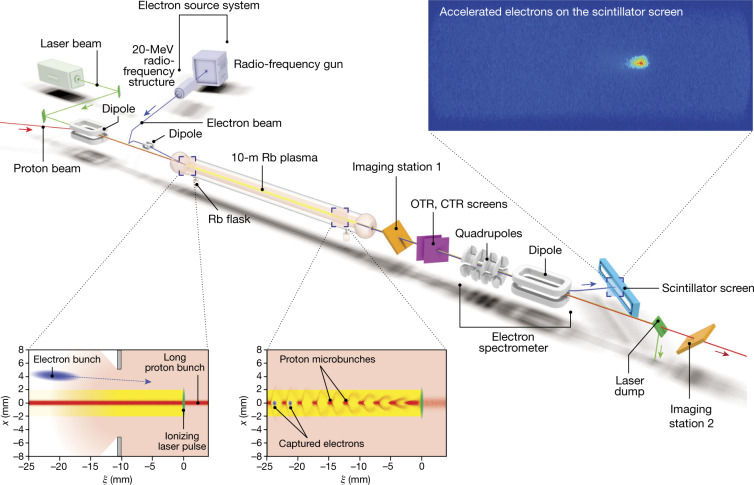
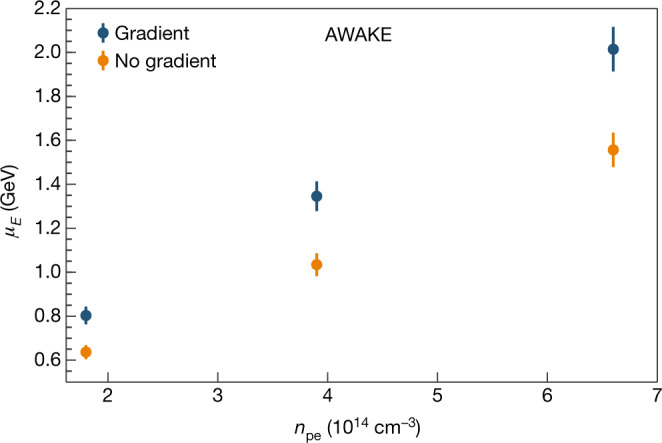
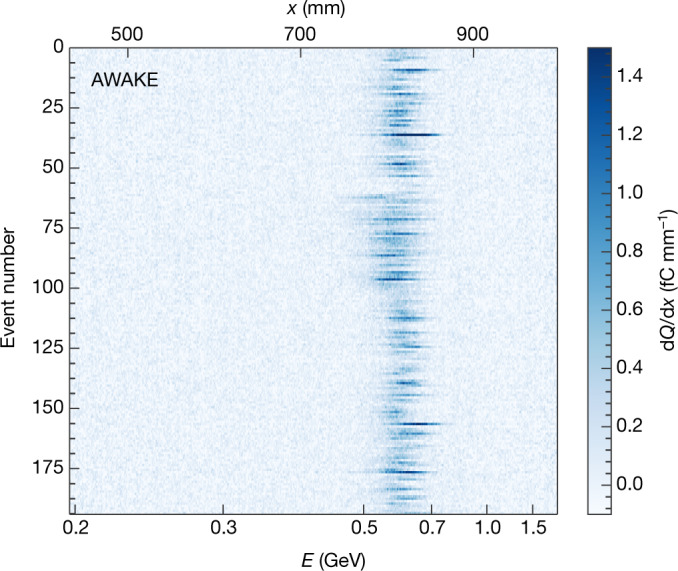
High-energy particle accelerators have been crucial in providing a deeper understanding of fundamental particles and the forces that govern their interactions. To increase the energy of the particles or to reduce the size of the accelerator, new acceleration schemes need to be developed. Plasma wakefield acceleration, in which the electrons in a plasma are excited, leading to strong electric fields (so called 'wakefields'), is one such promising acceleration technique. Experiments have shown that an intense laser pulse or electron bunch traversing a plasma can drive electric fields of tens of gigavolts per metre and above-well beyond those achieved in conventional radio-frequency accelerators (about 0.1 gigavolt per metre). However, the low stored energy of laser pulses and electron bunches means that multiple acceleration stages are needed to reach very high particle energies. The use of proton bunches is compelling because they have the potential to drive wakefields and to accelerate electrons to high energy in a single acceleration stage. Long, thin proton bunches can be used because they undergo a process called self-modulation, a particle-plasma interaction that splits the bunch longitudinally into a series of high-density microbunches, which then act resonantly to create large wakefields. The Advanced Wakefield (AWAKE) experiment at CERN uses high-intensity proton bunches-in which each proton has an energy of 400 gigaelectronvolts, resulting in a total bunch energy of 19 kilojoules-to drive a wakefield in a ten-metre-long plasma. Electron bunches are then injected into this wakefield. Here we present measurements of electrons accelerated up to two gigaelectronvolts at the AWAKE experiment, in a demonstration of proton-driven plasma wakefield acceleration. Measurements were conducted under various plasma conditions and the acceleration was found to be consistent and reliable. The potential for this scheme to produce very high-energy electron bunches in a single accelerating stage means that our results are an important step towards the development of future high-energy particle accelerators.
高能粒子加速器在深入了解基本粒子及其相互作用的力方面发挥了至关重要的作用。为了提高粒子的能量或缩小加速器的尺寸,需要开发新的加速方案。等离子体尾流加速是一种很有前途的加速技术,其中等离子体中的电子被激发,产生强电场(所谓的“尾流”)。实验表明,强激光脉冲或电子束穿过等离子体可以产生数十千兆伏/米以上的电场,远远超过传统射频加速器(约 0.1 千兆伏/米)所能达到的电场。然而,激光脉冲和电子束储存的能量较低,这意味着需要多个加速阶段才能达到非常高的粒子能量。质子束的使用很有吸引力,因为它们有可能在单个加速阶段中驱动尾流并将电子加速到高能。长而细的质子束可以使用,因为它们会经历一种称为自调制的过程,这是一种粒子-等离子体相互作用,它将束纵向分裂成一系列高密度微束,然后共振产生大的尾流。欧洲核子研究中心(CERN)的先进尾流实验(AWAKE)使用高强度质子束,每个质子的能量为 400 吉电子伏特,总束能量为 19 千焦耳,在一个 10 米长的等离子体中驱动尾流。然后将电子束注入到这个尾流中。在这里,我们展示了在 AWAKE 实验中,质子驱动等离子体尾流加速可将电子加速到 2 吉电子伏特,这证明了该方案的可行性。在各种等离子体条件下进行了测量,结果表明加速是一致和可靠的。该方案在单个加速阶段产生非常高能电子束的潜力意味着,我们的结果是朝着开发未来高能粒子加速器迈出的重要一步。