Developmental Biology & Cancer Programme, UCL Great Ormond Street Institute of Child Health, University College London, London, UK.
Department of Molecular Medicine and Surgery, Karolinska Institute, Stockholm, Sweden.
Hum Mol Genet. 2018 Dec 15;27(24):4218-4230. doi: 10.1093/hmg/ddy313.
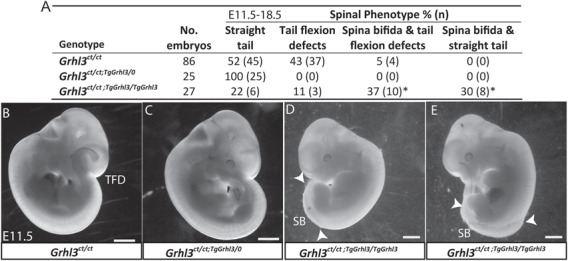
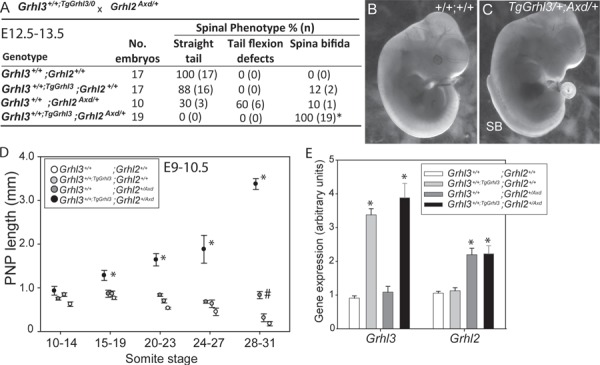
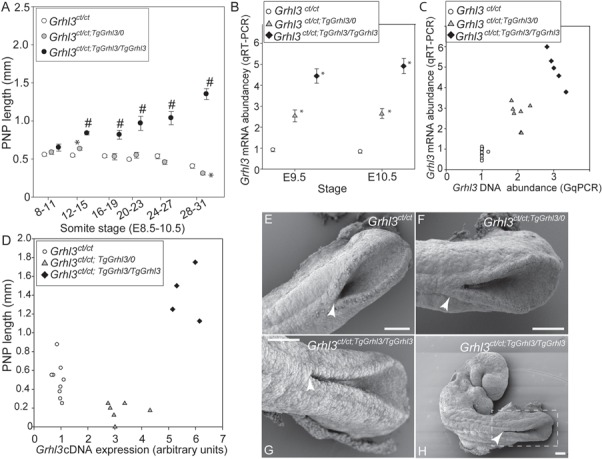
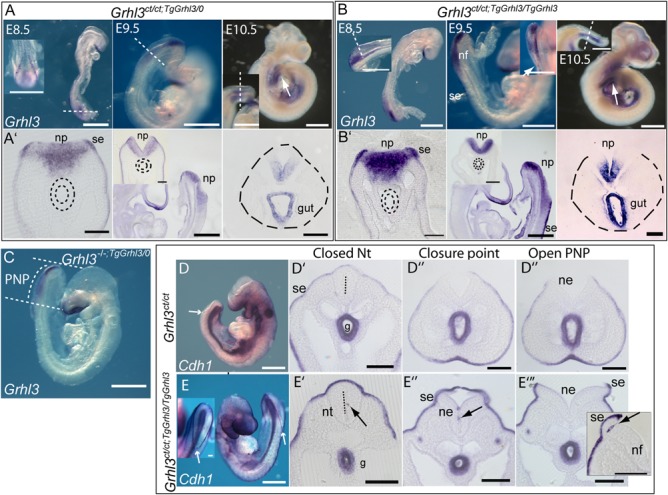
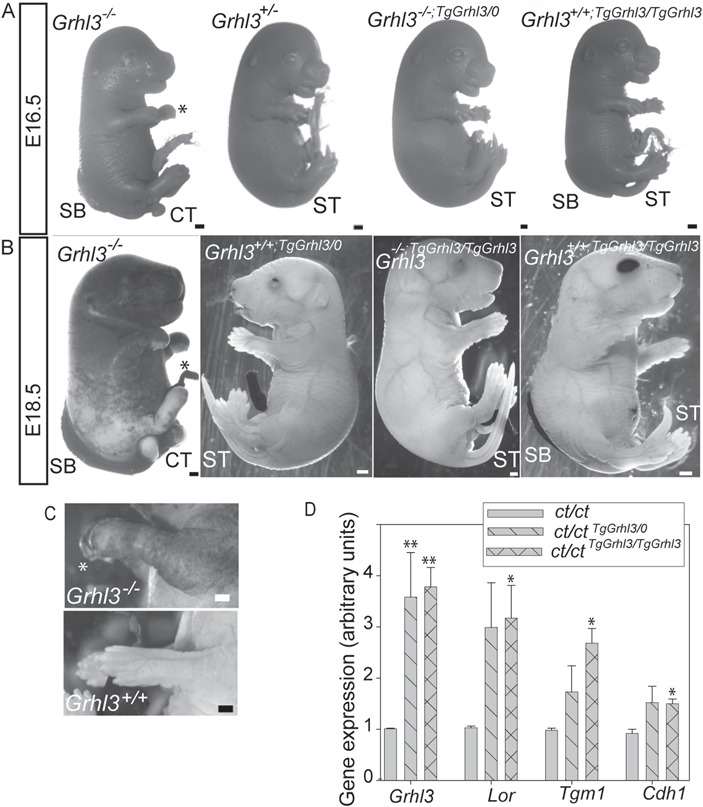
The genetic basis of human neural tube defects (NTDs), such as anencephaly and spina bifida (SB), is complex and heterogeneous. Grainyhead-like genes represent candidates for involvement in NTDs based on the presence of SB and exencephaly in mice carrying loss-of-function alleles of Grhl2 or Grhl3. We found that reinstatement of Grhl3 expression, by bacterial artificial chromosome (BAC)-mediated transgenesis, prevents SB in Grhl3-null embryos, as in the Grhl3 hypomorphic curly tail strain. Notably, however, further increase in expression of Grhl3 causes highly penetrant SB. Grhl3 overexpression recapitulates the spinal NTD phenotype of loss-of-function embryos, although the underlying mechanism differs. However, it does not phenocopy other defects of Grhl3-null embryos such as abnormal axial curvature, cranial NTDs (exencephaly) or skin barrier defects, the latter being rescued by the Grhl3-transgene. Grhl2 and Grhl3 can form homodimers and heterodimers, suggesting a possible model in which defects arising from overexpression of Grhl3 result from sequestration of Grhl2 in heterodimers, mimicking Grhl2 loss of function. This hypothesis predicts that increased abundance of Grhl2 would have an ameliorating effect in Grhl3 overexpressing embryo. Instead, we observed a striking additive genetic interaction between Grhl2 and Grhl3 gain-of-function alleles. Severe SB arose in embryos in which both genes were expressed at moderately elevated levels that individually do not cause NTDs. Furthermore, moderate Grhl3 overexpression also interacted with the Vangl2Lp allele to cause SB, demonstrating genetic interaction with the planar cell polarity signalling pathway that is implicated in mouse and human NTDs.
人类神经管缺陷(NTDs)的遗传基础复杂且具有异质性,例如无脑畸形和脊柱裂(SB)。基于携带 Grhl2 或 Grhl3 功能丧失等位基因的小鼠存在 SB 和无脑畸形,颗粒头样基因代表了参与 NTDs 的候选基因。我们发现,通过细菌人工染色体(BAC)介导的转基因使 Grhl3 表达恢复,可防止 Grhl3 缺失胚胎发生 SB,这与 Grhl3 功能减弱的卷曲尾巴品系相同。值得注意的是,然而,Grhl3 表达的进一步增加导致高度穿透性 SB。Grhl3 过表达重现了功能丧失胚胎的脊柱 NTD 表型,尽管潜在的机制不同。然而,它不能模拟 Grhl3 缺失胚胎的其他缺陷,例如异常的轴向曲率、颅 NTD(无脑畸形)或皮肤屏障缺陷,后者可被 Grhl3 转基因挽救。Grhl2 和 Grhl3 可以形成同源二聚体和异源二聚体,这表明一种可能的模型,即 Grhl3 过表达引起的缺陷可能是由于 Grhl2 被异源二聚体隔离,模拟 Grhl2 功能丧失。该假说预测,Grhl2 丰度的增加将对 Grhl3 过表达胚胎产生改善作用。相反,我们观察到 Grhl2 和 Grhl3 功能获得性等位基因之间存在显著的遗传相互作用。当两个基因以中等水平表达时,胚胎中会出现严重的 SB,而单独表达时不会导致 NTDs。此外,中度 Grhl3 过表达还与 Vangl2Lp 等位基因相互作用导致 SB,这表明与平面细胞极性信号通路存在遗传相互作用,该通路与小鼠和人类 NTDs 有关。