Global Health - Health Systems and Policy, Department of Public Health Sciences, Karolinska Institutet, Stockholm, Sweden.
Department of Nephrology, Guangdong Provincial Hospital of Chinese Medicine, The Second Affiliated Hospital, Guangzhou University of Chinese Medicine, Guangzhou city, Guangdong Province, China.
Sci Rep. 2018 Sep 6;8(1):13372. doi: 10.1038/s41598-018-31612-1.
Antibiotic resistance is a major global health threat. High prevalences of colonization and infection with multi-drug resistance organisms (MDROs) have been reported in patients undergoing dialysis. It is unknown if this finding extends to patients with mild and moderate/severe kidney disease. An observational study included all adult incident patients hospitalized with a discharge diagnosis of infection in four hospitals from Guangzhou, China.
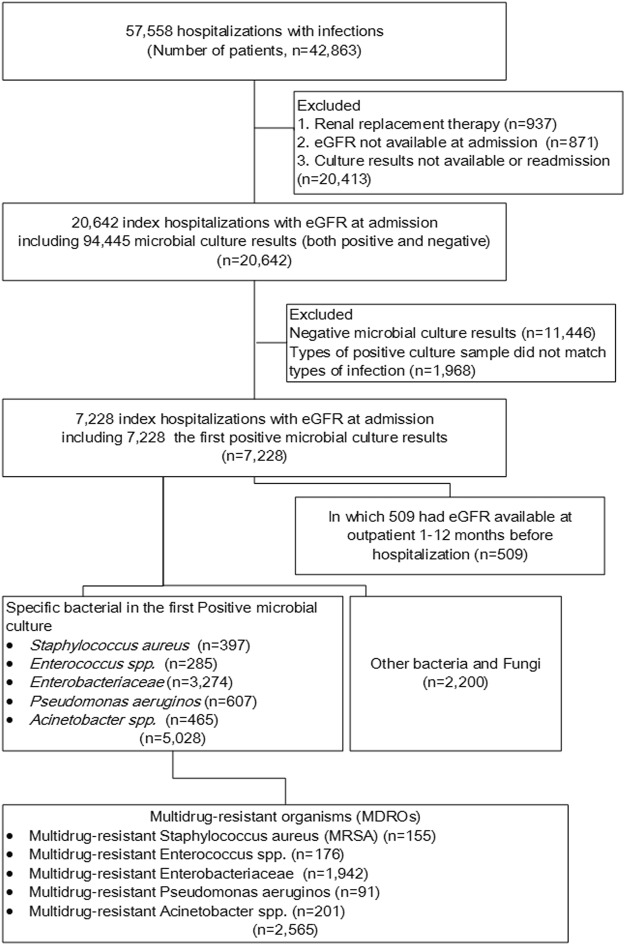
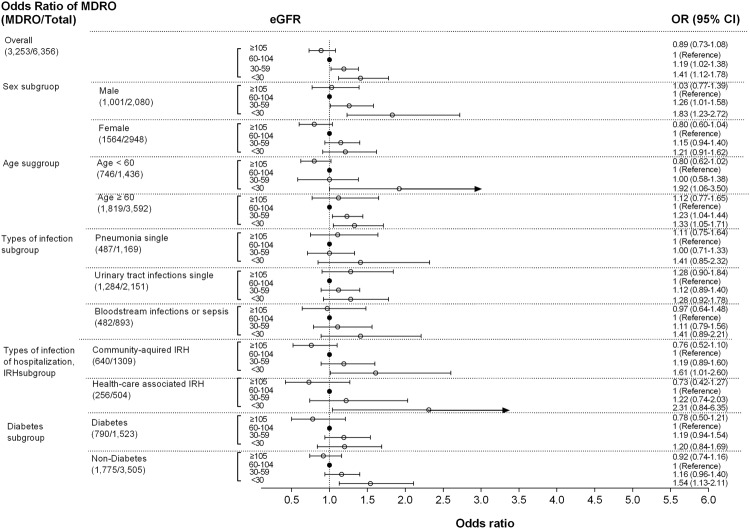
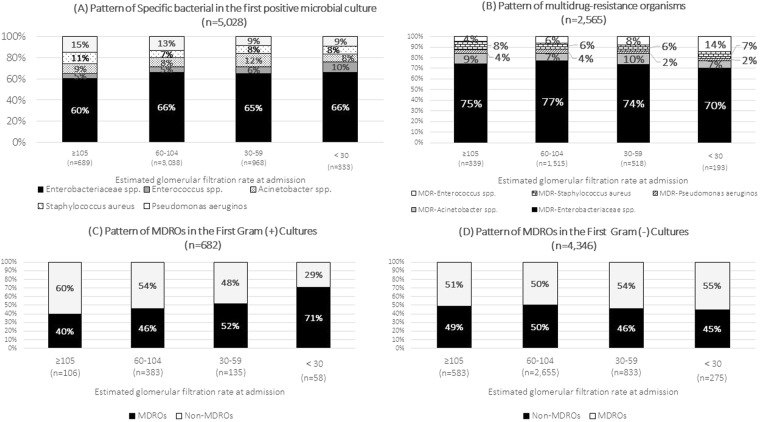
Serum creatinine measurement at admission together with microbial culture confirmed infections. Exclusion criterion: Undergoing renal replacement therapy. Four categories of Chronic Kidney Disease Epidemiology Collaboration (CKD-EPI) estimated glomerular filtration rate (eGFR) were compared: eGFR ≥ 105, 60-104 (reference), 30-59, and <30 ml/min/1.73 m. The odds ratio of MDROs, defined as specific pathogens (Staphylococcus aureus, Enterococcus spp., Enterobacteriaceae, Pseudomonas aeruginosa and Acinetobacter spp.) resistant to three or more antibiotic classes, were calculated using a multivariable logistic regression model across eGFR strata. Of 94,445 total microbial culture records, 7,288 first positive cultures matched to infection diagnosis were selected. Among them, 5,028 (68.9%) were potential MDROs. The odds of infections by MDROs was 19% and 41% higher in those with eGFR between 30-59 ml/min/1.73 m (Adjusted odds ratio, AOR): 1.19, 95% CI:1.02-1.38, P = 0.022) and eGFR < 30 ml/min/1.73 m (AOR: 1.41, 95% CI:1.12-1.78, P = 0.004), respectively. Patients with impaired renal function have a higher risk of infections by MDROs. Kidney dysfunction at admission may be an indicator for need of closer attention to microbial culture results requiring subsequent change of antibiotics.
抗生素耐药性是一个主要的全球健康威胁。在接受透析的患者中,已报道了多重耐药菌(MDROs)定植和感染的高流行率。但目前尚不清楚这一发现是否适用于轻度和中度/重度肾功能不全的患者。
这项观察性研究纳入了来自中国广州四家医院的所有因感染住院且有出院诊断的成年初治患者。
入院时进行血清肌酐检测,同时进行微生物培养以确认感染。排除标准:接受肾脏替代治疗。比较了慢性肾脏病流行病学合作(CKD-EPI)估计肾小球滤过率(eGFR)的四个类别:eGFR≥105、60-104(参考值)、30-59 和<30ml/min/1.73m。使用多变量逻辑回归模型,按 eGFR 分层计算 MDROs(定义为对三种或更多种抗生素类别耐药的特定病原体:金黄色葡萄球菌、肠球菌属、肠杆菌科、铜绿假单胞菌和不动杆菌属)的比值比。在 94445 份微生物培养记录中,有 7288 份首次阳性培养与感染诊断相匹配。其中,5028 份(68.9%)为潜在 MDROs。在 eGFR 为 30-59ml/min/1.73m 的患者中,MDROs 感染的几率增加了 19%(调整比值比,AOR:1.19,95%CI:1.02-1.38,P=0.022),而 eGFR<30ml/min/1.73m 的患者则增加了 41%(AOR:1.41,95%CI:1.12-1.78,P=0.004)。肾功能受损的患者感染 MDROs 的风险更高。入院时的肾功能障碍可能是需要更密切关注微生物培养结果并随后改变抗生素的指标。