
阿尔茨海默病患者大脑中特定区域突触线粒体的耗竭。
Region-specific depletion of synaptic mitochondria in the brains of patients with Alzheimer's disease.
机构信息
Centre for Discovery Brain Sciences, UK Dementia Research Institute, The University of Edinburgh, 1 George Square, Edinburgh, EH8 9JZ, UK.
Centre for Clinical Brain Sciences, Edinburgh Brain and Tissue Bank, The University of Edinburgh, Edinburgh, UK.
出版信息
Acta Neuropathol. 2018 Nov;136(5):747-757. doi: 10.1007/s00401-018-1903-2. Epub 2018 Sep 6.
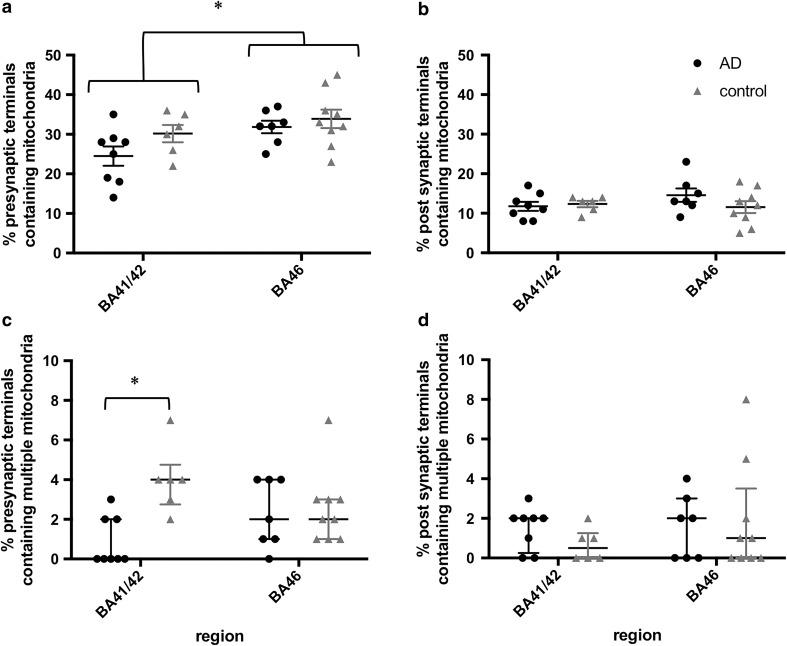
Of all of the neuropathological changes observed in Alzheimer's disease (AD), the loss of synapses correlates most strongly with cognitive decline. The precise mechanisms of synapse degeneration in AD remain unclear, although strong evidence indicates that pathological forms of both amyloid beta and tau contribute to synaptic dysfunction and loss. Synaptic mitochondria play a potentially important role in synapse degeneration in AD. Many studies in model systems indicate that amyloid beta and tau both impair mitochondrial function and impair transport of mitochondria to synapses. To date, much less is known about whether synaptic mitochondria are affected in human AD brain. Here, we used transmission electron microscopy to examine synapses and synaptic mitochondria in two cortical regions (BA41/42 and BA46) from eight AD and nine control cases. In this study, we observed 3000 synapses and find region-specific differences in synaptic mitochondria in AD cases compared to controls. In BA41/42, we observe a fourfold reduction in the proportion of presynaptic terminals that contain multiple mitochondria profiles in AD. We also observe ultrastructural changes including abnormal mitochondrial morphology, the presence of multivesicular bodies in synapses, and reduced synapse apposition length near plaques in AD. Together, our data show region-specific changes in synaptic mitochondria in AD and support the idea that the transport of mitochondria to presynaptic terminals or synaptic mitochondrial dynamics may be altered in AD.
在阿尔茨海默病(AD)中观察到的所有神经病理学变化中,突触的丧失与认知能力下降相关性最强。尽管有强有力的证据表明淀粉样β和 tau 的病理形式都导致了突触功能障碍和丧失,但 AD 中突触退化的确切机制仍不清楚。突触线粒体在 AD 中的突触退化中可能起着重要作用。许多模型系统的研究表明,淀粉样β和 tau 都损害了线粒体功能并损害了线粒体向突触的运输。迄今为止,关于人类 AD 大脑中是否存在突触线粒体受到影响的了解要少得多。在这里,我们使用透射电子显微镜检查了来自 8 个 AD 和 9 个对照病例的两个皮质区域(BA41/42 和 BA46)中的突触和突触线粒体。在这项研究中,我们观察了 3000 个突触,并发现 AD 病例与对照组相比,突触线粒体存在区域特异性差异。在 BA41/42 中,我们观察到 AD 中包含多个线粒体轮廓的突触前末端的比例减少了四倍。我们还观察到超微结构变化,包括线粒体形态异常、突触中多泡体的存在以及 AD 斑块附近突触贴合长度的减少。总之,我们的数据显示 AD 中突触线粒体存在区域特异性变化,并支持这样的观点,即线粒体向突触前末端的运输或突触线粒体动力学可能在 AD 中发生改变。



 Zotero 插件