Women's Mood Disorders Center, Departments of Psychiatry & Behavioral Sciences and Gynecology & Obstetrics, Johns Hopkins University School of Medicine, 550 N. Broadway, Suite 305C, Baltimore, MD 21205, United States.
Johns Hopkins Biostatistics Center, Department of Biostatistics, Johns Hopkins Bloomberg School of Public Health, Baltimore, MD, United States.
Psychoneuroendocrinology. 2019 Jan;99:80-86. doi: 10.1016/j.psyneuen.2018.08.038. Epub 2018 Aug 31.
There are complex associations between immune function and mental illness, yet studies in the perinatal period focus primarily on individual inflammatory markers and depressive symptoms only, cross-sectionally. We sought to examine associations between both depressive and anxious symptoms and immune activation longitudinally across the peripartum.
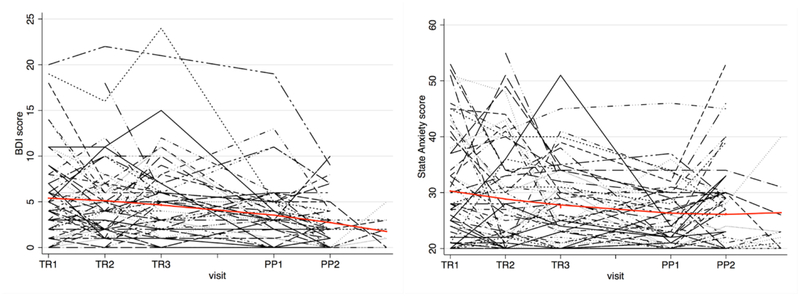
We measured mood (Beck Depression Inventory, BDI-1 A) and anxiety (State-Trait Anxiety Inventory, STATE) and levels of 23 cytokines at 5 points in pregnancy and postpartum in 51 women. Within subject cytokine trajectories over time by depressive and anxious symptom grouping were assessed using linear mixed effects models with random intercept and slope. We also undertook an exploratory cluster analysis based on third trimester cytokine values.
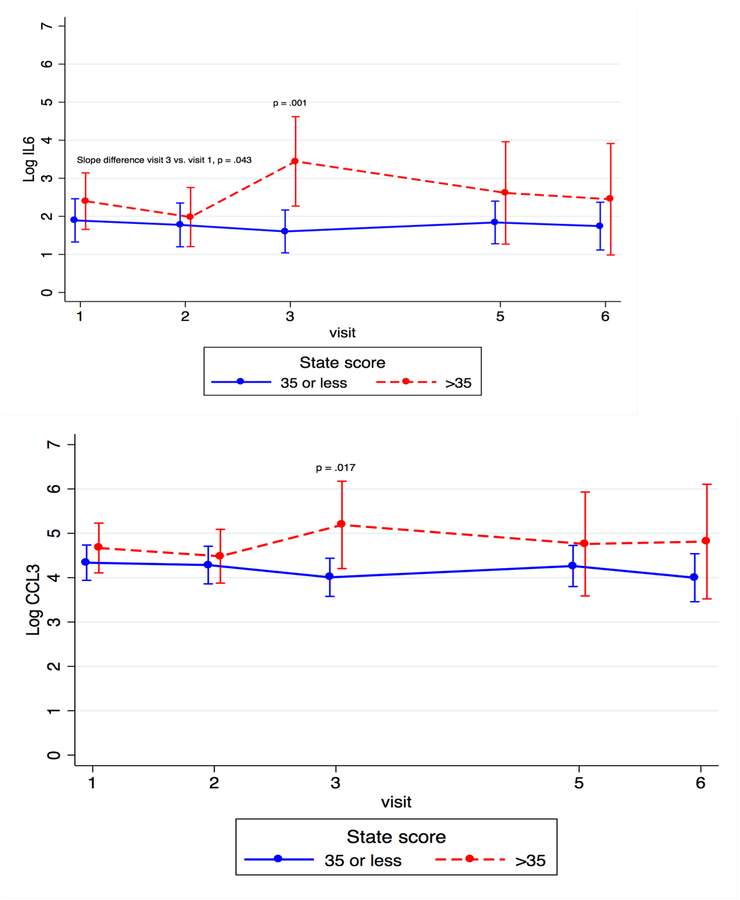
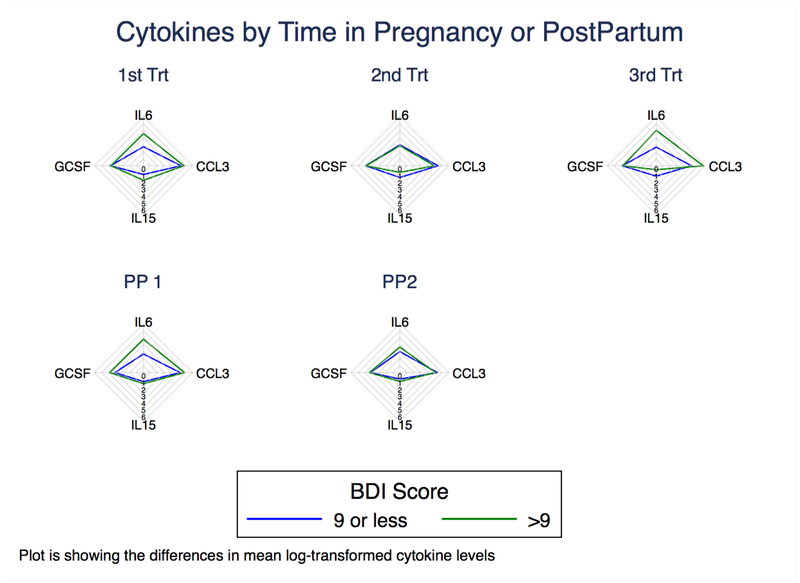
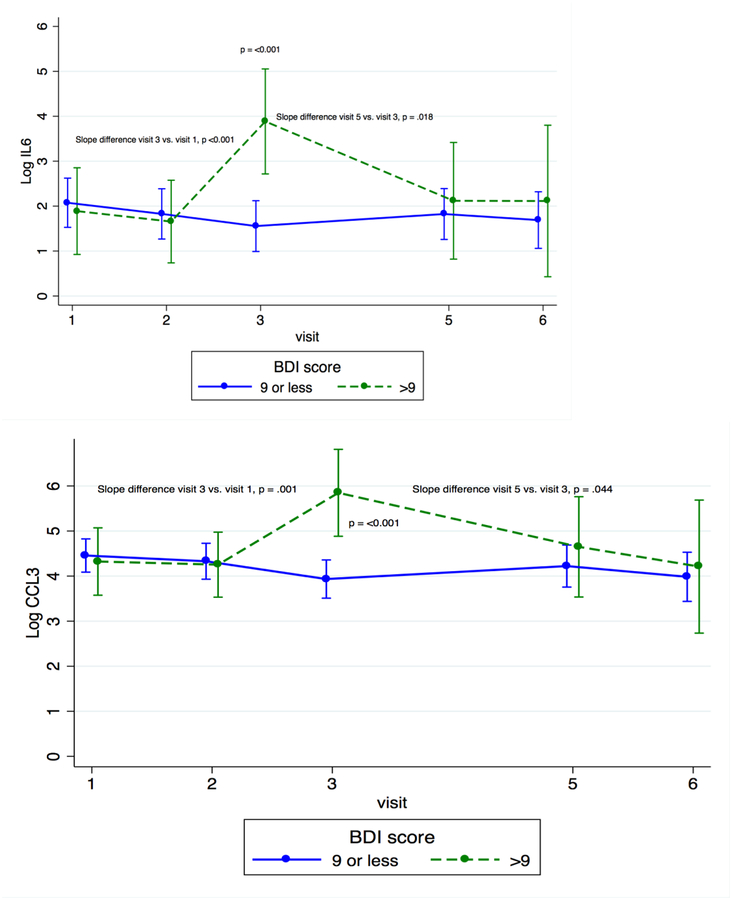
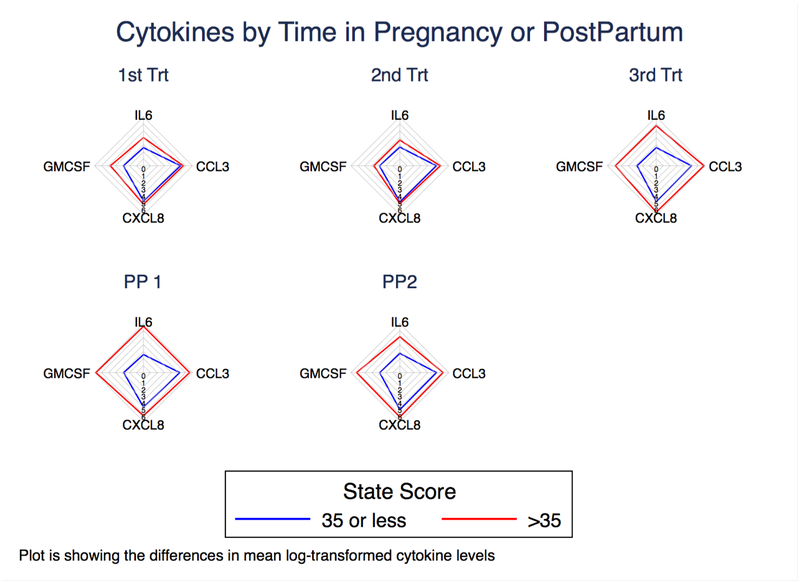
Based on categorical BDI scores, IL-6 (p < 0.001), IL-15 (p = 0.047), GCSF (p = 0.003), and CCL3 (p < .001) were significantly different across time, with IL-6 (p < 0.001), IL-15 (p = 0.003), and CCL3 (p < 0.001) higher at the third trimester visit in more depressed subjects. Based on categorical STATE scores, GM-CSF significantly decreased across pregnancy for the less anxious group (p = 0.016), but not for the more anxious, and CCL3 (p = 0.017), CXCL8 (p = 0.011), and IL-6 (p < 0.001) were higher at the third trimester visit for more anxious subjects. In exploratory cluster analysis based on cytokine level, there were no differences in mood or anxiety scores, but significant differences by race/ethnicity and overweight/obesity status. Women with higher pro-inflammatory cytokine values are more likely to be Hispanics (69.2% vs. 21.4%, p = 0.015), but less likely to be African American (23.1% vs. 60.7%, p = 0.015) or overweight/obese (25% vs. 69.2%, p = 0.016) compared to women with lower pro-inflammatory cytokine values.
We identified a pro-inflammatory burst at the third trimester, indicative of innate immune activation, in women with higher levels of both depressive and anxious symptoms, as well as differences in pro-inflammatory changes across time. We also found significant differences in cytokine levels by race, ethnicity, and overweight/obesity status. These results point the way toward future longitudinal work that considers race/ethnicity, timing, and weight status, and evaluates perinatal mood and anxiety disorders in the context of changing immune functioning across the peripartum.
免疫功能与精神疾病之间存在复杂的关联,但围产期研究主要集中在个体炎症标志物和抑郁症状上,且都是横截面研究。我们试图在围产期内纵向研究抑郁和焦虑症状与免疫激活之间的关系。
我们在妊娠和产后的 5 个时间点测量了 51 名女性的情绪(贝克抑郁量表,BDI-1A)和焦虑(状态-特质焦虑量表,STATE)以及 23 种细胞因子的水平。采用具有随机截距和斜率的线性混合效应模型评估按抑郁和焦虑症状分组的个体细胞因子随时间的变化轨迹。我们还基于第三个三个月的细胞因子值进行了探索性聚类分析。
基于 BDI 的分类评分,IL-6(p<0.001)、IL-15(p=0.047)、GCSF(p=0.003)和 CCL3(p<0.001)在时间上存在显著差异,在抑郁程度较高的受试者中,IL-6(p<0.001)、IL-15(p=0.003)和 CCL3(p<0.001)在第三个三个月的就诊时更高。基于 STATE 的分类评分,对于不太焦虑的组,GM-CSF 在整个孕期呈下降趋势(p=0.016),但对于更焦虑的组则不然,且 CCL3(p=0.017)、CXCL8(p=0.011)和 IL-6(p<0.001)在第三个三个月的就诊时对于更焦虑的受试者更高。基于细胞因子水平的探索性聚类分析中,情绪或焦虑评分没有差异,但在种族/民族和超重/肥胖状态方面存在显著差异。具有更高促炎细胞因子值的女性更有可能是西班牙裔(69.2%比 21.4%,p=0.015),而不太可能是非裔美国人(23.1%比 60.7%,p=0.015)或超重/肥胖(25%比 69.2%,p=0.016)与具有较低促炎细胞因子值的女性相比。
我们发现,在患有较高水平抑郁和焦虑症状的女性中,第三个三个月出现了促炎爆发,表明先天免疫激活,以及随着时间的推移促炎变化的差异。我们还发现细胞因子水平存在显著的种族、民族和超重/肥胖差异。这些结果为未来的纵向研究指明了方向,该研究将考虑种族/民族、时间和体重状况,并在围产期内随着免疫功能的变化评估围产期情绪和焦虑障碍。