Xu Yanjun, Tong Xiaoling, Yan Junrong, Wu Xue, Shao Yang W, Fan Yun
Key laboratory on Diagnosis and Treatment Technology on Thoracic Cancer, Zhejiang Cancer Hospital (Zhejiang Cancer Research Institute), Hangzhou, Zhejiang, China.
Translational Medicine Research Institute, Geneseeq Technology Inc., Toronto, Ontario, Canada.
Transl Oncol. 2018 Dec;11(6):1364-1369. doi: 10.1016/j.tranon.2018.08.010. Epub 2018 Sep 7.
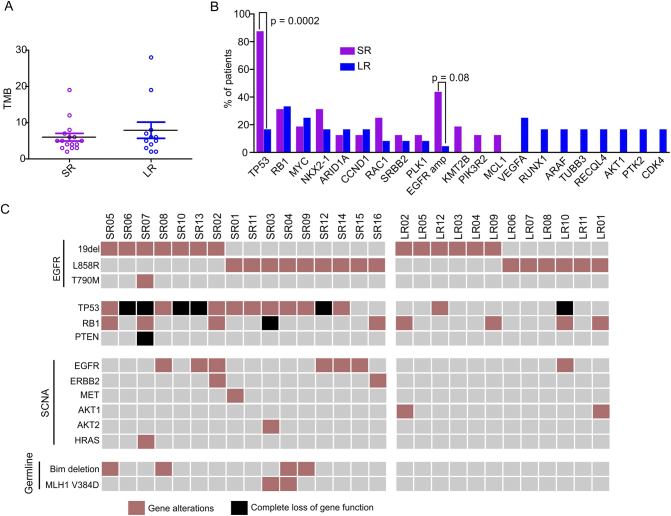
Non-small cell lung cancer (NSCLC) with activating EGFR mutations in exon 19 and 21 typically responds to EGFR tyrosine kinase inhibitors (TKI); however, for some patients, responses last only a few months. The underlying mechanisms of such short responses have not been fully elucidated. Here, we sequenced the genomes of 16 short-term responders (SR) that had progression-free survival (PFS) of less than 6 months on the first-generation EGFR TKI and compared them to 12 long-term responders (LR) that had more than 24 months of PFS. All patients were diagnosed with advanced lung adenocarcinoma and harbored EGFR 19del or L858R mutations before treatment. Paired tumor samples collected before treatment and after relapse (or at the last follow-up) were subjected to targeted next-generation sequencing of 416 cancer-related genes. SR patients were significantly younger than LR patients (P < .001). Collectively, 88% of SR patients had TP53 variations compared to 13% of LR patients (P < .001). Additionally, 37.5% of SR patients carried EGFR amplifications compared to 8% of LR patients. Other potential primary resistance factors were also identified in the pretreatment samples of 12 SR patients (75%), including PTEN loss; BIM deletion polymorphism; and amplifications of EGFR, ERBB2, MET, HRAS, and AKT2. Comparatively, only three LR patients (25%) were detected with EGFR or AKT1 amplifications that could possibly exert resistance. The diverse preexisting resistance mechanisms in SR patients revealed the complexity of defining treatment strategies even for EGFR-sensitive mutations.
外显子19和21中具有激活型EGFR突变的非小细胞肺癌(NSCLC)通常对EGFR酪氨酸激酶抑制剂(TKI)有反应;然而,对于一些患者来说,反应仅持续几个月。这种短期反应的潜在机制尚未完全阐明。在此,我们对16例短期反应者(SR)的基因组进行了测序,这些患者在第一代EGFR TKI治疗上的无进展生存期(PFS)小于6个月,并将其与12例长期反应者(LR)进行比较,后者的PFS超过24个月。所有患者均被诊断为晚期肺腺癌,且在治疗前携带EGFR 19del或L858R突变。收集治疗前和复发后(或最后一次随访时)的配对肿瘤样本,对416个癌症相关基因进行靶向二代测序。SR患者明显比LR患者年轻(P <.001)。总体而言,88%的SR患者有TP53变异,而LR患者为13%(P <.001)。此外,37.5%的SR患者携带EGFR扩增,而LR患者为8%。在12例SR患者(75%)的预处理样本中还发现了其他潜在的原发性耐药因素,包括PTEN缺失;BIM缺失多态性;以及EGFR、ERBB2、MET、HRAS和AKT2的扩增。相比之下,仅检测到3例LR患者(25%)有可能产生耐药的EGFR或AKT1扩增。SR患者中多种预先存在的耐药机制揭示了即使对于EGFR敏感突变,定义治疗策略的复杂性。