de Moel H, Jongman B, Kreibich H, Merz B, Penning-Rowsell E, Ward P J
Institute for Environmental Studies, VU University, Amsterdam, Netherlands.
GFZ German Research Centre for Geosciences, Helmholtz Centre Potsdam, Potsdam, Germany.
Mitig Adapt Strateg Glob Chang. 2015;20(6):865-890. doi: 10.1007/s11027-015-9654-z. Epub 2015 May 22.
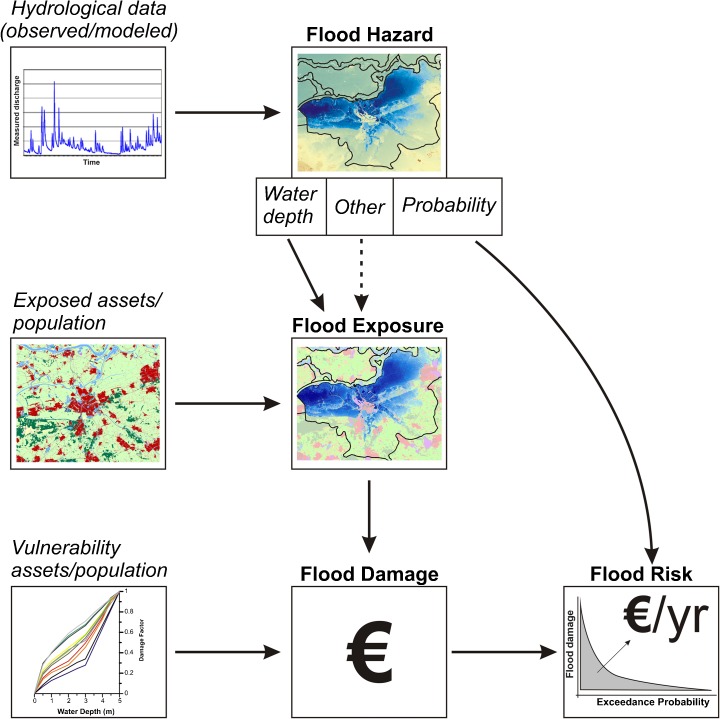
Managing flood risk, i.e. both the hazard and the potential consequences, is an important aspect of adapting to global change and has gained much traction in recent decades. As a result, a priori flood risk assessments have become an important part of flood management practices. Many methodologies have been set up, ranging from global risk assessments for the world as a whole, to local assessments for a particular stretch of a river/coast or small town. Most assessment frameworks generally follow a similar approach, but there are also notable differences between assessments at different spatial scales. This review article examines these differences, for instance those related to the methodology, use of assessments and uncertainties. From this review, future research needs are identified in order to improve flood risk assessments at different scales. At global/continental scale, there is a clear need for harmonised information on flood defences to improve assessments. Furthermore, inclusions of indirect economic effects at the macro-/meso-scale would give a better indication of the total effects of catastrophic flooding. At the meso-/micro-scale, there is an urgent need to improve our understanding of the effects of flooding on critical infrastructures, given their importance to society, the economy, emergency management and reconstruction. An overarching theme at all scales is the validation of flood risk assessments, which is often limited. More detailed post-disaster information would allow for improved calibration, validation and thus performance of flood risk models. Lastly, the link between spatial scales also deserves attention, for instance up- or downscaling methodologies.
管理洪水风险,即洪水灾害及其潜在后果,是适应全球变化的一个重要方面,并且在近几十年中受到了广泛关注。因此,先验洪水风险评估已成为洪水管理实践的重要组成部分。已经建立了许多方法,从针对全球的全球风险评估到针对特定河段/海岸或小镇的局部评估。大多数评估框架通常遵循类似的方法,但不同空间尺度的评估之间也存在显著差异。这篇综述文章研究了这些差异,例如与方法、评估用途和不确定性相关的差异。通过这篇综述,确定了未来的研究需求,以改进不同尺度的洪水风险评估。在全球/大陆尺度上,显然需要关于防洪的统一信息来改进评估。此外,在宏观/中观尺度纳入间接经济影响将能更好地表明灾难性洪水的总体影响。在中观/微观尺度上,鉴于关键基础设施对社会、经济、应急管理和重建的重要性,迫切需要提高我们对洪水对其影响的理解。所有尺度的一个总体主题是洪水风险评估的验证,而这往往是有限的。更详细的灾后信息将有助于改进洪水风险模型的校准、验证以及性能。最后,空间尺度之间的联系也值得关注,例如向上或向下缩放方法。