Lin Siying, Harlalka Gaurav V, Hameed Abdul, Reham Hadia Moattar, Yasin Muhammad, Muhammad Noor, Khan Saadullah, Baple Emma L, Crosby Andrew H, Saleha Shamim
Medical Research, RILD Wellcome Wolfson Centre (Level 4), Royal Devon and Exeter NHS Foundation Trust, Exeter, Devon, EX2 5DW, UK.
Institute of Biomedical and Genetic Engineering (IBGE), Islamabad, 44000, Pakistan.
BMC Med Genet. 2018 Sep 10;19(1):160. doi: 10.1186/s12881-018-0678-6.
Autosomal recessive anophthalmia and microphthalmia are rare developmental eye defects occurring during early fetal development. Syndromic and non-syndromic forms of anophthalmia and microphthalmia demonstrate extensive genetic and allelic heterogeneity. To date, disease mutations have been identified in 29 causative genes associated with anophthalmia and microphthalmia, with autosomal dominant, autosomal recessive and X-linked inheritance patterns described. Biallelic ALDH1A3 gene variants are the leading genetic causes of autosomal recessive anophthalmia and microphthalmia in countries with frequent parental consanguinity.
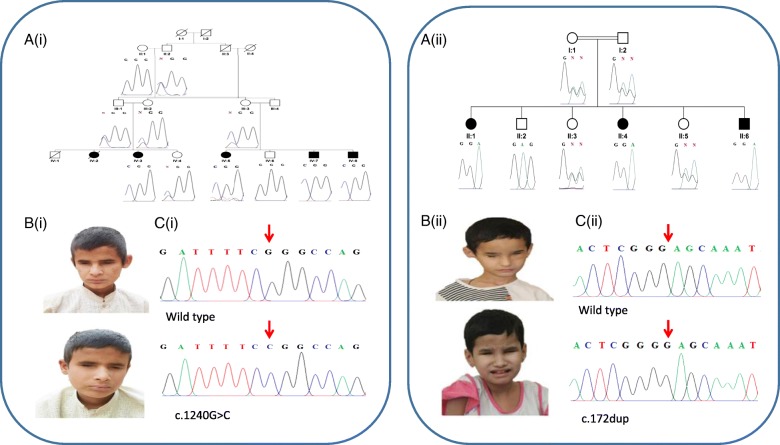
This study describes genetic investigations in two consanguineous Pakistani families with a total of seven affected individuals with bilateral non-syndromic clinical anophthalmia.
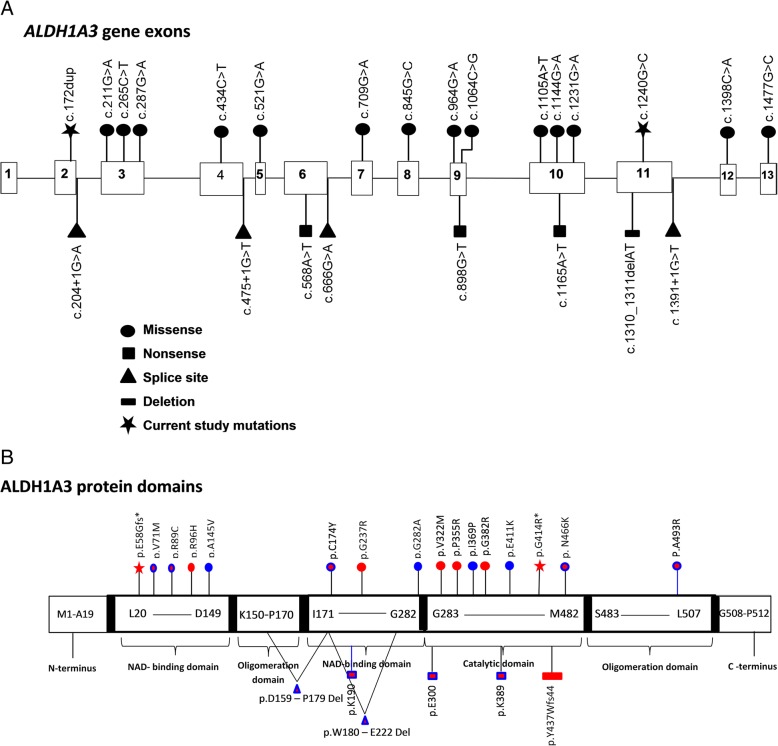
Using whole exome and Sanger sequencing, we identified two novel homozygous ALDH1A3 sequence variants as likely responsible for the condition in each family; missense mutation [NM_000693.3:c.1240G > C, p.Gly414Arg; Chr15:101447332G > C (GRCh37)] in exon 11 (family 1), and, a frameshift mutation [NM_000693.3:c.172dup, p.Glu58Glyfs*5; Chr15:101425544dup (GRCh37)] in exon 2 predicted to result in protein truncation (family 2).
This study expands the molecular spectrum of pathogenic ALDH1A3 variants associated with anophthalmia and microphthalmia, and provides further insight of the key role of the ALDH1A3 in human eye development.
常染色体隐性无眼畸形和小眼畸形是胎儿早期发育过程中罕见的发育性眼部缺陷。无眼畸形和小眼畸形的综合征型和非综合征型表现出广泛的遗传和等位基因异质性。迄今为止,已在29个与无眼畸形和小眼畸形相关的致病基因中鉴定出疾病突变,并描述了常染色体显性、常染色体隐性和X连锁遗传模式。在父母近亲通婚频繁的国家,双等位基因ALDH1A3基因变异是常染色体隐性无眼畸形和小眼畸形的主要遗传原因。
本研究描述了对两个巴基斯坦近亲家庭的基因研究,这两个家庭共有7名双侧非综合征型临床无眼畸形患者。
通过全外显子组测序和桑格测序,我们在每个家庭中均鉴定出两个可能导致该病的新的纯合ALDH1A3序列变异;外显子11中的错义突变NM_000693.3:c.1240G>C,p.Gly414Arg;Chr15:101447332G>C(GRCh37),以及外显子2中的移码突变[NM_000693.3:c.172dup,p.Glu58Glyfs*5;Chr15:101425544dup(GRCh37)],预计会导致蛋白质截短(家系2)。
本研究扩展了与无眼畸形和小眼畸形相关的致病性ALDH1A3变异的分子谱,并进一步深入了解了ALDH1A3在人类眼睛发育中的关键作用。