Environmental Defense Fund, New York, NY 10010;
Environmental Defense Fund, New Delhi 110001, India.
Proc Natl Acad Sci U S A. 2018 Sep 25;115(39):9720-9725. doi: 10.1073/pnas.1809276115. Epub 2018 Sep 10.
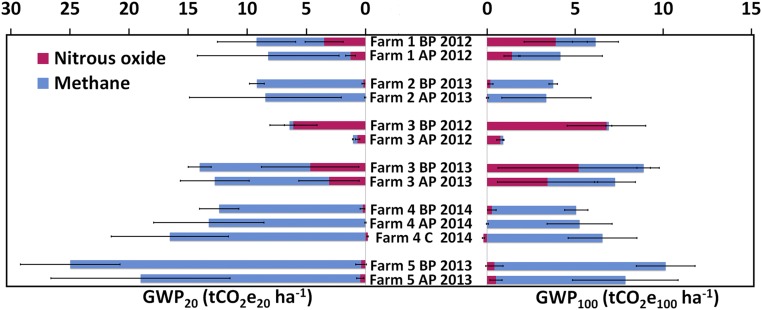
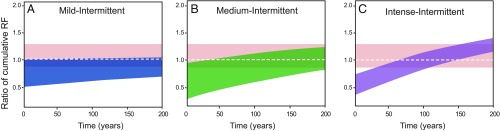
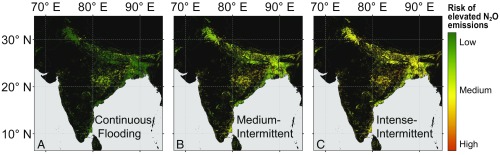
Global rice cultivation is estimated to account for 2.5% of current anthropogenic warming because of emissions of methane (CH), a short-lived greenhouse gas. This estimate assumes a widespread prevalence of continuous flooding of most rice fields and hence does not include emissions of nitrous oxide (NO), a long-lived greenhouse gas. Based on the belief that minimizing CH from rice cultivation is always climate beneficial, current mitigation policies promote increased use of intermittent flooding. However, results from five intermittently flooded rice farms across three agroecological regions in India indicate that NO emissions per hectare can be three times higher (33 kg-NO⋅ha⋅season) than the maximum previously reported. Correlations between NO emissions and management parameters suggest that NO emissions from rice across the Indian subcontinent might be 30-45 times higher under intensified use of intermittent flooding than under continuous flooding. Our data further indicate that comanagement of water with inorganic nitrogen and/or organic matter inputs can decrease climate impacts caused by greenhouse gas emissions up to 90% and nitrogen management might not be central to NO reduction. An understanding of climate benefits/drawbacks over time of different flooding regimes because of differences in NO and CH emissions can help select the most climate-friendly water management regimes for a given area. Region-specific studies of rice farming practices that map flooding regimes and measure effects of multiple comanaged variables on NO and CH emissions are necessary to determine and minimize the climate impacts of rice cultivation over both the short term and long term.
全球水稻种植估计占当前人为变暖的 2.5%,原因是甲烷(CH)的排放,这是一种短寿命温室气体。这一估计假设大多数稻田普遍存在持续洪水泛滥的情况,因此不包括一氧化二氮(NO)的排放,一氧化二氮是一种长寿命温室气体。基于尽量减少水稻种植中 CH 排放总是有利于气候的信念,目前的减排政策提倡增加间歇性洪水的使用。然而,来自印度三个农业生态区的五个间歇性洪水泛滥的水稻农场的结果表明,每公顷的 NO 排放可能是之前报道的最大值的三倍(33kg-NO·ha·season)。NO 排放与管理参数之间的相关性表明,在印度次大陆,与连续洪水相比,间歇性洪水的集约化利用可能使水稻的 NO 排放增加 30-45 倍。我们的数据还表明,水与无机氮和/或有机物质投入的联合管理可以将温室气体排放造成的气候影响降低 90%,而氮管理可能不是减少 NO 的核心。由于 NO 和 CH 排放的差异,不同洪水管理体制在不同时间的气候效益/弊端的理解,可以帮助选择特定地区最有利于气候的水管理体制。需要对水稻种植实践进行特定于区域的研究,绘制洪水管理体制,并测量多种联合管理变量对 NO 和 CH 排放的影响,以确定和尽量减少水稻种植在短期和长期内的气候影响。